
- 150+ countries and international organizations support China's Global Governance Initiative (GGI).
- China is the second-largest financial contributor to the UN's regular and peacekeeping budgets.
- The event in Geneva gathered around 200 diplomats, UN officials, and think tank representatives.
Experts would likely conclude that China is strategically leveraging its growing influence within the UN to promote its governance model, challenging the existing world order and advocating for a more state-centric approach to global governance.
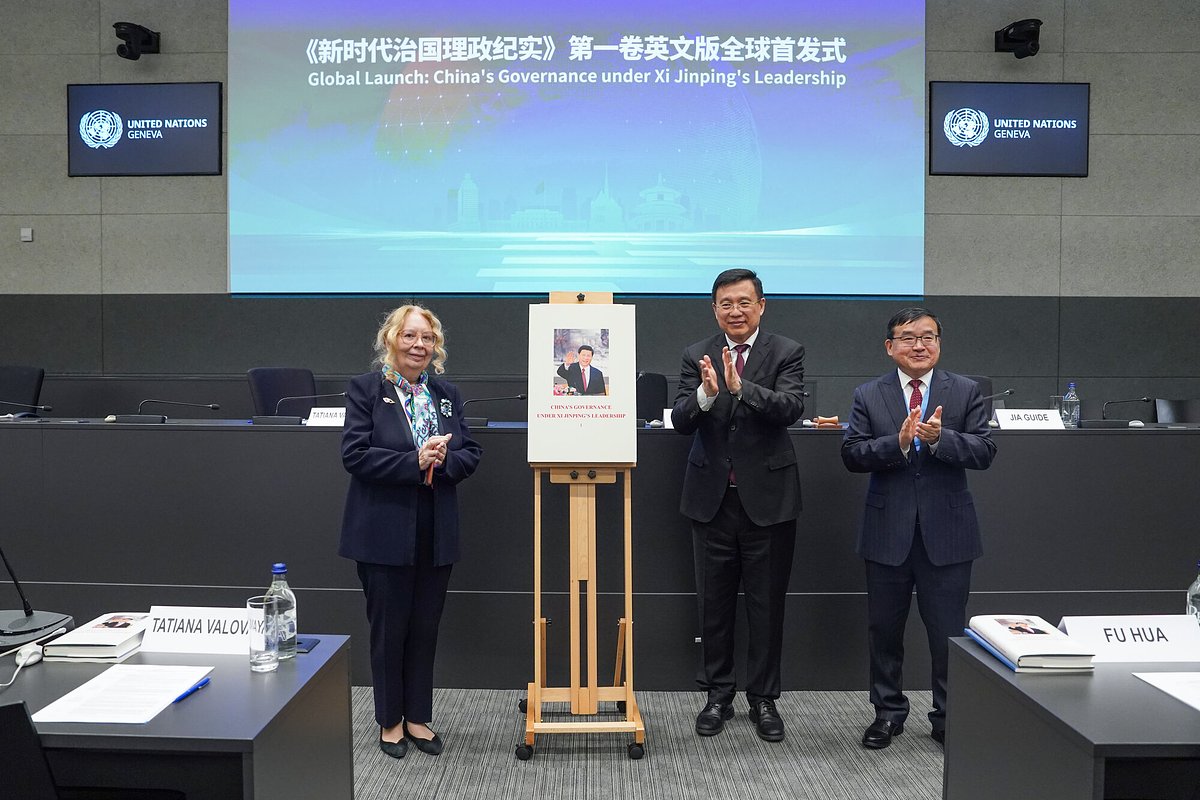
China Promotes 'Xi Jinping Thought' on Global Stage in Geneva
GENEVA, SWITZERLAND – February 27, 2026 – Amid the historic halls of the Palais des Nations, China this week presented its vision for a new era of international relations, leveraging the symbolic heart of global diplomacy to promote its governance model and challenge the existing world order. The event, a seminar on global governance, was marked by the launch of the English edition of the first volume of China's Governance Under Xi Jinping's Leadership, a book that encapsulates the political philosophy of its current leader.
Jointly hosted by China's permanent mission to the UN and the state-run Xinhua News Agency, the gathering of around 200 diplomats, UN officials, and think tank representatives underscored Beijing's increasingly assertive strategy to shape global discourse. The message was clear: as the world stands at a crossroads, China is ready to offer its solutions.
A New Blueprint for Global Order?
The centerpiece of China's pitch is the Global Governance Initiative (GGI), first proposed by President Xi Jinping in September 2025. Chinese officials presented the GGI as a framework for a "more just and equitable global governance system." Speaking at the seminar, Jia Guide, China's ambassador to the UN in Geneva, argued that the multilateral order is being undermined by "unilateralism, protectionism and hegemonism." He stated that the GGI, which has reportedly received support from over 150 countries and international organizations, is China's answer to these challenges.
The initiative is built on five core principles: sovereign equality for all nations, adherence to international rule of law, the practice of true multilateralism, a people-centered approach, and a focus on tangible actions over rhetoric. Supporters, including Russia, Pakistan, and Malaysia, have lauded the GGI for championing the role of the UN and promoting a more inclusive approach to global decision-making.
At the event, President of Xinhua News Agency Fu Hua introduced the newly translated book, describing it as a panoramic view of China's "extraordinary practices and remarkable achievements." He said it allows readers to appreciate Xi's "deep commitments as well as his personal charisma." The book and the GGI are key pillars in a broader campaign to export 'Xi Jinping Thought' as a viable alternative to Western liberal democracy, particularly for the Global South. However, while promoted heavily by Chinese state media, the initiative has received minimal coverage in the West, a silence that some Chinese commentators attribute to a lingering "Cold War lens" that views Beijing's proposals as a threat.
The Battle for Influence at the United Nations
The choice of the Palais des Nations for the launch was highly symbolic, placing China's ideological project at the center of the very institutions it seeks to reform. Tatiana Valovaya, Director-General of the UN Office at Geneva, addressed the seminar, noting that President Xi's initiative "highlights the importance of dialogue, development and win-win cooperation." She praised China's contributions to multilateralism and reaffirmed that the UN "remains the only place where all the world's nations can gather together to address common problems."
Valovaya's welcoming remarks highlight China's dramatically expanded influence within the UN system. Now the second-largest financial contributor to both the UN's regular and peacekeeping budgets, Beijing has strategically increased its presence and power. It provides more peacekeepers than any other permanent member of the Security Council and has secured leadership positions in key UN specialized agencies, such as the Food and Agriculture Organization (FAO).
This influence is not merely financial or logistical. Analysts note a concerted effort by Beijing to embed its political vocabulary, such as the concept of a "community with a shared future for humanity," into official UN resolutions and documents. Critics from Western think tanks and human rights organizations argue this state-centric vision purposefully dilutes the UN's traditional emphasis on universal human rights, promoting state sovereignty and non-interference above all else. This push represents a quiet but determined campaign to reshape the norms of global governance from within.
The Messenger and The Message
Crucially, the event's co-host and primary promoter was Xinhua News Agency, an organization that functions as far more than a media outlet. As the official state news agency of the People's Republic of China, Xinhua is a ministry-level arm of the government, tasked with advancing the country's diplomatic and ideological goals. Its role in organizing and publicizing the Geneva seminar exemplifies its function as a key instrument of statecraft.
In 2020, the U.S. State Department designated Xinhua as a "foreign mission," recognizing its role as a propaganda entity controlled by the Chinese Communist Party. Fu Hua's own words at the seminar confirmed this mission, stating that Xinhua is committed to promoting concepts like the GGI and will "strengthen exchanges and cooperation with international organizations, so as to better present on the international stage the vivid stories of China's efforts."
This strategy is part of a multi-billion-dollar global campaign to bolster China's soft power. It includes a "borrowing a boat to reach the sea" approach, where Xinhua provides free, pre-packaged news content to media outlets around the world, often in regions underserved by Western media. By co-hosting the Geneva event and releasing an accompanying think tank report on "China's Solution to Global Governance," Xinhua acts as both a messenger and a core component of the message itself, blurring the lines between journalism and state diplomacy to project a carefully curated image of China to the world.
Topics & Related
International Relations
Generative AI
Large Language Models
Trade Wars & Tariffs
Corporate Finance
Venture Capital
AI & Machine Learning
Software & SaaS
Revenue
Related Company Pulse