
- 0.01 millimeters: Precision of TMR sensors for key registration
- 8000 Hz polling rate: Keyboard reports status up to 8,000 times per second
- €149.99 ($150 USD): Recommended price for the K5 Pro TMR Compact
Experts view the K5 Pro TMR as a significant technological advancement in gaming keyboards, particularly for competitive esports athletes, though the incremental precision gains over Hall Effect sensors may be less perceptible to average players.
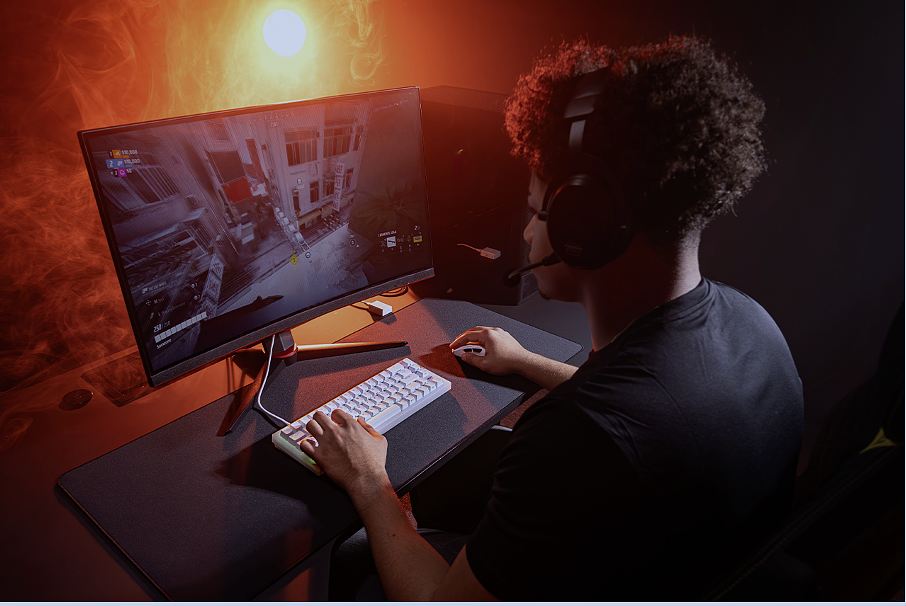
Cherry XTRFY K5 Pro Aims for Gaming Supremacy with New TMR Switch Tech
AUERBACH, GERMANY – April 09, 2026 – By Alexander Harris
CHERRY XTRFY, the gaming-focused division of the renowned German peripheral manufacturer, today launched the K5 Pro TMR Compact, a high-performance keyboard that signals a new front in the war for input speed and precision. Featuring the company’s new CHERRY MK Crystal Magnetic switches powered by Tunnel Magnetoresistance (TMR) technology, the keyboard is engineered to deliver micrometer-level accuracy and ultra-fast response times for the most demanding competitive gamers.
In a market saturated with high-speed peripherals, the K5 Pro TMR is making a bold claim: that its core technology represents the next evolutionary step in gaming keyboards. “The K5 has become an iconic keyboard in the CHERRY XTRFY range, and with TMR, we’re taking it even further,” said Joakim Jansson, Director of Product Management at CHERRY, in the official announcement. “TMR delivers higher precision and greater flexibility, while 8000 Hz polling brings you a faster, more responsive gaming experience than ever.”
The Precision Revolution: TMR vs. The World
At the heart of the K5 Pro TMR is its namesake Tunnel Magnetoresistance technology. While many high-end gaming keyboards have adopted Hall Effect magnetic switches, which register keystrokes by detecting changes in a magnetic field, CHERRY XTRFY claims TMR offers a significant leap forward. TMR sensors operate by measuring resistance changes across an ultra-thin magnetic barrier, allowing them to capture extremely small fluctuations in the magnetic field with greater fidelity and less electrical noise. The result is a claimed precision down to 0.01 millimeters.
For gamers, this translates into tangible performance benefits. The heightened sensitivity allows for a more immediate and accurate registration of even the slightest key press. This is coupled with an 8000 Hz polling rate, meaning the keyboard reports its status to the computer up to 8,000 times per second, or once every 0.125 milliseconds. This combination of near-instantaneous detection and rapid-fire reporting minimizes latency, providing a critical advantage in fast-paced competitive titles where every millisecond counts.
Like their Hall Effect counterparts, these magnetic switches are contactless, which drastically increases their lifespan by eliminating the physical wear and tear found in traditional mechanical switches. More importantly for competitive play, this technology enables a suite of software-driven features. Using the CHERRY MagCrate software, users can customize the actuation point of every key, assign multiple functions to a single key based on press depth, and utilize a Rapid Trigger function, which has become a baseline expectation for elite gaming keyboards. Rapid Trigger allows a key to reset the instant it begins to travel upwards, enabling faster repeated keystrokes.
Navigating a Crowded Battlefield
The K5 Pro TMR Compact enters a fiercely competitive arena. The market for high-performance, compact gaming keyboards is dominated by established players like Wooting, SteelSeries, and Razer, each with their own take on adjustable, high-speed switch technology. Wooting’s 60HE keyboard, with its Hall Effect-based Gateron Lekker switches, is often considered the benchmark for its robust software and analog input capabilities. Similarly, SteelSeries’ Apex Pro Mini series features proprietary OmniPoint switches with adjustable actuation, while Razer’s Huntsman line uses analog optical switches to achieve similar results.
Priced at a recommended €149.99 (approximately $150 USD), the K5 Pro TMR positions itself squarely within this premium segment. Its primary differentiator is the TMR technology itself. While some industry experts question whether the incremental precision gains over high-quality Hall Effect sensors will be perceptible to the average player, CHERRY XTRFY is betting that for the top tier of esports athletes and hardcore enthusiasts, this technical edge will be a compelling reason to switch. It’s a move that targets gamers who, as one analyst noted, “want every millisecond they can squeeze out of their setup.”
More Than Just Speed: Design and Customization
Beyond raw performance, the K5 Pro TMR Compact is built to provide a premium user experience. Its 65% layout is often described as a “gaming goldilocks zone,” retaining dedicated arrow keys while freeing up significant desk space for sweeping mouse movements—a crucial factor in low-DPI aiming styles common in first-person shooters. The keyboard’s aesthetic is clean and modern, accented by an ARGB LED light strip that wraps around the chassis for dynamic, customizable illumination.
The construction emphasizes durability and a refined typing feel. A sturdy metal top plate provides rigidity, while multiple internal layers of sound-dampening foam and pre-lubricated, PCB-mounted stabilizers work to eliminate rattle and produce a smooth, acoustically pleasing keystroke. For tinkerers, the switches are hot-swappable, allowing users to easily replace them with other compatible magnetic options to fine-tune the keyboard’s feel without soldering.
This focus on user control extends to the software. The CHERRY MagCrate suite offers an impressive array of customization tools, including per-key actuation adjustment, Rapid Trigger settings, and the ability to save all profiles and macros directly to the keyboard's onboard memory. This allows a player’s personalized settings to travel with them to different PCs or tournaments without needing to reinstall software.
Cherry's Strategic Play for the Future
The launch of the K5 Pro TMR is more than just a new product release; it represents a significant strategic move by parent company Cherry SE. Founded in 1953, Cherry has built a legacy on high-quality, durable input devices, most famously its own line of mechanical switches that defined the market for decades. By championing TMR as the next step beyond the now-commonplace Hall Effect technology, the company is reasserting its role as an innovator at the cutting edge of the peripheral industry.
This push into hyper-precision gaming keyboards aligns with the company's broader portfolio, which spans office, industrial, and even digital healthcare applications. While the K5 Pro TMR is aimed squarely at gamers, the underlying TMR sensor technology, with its promise of superior accuracy and durability, could potentially find applications in other professional fields where precise input is paramount. By investing in and marketing this technology, Cherry is not only competing for today’s gaming market but is also cultivating innovations that could define the future of high-performance input devices across multiple sectors. The K5 Pro TMR stands as a testament to this forward-looking strategy, a synthesis of premium construction and a technological bet on the future of competitive gaming.