
- $1,500+: Cost for agents to acquire a client through Zillow's Premier Agent program (mid-2024 data).
- 1-877-BUY-REGO: Memorable phone number central to buyrego™'s strategy to disrupt real estate search.
- Tier 5 AI: buyrego™'s proprietary valuation protocol aiming for 'institutional-grade accuracy'.
Experts view buyrego™'s challenge to the real estate search monopoly as innovative but formidable, requiring proof of superior technology and consumer adoption to disrupt entrenched digital giants like Zillow and Redfin.
Can a Phone Number and AI Topple Real Estate's Search Monopoly?
NAPERVILLE, Ill. – February 09, 2026 – A new property technology startup, buyrego™, has entered the fray of the multi-trillion dollar real estate market, armed with a seemingly retro weapon—a memorable phone number—and a cutting-edge AI engine. In a white paper released today, the company outlines an audacious plan to dismantle what it calls the "Search Monopoly" held by digital giants like Zillow and Redfin, proposing a radical new model for how consumers access property valuations and connect with real estate services.
The company's strategy, detailed in a thesis titled "The Physics of Friction," hinges on two core innovations: a "Mnemonic Infrastructure" built around the nationwide asset 1-877-BUY-REGO, and a sophisticated "Tier 5" valuation AI. The goal is to bypass the expensive, click-driven world of online real estate portals and create a direct-to-brand channel for homeowners and buyers, a move that could have significant implications for agents and consumers alike.
The High Cost of Clicks
At the heart of buyrego™'s strategy is a direct challenge to the economic model that underpins modern online real estate. For years, agents have become increasingly reliant on platforms like Zillow and Redfin for lead generation, often paying a premium for consumer attention. This system, which the startup calls "High-Friction Search," creates a scenario where customer acquisition costs (CAC) are steep and continually rising.
Industry data supports this premise. Reports from mid-2024 indicated that an agent's cost to acquire a single client through Zillow's Premier Agent program could be over $1,500, while leads from Redfin's partner program could cost more than double that. This "Search Monopoly tax," as buyrego™ founder Jeff Knize calls it, is a cost ultimately borne by the consumer through commissions.
"We aren't chasing clicks; we are dismantling the 'Search Monopoly' tax," Knize stated in the announcement. "The industry is fragmented by millions of random, forgettable agent numbers. By treating one mnemonic number as physical infrastructure, we unify that chaos—achieving the brand power of a national fleet without the operational drag."
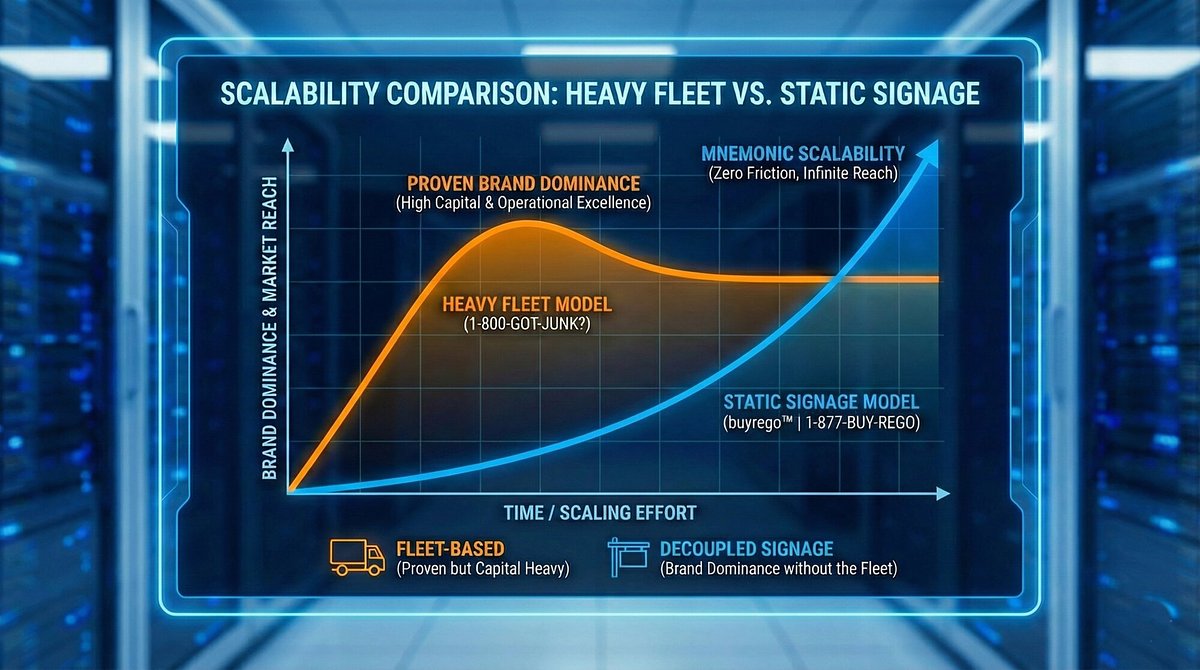
buyrego™'s solution is to pivot away from this digital auction block. Instead of competing for keywords on Google or paying for premier placement on Zillow, the company is banking on the cognitive power of a memorable phone number. The model emulates the brand dominance of service icons like 1-800-GOT-JUNK? but with a crucial twist. Where those brands scale with expensive fleets of trucks and labor, buyrego™ plans to scale its "Mnemonic Infrastructure" through low-cost static signage—yard signs, billboards, and other physical media—creating a fixed-cost marketing engine designed to intercept high-intent customers before they even begin their online search.
Beyond the 'Zestimate': A New Breed of AI Valuation?
The second pillar of the company's platform is its proprietary "Tier 5" valuation protocol. For millions of homeowners, the Zillow "Zestimate" has become the de facto starting point for understanding a property's worth. However, these automated valuation models (AVMs) have long been criticized for their "black box" nature and their inability to account for the subjective nuances that heavily influence a home's true market value.
buyrego™ claims its a-Logic™ engine, architected for Google Cloud Vertex AI, represents a leap forward. The system is designed to encode "proprietary practitioner logic"—the kind of expertise a seasoned managing broker or certified appraiser brings to an assessment. This allows the AI to weigh subjective variables like the quality of a view, the condition of a kitchen, or the specific desirability of a micro-location, factors that traditional data-scraping AVMs often miss.
The company is aiming for what it calls "institutional-grade accuracy," a high bar that suggests a level of reliability sufficient for lenders and investors, particularly for off-market assets where comparable sales data is limited. This promise of a more transparent, defensible valuation is compelling, but it also enters a complex regulatory environment. The company's own disclaimer notes that its bestimation™ reports are broker-prepared opinions of value and not formal appraisals under USPAP standards, a crucial legal and practical distinction. The challenge will be to prove its superior accuracy while navigating the established rules of the appraisal industry.
A David vs. Goliath Battle
While the strategy is novel, buyrego™ faces a monumental challenge. Zillow and Redfin are not merely websites; they are deeply entrenched ecosystems with immense brand recognition and powerful network effects. The consumer habit of starting a home search on these platforms is a formidable barrier to entry.
Furthermore, these incumbents are not standing still. Zillow has been aggressively integrating mortgage services into its platform with tools like "BuyAbility," aiming to capture users earlier in the home-buying journey. Redfin, following its 2025 acquisition by Rocket Companies, is similarly focused on creating a seamless transaction pipeline from search to mortgage. They are large, well-funded, and have proven adept at defending their market share.
For buyrego™ to succeed, it must not only prove its technology is superior but also convince a critical mass of consumers and agents to abandon familiar pathways. The effectiveness of its static signage model in a digital-first world will be a key test. While vanity numbers remain relevant for many service businesses, whether they can redirect the ingrained behavior of the modern home searcher is an open question.
The Test Begins in Naperville
The theoretical framework of the "Physics of Friction" will now be put to the test on the ground in Naperville, Illinois. The Chicago suburb has been chosen as the platform's initial launch site, where a local home value estimator will serve as the first public-facing application of the Tier 5 engine.
This hyper-local focus will be critical. Real estate is, at its core, a local business. The platform's success in Naperville will depend on its ability to deliver valuations that local agents and homeowners find demonstrably more accurate than existing tools. It will also be the first real-world test of the "Mnemonic Infrastructure" concept—can yard signs and a memorable number genuinely generate a significant flow of high-quality leads, bypassing the digital gatekeepers?
The real estate industry will be watching closely. If buyrego™ can prove its model—reducing agent costs, delivering superior valuations, and capturing consumer intent through a low-friction channel—it could represent a genuine paradigm shift. However, the path from a compelling white paper to disrupting a market dominated by billion-dollar incumbents is a long and uncertain one, and the battle for the future of real estate search has only just begun.