
- Focus on highly regulated FinTech sector initially
- Combines LittleHorse's Business-as-Code platform with El Paso Labs' integration expertise
- Aims to provide transparent, auditable, and secure framework for AI in business workflows
Experts would likely conclude that the Business-as-Code approach offers a structured, governed framework for integrating AI into enterprise workflows, particularly in highly regulated industries like FinTech, enhancing compliance and operational efficiency.
Business-as-Code: The New Blueprint for Enterprise AI Governance
LAS VEGAS, NV – April 07, 2026 – A new partnership between workflow automation leader LittleHorse Enterprises and certified consulting firm El Paso Labs is poised to address one of the most significant challenges facing modern enterprises: how to safely integrate and govern artificial intelligence. The collaboration, announced today, combines LittleHorse's "Business-as-Code" platform with El Paso Labs' integration expertise to speed the deployment of AI agents in complex business workflows, with an initial focus on the highly regulated financial technology sector.
While the promise of AI agents to enhance customer engagement and streamline operations is immense, industries like FinTech have been cautious, grappling with concerns over regulatory compliance, data security, and the "black box" nature of AI decision-making. This new offering aims to provide a concrete solution by codifying business processes, creating a transparent, auditable, and secure framework for AI to operate within.
From Abstract Rules to Executable Code
At the heart of the partnership lies the concept of "Business-as-Code" (BaC), a paradigm pioneered by LittleHorse. Unlike low-code platforms that simplify development through visual interfaces, or Infrastructure-as-Code (IaC) which manages hardware resources, BaC focuses on translating the core logic of a business directly into executable software. This involves formally defining business entities, operational rules, and domain expertise in machine-readable formats.
The approach ensures that what the business intends is precisely what the software implements. By defining business processes as code, organizations gain unprecedented observability, version control, and governance over their workflows. This code-first methodology allows for the kind of rigorous testing, auditing, and management that traditional software development enjoys, a feature often missing in opaque SaaS solutions or implicit, unwritten "tribal knowledge."
LittleHorse's Saddle Command Center platform enables developers to use familiar languages like Java, Python, and Go to orchestrate microservices and connect disparate systems. The platform allows businesses to create a clear, governed environment where AI agents can make intelligent decisions on routine tasks while delegating critical, high-risk actions to deterministic, pre-approved workflows. This provides essential guardrails, mitigating the risks associated with probabilistic AI in sensitive operations.
Taming AI for the Demands of FinTech
The financial services industry is a prime testing ground for this new model. FinTech companies operate under a heavy burden of regulatory scrutiny, including Anti-Money Laundering (AML), Know Your Customer (KYC), and data privacy laws like GDPR. Any AI solution must not only be effective but also demonstrably compliant.
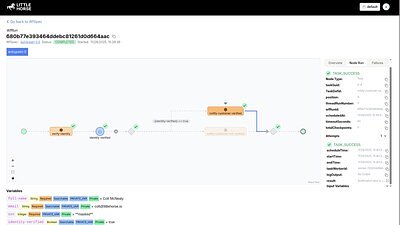
The partnership directly addresses these challenges by providing a framework to build custom, auditable AI-powered workflows. For example, an AI agent could handle initial customer onboarding tasks, but the final identity verification step could be delegated to a codified, deterministic workflow that logs every action for compliance audits. This hybrid approach—combining intelligent automation with strict governance—is crucial for gaining regulatory acceptance.
The collaboration also targets a growing pain point for many businesses: SaaS cost inflation and inflexibility. Many companies find themselves constrained by the limitations of expensive, one-size-fits-all software. Catherine Troxell, Practice Lead at PIF Advisory, highlighted this issue. "Even though we're not a tech company, we were held back by the limitations of SaaS software that we use to serve our clients and we needed custom workflows and integrations," she stated. "El Paso Labs and LittleHorse's AI-enabled Business-as-Code Practice gives us the same tech advantages of larger companies but optimized for exactly what we need at a price tag we can afford."
The Synergy of Platform and Practice
Technology alone is rarely a silver bullet. The success of complex enterprise solutions often hinges on the expertise of those implementing them. This is where the synergy between LittleHorse and El Paso Labs becomes critical. LittleHorse provides the powerful Saddle Command Center platform, while El Paso Labs, as a certified partner, brings the specialized knowledge required to bridge the "last mile" between business need and technical execution.
El Paso Labs specializes in custom application development, cloud solutions, and AI integrations, giving them the capability to tailor the Business-as-Code framework to each client's unique environment. "There is no one-size-fits-all because each customer has unique business workflows. Our experience accelerates getting the right answer for every customer," said Ivan Huerta, Partner at El Paso Labs. "We are looking forward to continuing our relationship with LittleHorse as a Certified Partner."
This combination of a robust platform and expert implementation services ensures that businesses can move from concept to a fully operational, governed AI solution quickly and effectively. "LittleHorse can help enterprises contain SaaS costs, and innovate by safely and securely introducing agents into workflows," explained Colt McNealy, CEO of LittleHorse. "Our platform lets El Paso Labs deliver on time, to specifications, and operate with enterprise grade scale and reliability."
A Blueprint for Broader Industry Transformation
While the initial focus is on FinTech, the implications of a governed, code-based approach to AI integration extend far beyond financial services. Other regulated and complex industries, such as healthcare and retail, face similar challenges and stand to reap significant benefits.
In healthcare, the BaC model could be used to orchestrate patient care pathways, ensuring every step from admission to discharge complies with HIPAA regulations and clinical best practices. AI agents could manage appointment scheduling and medication reminders, while critical diagnostic or treatment decisions remain within governed, auditable workflows. This would enhance efficiency without compromising patient safety or data privacy.
Similarly, in the retail sector, the framework can be applied to optimize complex supply chains, personalize customer experiences, and manage inventory with greater precision. AI agents could dynamically adjust pricing or promotions based on real-time data, all while operating within codified rules that protect brand integrity and customer data. By providing a structured and transparent way to manage automation, the Business-as-Code approach offers a scalable blueprint for digital transformation across any industry seeking to harness the power of AI responsibly and effectively.