
- Industry average score: 70 (up from 68 in the previous year)
- AI adoption impact: 77% of plan participants feel overwhelmed and desire more professional help
- Consumer sentiment: 56% of Americans are now open to using AI for retirement planning recommendations
Experts agree that AI is becoming the critical differentiator in retirement planning, with early adopters gaining significant competitive advantages through personalized, proactive guidance and improved user experiences.
AI Arms Race: How Technology is Reshaping Retirement's Digital Frontier
NEW YORK, NY – December 11, 2025 – The landscape of retirement planning is being redrawn, not by market fluctuations, but by lines of code and learning algorithms. A new benchmark report reveals that while established giants like Fidelity and TIAA continue to lead the digital race, their dominance is being challenged as a new factor emerges as the ultimate differentiator: artificial intelligence. The message is clear: strategic AI investment is no longer a futuristic concept but a present-day imperative, fueling a competitive surge that is reshaping the digital experience for millions of American savers.
Corporate Insight's 2025 DC Plan Participant Website Experience Benchmark confirms this trend, showing an industry in motion. Fidelity secured its third consecutive win, but the real story lies in the narrowing gap and the rapid ascent of mid-tier players. The industry's average score climbed from 68 to 70, a testament to widespread digital progress. However, this rising tide isn't lifting all boats equally. Firms that made early, targeted bets on AI are now reaping significant rewards, creating a new hierarchy based on technological prowess.
AI: The New Competitive Battleground
The days of digital leadership being defined solely by a clean user interface or basic transaction capabilities are over. The 2025 benchmark illustrates that the most significant gains are being driven by the sophisticated implementation of AI across the user journey.
"AI implementation is paying real dividends for early adopters," notes Kara Sostar, retirement research manager at Corporate Insight, in the report's findings. "Providers that invested in AI-powered features across search, virtual assistance, and personalized content delivery in 2024 are seeing measurable score improvements this year."
This isn't about generic chatbots. Leaders are deploying AI to create deeply personalized and intuitive experiences. Fidelity's top-ranked platform, for example, leverages a Financial Wellness dashboard that delivers timely, relevant content tailored to an individual's specific financial situation and goals. TIAA, which posted an impressive three-point gain to secure second place, is winning praise for its unique FAQ-style search results that anticipate user intent, moving beyond clumsy keyword limitations. Similarly, Alight’s use of its LumenAI to provide summaries helps participants quickly grasp complex information.
These advancements demonstrate a fundamental shift from passive information portals to proactive guidance engines. AI is being used to deliver personalized "nudges," such as reminders to increase contributions after a salary increase or alerts about an underutilized employer match. This level of proactive, data-driven engagement was once the exclusive domain of human financial advisors. Now, technology is democratizing access to this personalized guidance, a critical development given that studies show a vast majority of plan participants—as many as 77%—feel overwhelmed and desire more professional help.
Challengers Rise as Leaders Adapt
While Fidelity and TIAA hold the top spots, the most dynamic part of the market is the crowded midfield, where challengers are leveraging technology to rapidly close the gap. Transamerica emerged as the year's biggest mover, jumping three positions to eighth place with a substantial five-point score increase. This leap was powered by a comprehensive redesign, including a refreshed dashboard and a modernized education center, signaling a strategic commitment to improving the core digital experience.
Meanwhile, Empower, which tied for third place, is aggressively integrating AI into its services. The firm is using AI-powered workflows to automate routine service tasks, freeing up human advisors to focus on more complex strategic planning. This hybrid approach aligns with growing consumer sentiment; Empower's own research shows that 56% of Americans are now open to using AI for retirement planning recommendations.
The success of these rising players has not gone unnoticed by the incumbents. The leaders are not resting on their laurels but are making significant strategic moves to defend and extend their advantage. TIAA's multi-year partnership with Accenture, kicking off in 2025, is a prime example. The collaboration is designed to overhaul its retirement recordkeeping capabilities by leveraging Accenture's expertise in automation and AI. The goal is to deliver next-generation digital tools for participants and AI-enabled insights for plan sponsors, a clear signal that even the top players must continuously invest and innovate to stay ahead.
Balancing Innovation with Trust and Security
The rapid infusion of AI into financial planning is not without its challenges. The ultimate currency in the retirement industry is trust, and as platforms become more automated, providers must navigate a delicate balance between cutting-edge functionality and the fundamental human need for security and transparency.
Recent surveys reveal a nuanced participant perspective. While comfort with AI is growing—one study found nearly half of Americans feel more comfortable using AI for financial decisions than a year ago—a significant portion still expresses caution. Many savers see AI as a powerful tool for data analysis and generating investment ideas but remain wary of ceding final decision-making authority, especially for complex life choices. This underscores a preference for a hybrid model where technology empowers, but a human advisor is available for validation and nuanced counsel.
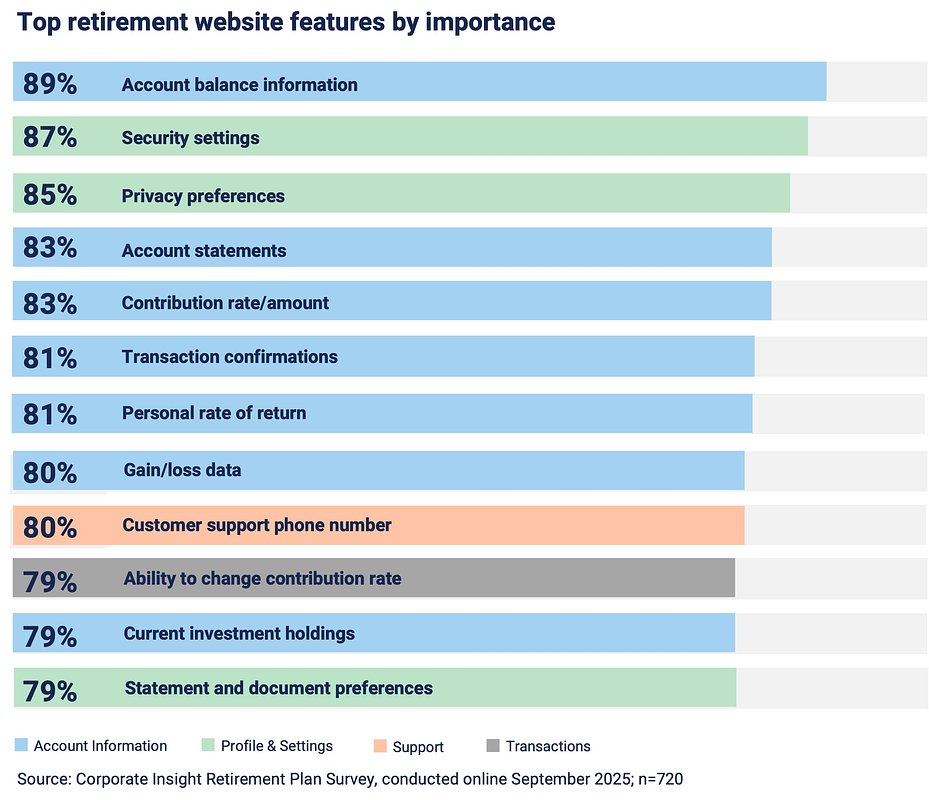
Recognizing this, providers are doubling down on features that build confidence. The Corporate Insight benchmark found that the "Profile & Settings" category saw one of the largest areas of improvement across the industry, with 13 firms boosting their scores. This was driven by the rollout of enhanced security measures. TIAA and Vanguard introduced passwordless login capabilities, reducing friction while improving security. Fidelity launched a dedicated Security Center, providing users with metrics and a checklist to actively manage their account's safety. These enhancements are not just technical upgrades; they are direct responses to participant demand for greater control and visible security in an era of increasing cyber threats.
Navigating a Complex Regulatory Horizon
This technological arms race is unfolding within an increasingly complex regulatory and cybersecurity landscape. Financial services firms are not innovating in a vacuum; they must adhere to a tightening web of rules governing data privacy, AI ethics, and fraud prevention.
Regulators like the Securities and Exchange Commission (SEC) and the Financial Industry Regulatory Authority (FINRA) are closely monitoring the use of AI. The SEC has proposed rules to address potential conflicts of interest from predictive analytics and has made it clear that existing fiduciary duties apply to AI-driven advice. FINRA's 2025 oversight report specifically identifies AI as a risk area for financial crimes and fraud. The focus is on fairness, transparency, and ensuring that algorithms do not produce biased or discriminatory outcomes.
Simultaneously, data privacy laws are becoming more stringent. New regulations in states like Montana and Connecticut, effective in 2025, are expanding data protection obligations for nonbank financial firms. These laws broaden the definition of "sensitive data" and grant consumers more rights over their information. This means that as providers collect more data to fuel their AI engines, they also face greater responsibility and liability for protecting it. The push for enhanced security features is therefore not just a market-driven trend but a compliance imperative, as firms work to build digital fortresses capable of withstanding sophisticated cyberattacks while meeting the high expectations of both users and regulators.
The firms that will define the next era of retirement planning will be those that master this intricate dance—innovating at speed with powerful AI, while simultaneously building deep user trust through robust security and transparent, ethical practices.