
- US$2.55 million: Investment by Island Passage Exploration (IPX) in 2025 alone.
- 64.03 g/t gold: Highest-grade sample from the Takina vein complex, far exceeding typical profitable mine grades.
- 97.7%: Percentage of Bougainvilleans who voted for independence in 2019, shaping the economic stakes of the EL02 project.
Experts would likely conclude that the EL02 project represents a promising but cautious step toward responsible mining in Bougainville, with its community-focused model offering a potential path to economic independence while navigating the legacy of past exploitation.
Bougainville's New Gold Rush: Can Mining Heal Old Wounds?
ARAWA, BOUGAINVILLE – May 04, 2026 – In the dense, mountainous jungle of Central Bougainville, a Canadian exploration company and its local landowner partners are unearthing more than just high-grade gold and copper. They are testing a new model for resource extraction on an island where the very word “mining” is synonymous with environmental disaster, foreign exploitation, and a decade-long civil war.
Island Passage Exploration (IPX) and its partner, the customary landowner company Isina Resource Holdings Limited (IRHL), recently filed an annual report detailing remarkable technical success at their EL02 project. The findings confirm the presence of large-scale mineral systems with grades high enough to turn heads across the global mining industry. But for Bougainville, the true significance may lie in the project’s structure, which seeks to right the wrongs of a painful past and chart a new course for economic development on the cusp of potential independence.
A New Model Built on Partnership
At the heart of the EL02 project is a structure that deliberately inverts the old, colonial-era approach to mining. Under Bougainville’s groundbreaking 2015 Mining Act—a direct response to the grievances that fueled the conflict—the mineral rights belong to the customary landowners, not the state. IRHL, a company founded by chiefs from the ten major clans in the area, holds the exploration license. They invited IPX, a private Canadian firm, to partner with them, retaining ownership and agency in the process.
This partnership is more than just a name on a legal document. In 2025 alone, IPX invested nearly 11 million Papua New Guinea kina (US$2.55 million) into the project. Critically, 5% of all exploration expenditures are dedicated to community development. This has translated into tangible benefits, including building materials for new classrooms and a teacher's house at Isina primary school, cash donations to over a dozen local schools, and support for developing locally-owned agricultural businesses.
The project prioritizes local employment, with 32 full-time Bougainvillean staff and an average of 130 casual workers per month. This stands in stark contrast to the historical model where local people were often sidelined.
Glyn Tovirika, CEO of IRHL, highlighted the project's success in defying skepticism. “Critics had said that the parties would not be successful and they would not survive the environment created by the Bougainville crisis,” he stated in the report. “We have proven them wrong... We are training youth and proving that exploration can be environmentally friendly. We appreciate the expenditures being made by IPX as it is having a great impact in our communities.”
Unearthing World-Class Potential
The community-first approach is backed by astonishing geological potential. The 2025 exploration campaign has significantly de-risked the project, confirming what geologists had long suspected: the region that hosts the giant Panguna deposit holds more secrets. IPX has identified both large-scale, disseminated porphyry-style mineralization—similar in type to Panguna—and extremely high-grade vein systems.
At the Bara-Tangka prospect, exploration has defined a massive 4-square-kilometer copper-gold soil anomaly. Channel sampling, a process of cutting a continuous groove in the rock to get a representative sample, returned results like 55 meters grading 0.56% copper and 0.61 g/t gold, indicating a large, mineralized body.
Even more striking are the results from the Takina vein complex, a 9-kilometer-long series of structures. Here, samples have returned bonanza grades, including a 7-meter channel sample grading an incredible 64.03 grams per tonne (g/t) gold and 1.55% copper. For context, many profitable gold mines today operate on grades of 1 to 2 g/t. Another sample returned 6 meters at 20.98 g/t gold.
These results have given the partners confidence to advance toward drilling in the latter half of 2026, a crucial step that will determine the true size and economic viability of the deposits.
The Lingering Shadow of Panguna
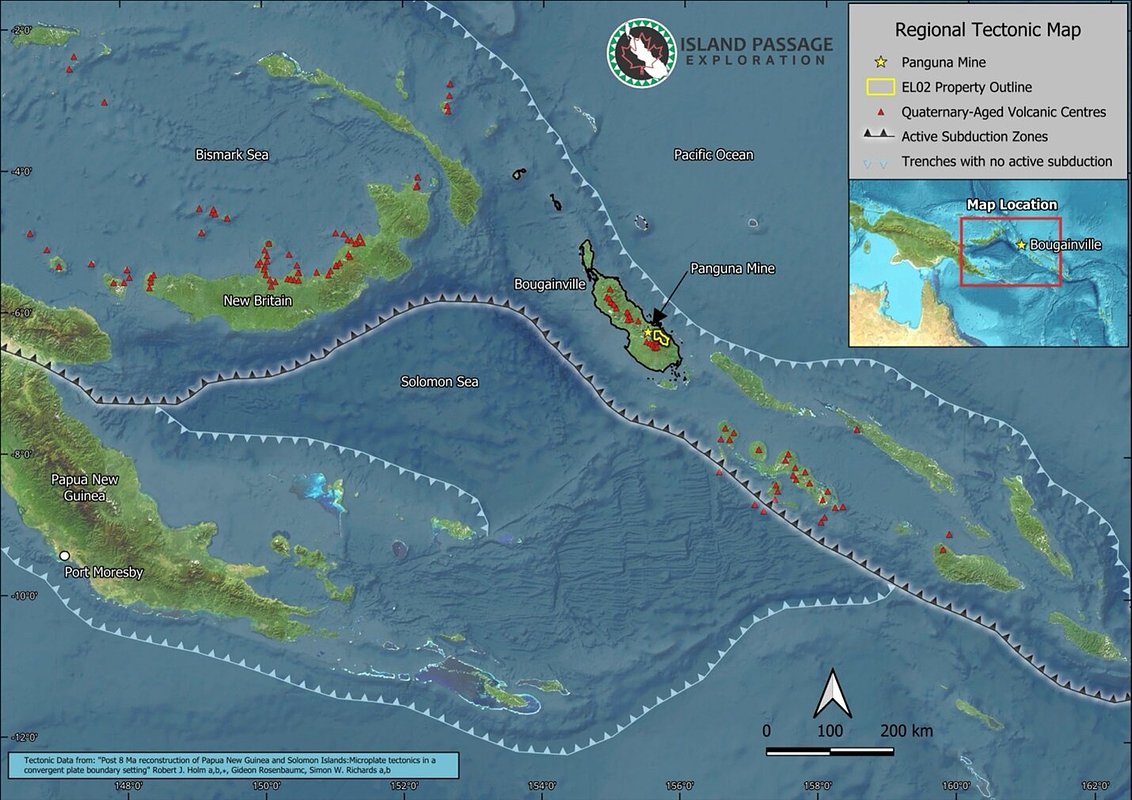
No exploration project in Bougainville can escape the shadow of the Panguna mine. Located just 9 kilometers from the EL02 license, Panguna was once the world's largest open-pit copper mine and the economic engine of Papua New Guinea. It was also a catastrophe.
Operated by a subsidiary of Rio Tinto from 1972 to 1989, the mine generated immense wealth, but a paltry 1.25% of profits went to the landowners. Meanwhile, billions of tonnes of waste rock and tailings were dumped directly into the Jaba River, poisoning the water supply, destroying ecosystems, and causing reported health issues. The perceived injustices and environmental ruin ignited a civil war that lasted a decade and claimed up to 20,000 lives, ultimately forcing the mine’s closure.
An independent assessment funded by Rio Tinto in 2024 confirmed the mine's legacy presents "very high risks" to local communities from contamination and flooding. This history is the reason the Bougainville Mining Act was written, and it is the standard against which the EL02 project will be judged.
A Nation's Economic Future at Stake
The success or failure of the EL02 project carries weight far beyond its license boundaries. In a historic 2019 referendum, 97.7% of Bougainvilleans voted for independence from Papua New Guinea. While the result awaits ratification by PNG's national parliament, the Autonomous Bougainville Government (ABG) is tasked with building a viable, self-sufficient state.
To do that, it needs an economy. The ABG, led by President Ishmael Toroama, views a reformed and responsible mining sector as the cornerstone of its economic strategy. The government has publicly supported the EL02 project, renewing its license for five years and praising its collaborative model. IPX, for its part, has actively engaged with the government, sponsoring official delegations to international mining conferences to build capacity and attract further investment to the region.
“2025 was a breakout year for IRHL and IPX,” said Donald McInnes, Chairman and CEO of Island Passage Exploration. “Perhaps most rewarding for our investors is that we have successfully proven that exploration work can occur safely and effectively in Bougainville.”
For the people of Bougainville, the stakes are immeasurably higher. They are cautiously watching a project that offers both the promise of economic independence and a chilling echo of the past. The hope is that this time, the immense wealth locked in Bougainville's mountains can be used to build a nation, not break it.