
- 266% greater improvement on the Motor Assessment Scale compared to standard robotic therapy.
- 88% greater improvement on the Fugl-Meyer scale with Error Augmentation (EA) technology.
- $15 million in funding secured for expansion into U.S. and European markets.
Experts would likely conclude that Bioxtreme's Error Augmentation technology presents a groundbreaking shift in stroke rehabilitation, with compelling clinical evidence supporting its potential to significantly enhance recovery outcomes compared to traditional robotic therapy.
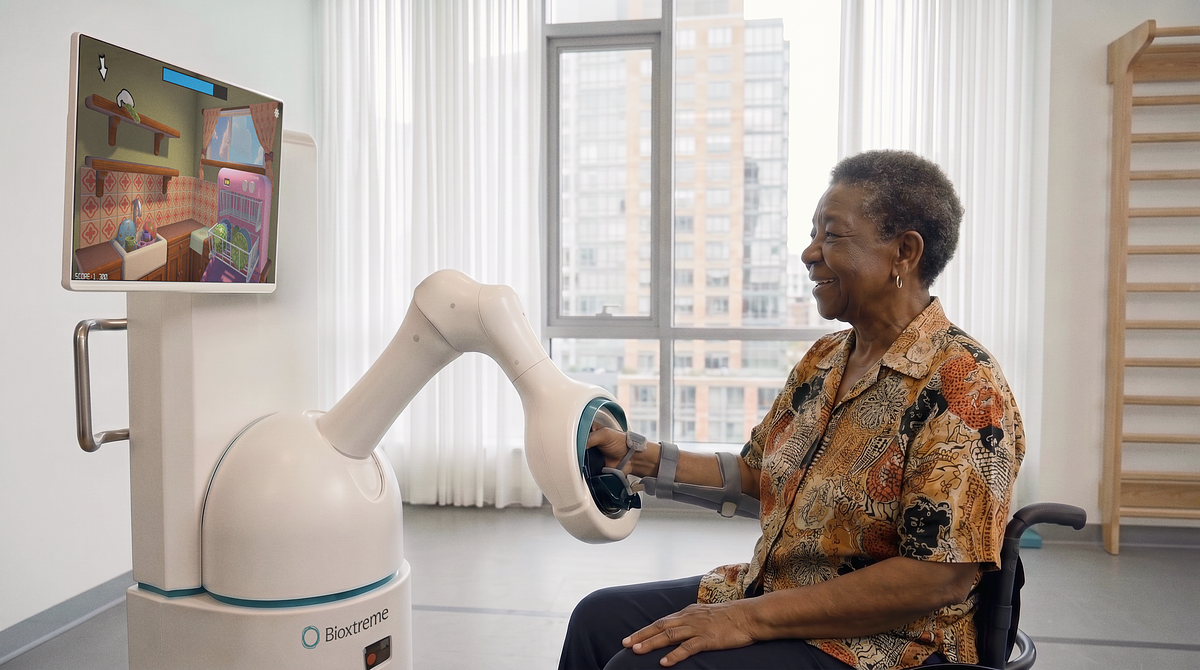
Bioxtreme's New Robot Challenges Rehab Norms by Amplifying Patient Errors
PETACH TIKVA, ISRAEL – June 17, 2026 – In the precise and measured world of medical robotics, the conventional wisdom has been to guide, assist, and correct. Robots designed for post-stroke rehabilitation have traditionally acted as unerring partners, gently steering a patient’s limb through a perfect motion to retrain the body. Today, Israeli innovator Bioxtreme is launching a system that turns that logic on its head. Its new Dextreme™ 2.0 platform isn't designed to prevent mistakes; it's designed to amplify them.
This counter-intuitive approach, a proprietary technology the company calls Error Augmentation (EA), is at the heart of a system that combines adaptive artificial intelligence, robotics, and immersive 3D gaming. Bioxtreme is making a bold claim: by strategically exaggerating a patient's movement errors, its system can trigger the brain's natural learning mechanisms more powerfully, leading to recovery improvements up to twice as effective as standard robotic therapy. It’s a fundamental challenge to the established paradigms of neurorehabilitation and a compelling glimpse into the future of how we might mend the brain.
A Paradigm Shift in Neuroplasticity
The science behind Dextreme 2.0 is rooted in the very essence of motor learning and neuroplasticity—the brain's remarkable ability to rewire itself. When a person makes a movement error, the brain registers the discrepancy and attempts to correct it in the next attempt. Bioxtreme's Error Augmentation technology seizes on this process. Instead of minimizing the error, the robotic arm applies a subtle, adaptive force that makes the mistake more pronounced, effectively turning up the volume on the brain's error signal.
This forces the central nervous system into a more active problem-solving state. The brain is not passively being shown the correct path; it is being challenged to find it on its own. As Bioxtreme's CEO Eyal Samuel Shachar stated, "Dextreme was built on a simple but powerful idea, that the brain learns best when it is challenged to adapt. Rather than compensating for errors, Dextreme uses them as a therapeutic tool."
This isn't just a theoretical concept. The company's claims are supported by a growing body of clinical evidence. One study comparing EA training to standard robotic therapy found that the EA group showed a 266% greater improvement on the Motor Assessment Scale and an 88% greater improvement on the highly respected Fugl-Meyer scale. These are not marginal gains; they represent a potentially transformative leap in outcomes. A separate pilot study involving 22 chronic stroke patients using the Dextreme system reported significant improvements across clinical, patient-reported, and kinematic measures after just five hours of training, during which patients performed over 1,000 reaching movements.
Inside the Intelligent Machine
The Dextreme 2.0 system is a convergence of multiple cutting-edge technologies. For the patient, the experience is less like a sterile medical procedure and more like an interactive, personalized training session. The platform's adaptive AI constantly analyzes a patient's performance, adjusting forces and therapy parameters in real-time to maintain a 'sweet spot' of challenge that promotes progressive learning.
This intelligence is paired with a host of new features designed to maximize engagement and accessibility. The system now includes enhanced arm support and automatic movement scaling, which personalizes exercises to a patient's specific functional capacity. This allows even individuals with very limited range of motion to participate actively. The therapy itself is delivered through an expanded library of gamified activities and simulations of Activities of Daily Living (ADLs), all presented in an immersive 3D environment. This not only improves motivation but directly translates the training into functional skills needed for everyday independence.
Furthermore, the introduction of personalized therapy playlists and intuitive handle controls allows patients to navigate sessions with greater autonomy, a key feature that points toward more efficient clinical workflows. By integrating robotics for force delivery, AI for personalization, and neuroscience principles for the core therapeutic strategy, Dextreme 2.0 exemplifies the next generation of intelligent, data-driven medical devices.
Navigating a Competitive and Costly Market
Bioxtreme enters a dynamic and rapidly expanding market. The global neurorehabilitation robotics sector, currently valued at around $800 million, is projected to surge to over $3.4 billion by 2034, fueled by an aging global population and the rising incidence of neurological disorders like stroke. This growth has attracted a host of sophisticated competitors, including established players like Switzerland's Hocoma and innovative firms such as Bionik Laboratories and Tyromotion.
These companies offer a range of advanced systems, from Bionik's InMotion robots that provide assistance only when needed to Tyromotion's interactive therapy tables. In this competitive landscape, Bioxtreme's core differentiator is unequivocally its Error Augmentation technology. While others focus on assistance and guidance, Bioxtreme is carving out a niche based on a fundamentally different therapeutic philosophy.
However, the high cost of advanced robotic systems remains a significant barrier to widespread adoption. This is where Dextreme 2.0's design for greater patient independence could become a crucial market advantage. By enabling customized game playlists that patients can complete with minimal therapist intervention, the system promises to improve clinical throughput. If one therapist can effectively oversee multiple patients who are engaged in self-directed, AI-monitored sessions, it could significantly alter the cost-benefit analysis for rehabilitation centers, making advanced therapy accessible to more patients.
From the Lab to Lived Experience
Ultimately, the success of any medical technology is measured not in market projections but in human impact. For stroke survivors, an 88% improvement on the Fugl-Meyer scale is not an abstract statistic; it is the regained ability to lift a glass of water, button a shirt, or comb one's own hair. It is the restoration of dignity and independence.
One occupational therapist working with the system noted that it "gives the therapist the ability to control the amount of help given to each patient according to their needs," adding that they observed "clear improvement in arm functionality" after its use. This translation from technological innovation to tangible clinical benefit is paramount.
To deliver on this promise, Bioxtreme has been building a solid corporate and regulatory foundation. The company has secured $15 million in funding, including a recent strategic investment to fuel its expansion into the critical U.S. and European markets. Crucially, the Dextreme 2.0 system is both FDA-registered and CE-registered, confirming it meets the stringent safety and quality standards required for market access in North America and Europe. This regulatory validation is a non-negotiable step in bridging the gap between a brilliant idea and a life-changing therapy, signaling that this novel approach to rehabilitation is ready to be put to the test in clinics around the world.