
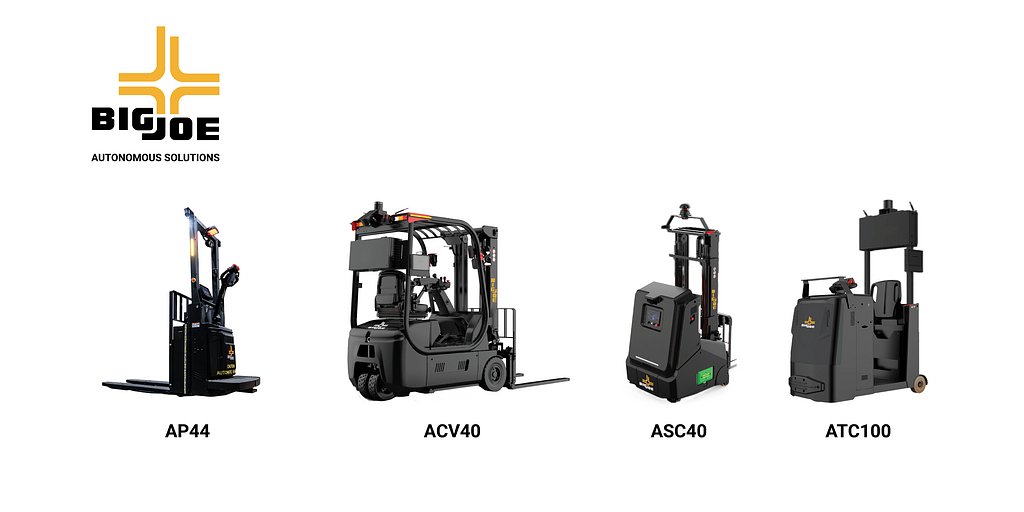
- 4 New Autonomous Models: AP44 pallet truck, ASC40 stacker, ATC100 tugger, ACV40 forklift launched at Automate 2026.
- Labor Savings Potential: Automation can reduce warehouse labor costs (50-70% of operating budget) with ROI in 14-20 months.
- Safety & Productivity Gains: Autonomous forklifts may cut accidents by up to 90%, boost productivity by 85% when paired with humans.
Experts would likely conclude that Big Joe's approach of offering flexible, easily deployable automation solutions could significantly lower adoption barriers for SMBs and accelerate industry-wide warehouse automation.
Big Joe's New Robots: Making Warehouse Automation Accessible to All?
CHICAGO, IL – June 22, 2026 – The floor of Automate 2026 is buzzing with the sleek, quiet hum of progress, but no company has made a more calculated bid for the soul of the modern warehouse than Big Joe Autonomous Solutions. The material handling veteran, established in 1951, just pulled the curtain back on four new autonomous vehicles, not as futuristic concepts, but as immediate answers to the industry’s most crippling headache: a persistent and costly labor shortage.
The debut of the AP44 pallet truck, ASC40 stacker, ATC100 tugger, and ACV40 forklift represents more than just an expanded product line. It’s a strategic push to democratize a technology that has, for many, remained just out of reach. Big Joe is betting that the future of logistics isn’t just autonomous—it’s approachable. For executives and investors watching the supply chain strain, the question is whether this pragmatic approach can finally unlock widespread adoption and deliver a compelling return.
The 'Approachable' Automation Gambit
For years, the promise of a fully automated warehouse has been dangled before operators, often attached to a daunting price tag and the threat of a complete operational overhaul. The market is crowded with sophisticated systems from giants like Kion Group and Seegrid, which frequently require significant capital investment, facility retrofits, and specialized engineering teams. This has created a two-tiered system: large enterprises that can afford to automate, and a vast number of small-to-medium-sized businesses (SMBs) left to contend with a shrinking labor pool.
Big Joe is aiming squarely at this gap. “Customers are looking for practical and approachable automation that simply works within their existing operations, not systems that require a complete redesign of their facility,” said Nick Malewicki, GM of Big Joe Autonomous Solutions, in a statement. This philosophy is the core of their new lineup. The vehicles are designed to be deployed without needing to install new infrastructure like magnetic floor tape or dedicated Wi-Fi networks, instead using modern LiDAR and SLAM navigation to map and navigate existing layouts.
The AP44 autonomous pallet truck perfectly embodies this strategy. With a 4,400 lb. capacity, it offers a unique three-mode flexibility. An employee can use it as a standard manual pallet truck, switch to a semi-autonomous mode where they load the pallet and let the robot handle the long-distance transport, or deploy it in a fully-autonomous mode for pre-programmed missions. This allows a facility to automate task by task, scaling their investment and training at a manageable pace without disrupting entire workflows. It’s a powerful answer to the high initial barriers that deter many SMBs, where the fear of operational disruption can be as significant as the financial cost.
Beyond the Hype: A Look Under the Hood
While the "approachable" message is compelling, it’s backed by serious hardware. All four new models—from the 4,000 lb. capacity ASC40 stacker designed for vertical movement to the hefty ATC100 tugger capable of towing 10,000 lbs.—run on Big Joe’s proven lithium-ion battery platform. This is a crucial detail, tying the new autonomous line to the company's successful push to electrify the material handling industry. Lithium power offers tangible benefits like opportunity charging, longer run times, and zero emissions, which are already key decision drivers for modern operations.
"Big Joe has been on the leading edge of the industry's shift from internal combustion to electric, and now we're taking that same approach to autonomous vehicles," noted Martin Boyd, Chief Marketing Officer. "We're meeting customers exactly where they are and giving them a clear road forward." This evolutionary path, from manual IC to electric and now to autonomous, builds credibility and leverages an existing, robust nationwide dealer network for sales and support—a significant advantage over software-centric startups that may lack a physical service infrastructure.
The competitive landscape is fierce, with the global autonomous forklift market projected to soar past $8 billion by 2026. Established players like Toyota Material Handling and Crown Equipment are also heavily invested in automation. However, Big Joe’s focus on multi-use, easily deployable units that can co-exist with and augment a human workforce, rather than demanding a fully robotic environment, carves out a distinct and potentially massive niche.
Redefining the Warehouse Workforce, Not Replacing It
The narrative of robots taking jobs is a persistent fear, but the reality on the warehouse floor is one of transformation, not elimination. With warehouse worker turnover rates hovering near 36%, companies are struggling simply to keep positions filled. Big Joe’s autonomous fleet is designed to augment this strained workforce, not replace it.
By automating the most physically demanding and repetitive tasks—like hauling pallets across a vast distribution center or repetitively stacking goods—these robots free up human workers for more complex, value-added roles. An employee who once spent their entire shift walking miles behind a pallet jack can now be retrained to manage a fleet of robots, troubleshoot workflow exceptions, or focus on quality control. This shift not only boosts overall productivity but also improves workplace safety and job satisfaction. Industry data suggests autonomous forklifts can reduce accidents by up to 90% and that human-robot teams can be 85% more productive than either working alone. This leads to a more resilient, skilled, and stable workforce—a valuable asset in any labor market.
The Investment Case: Calculating the ROI on Automation
For the executive investor, the ultimate test is the bottom line. While an autonomous forklift’s upfront cost of $50,000 to $250,000 is steep compared to its manual counterpart, the return on investment analysis is compelling. Labor typically constitutes 50-70% of a warehouse’s operating budget. By automating even a single shift, a company can save the entire annual salary and benefits of an operator, often leading to a payback period of just 14 to 20 months, especially in multi-shift operations.
The ROI extends far beyond direct labor savings. Automation drives down error rates by as much as 50%, saving costs associated with mis-picks and returns. Precision handling dramatically reduces damage to products, pallets, and facility racking. Furthermore, the ability to operate 24/7 without breaks or fatigue can increase warehouse throughput by 30% or more, allowing companies to grow their business without a proportional increase in headcount or facility footprint.
When factoring in reduced workers' compensation claims from improved safety, lower employee turnover costs, and the data-driven operational insights provided by a managed fleet, the financial case becomes clear. Big Joe's strategy of lowering the initial barrier to entry allows more companies to begin realizing these returns sooner, creating a ripple effect that could accelerate automation adoption across the entire supply chain.
This launch at Automate 2026 is a clear signal that the era of pragmatic automation has arrived, offering a tangible path for companies to not just survive the current labor crisis, but to build a more efficient, resilient, and productive future.