
- 93% of C-suite executives are concerned about ungoverned AI-generated applications (vibe coding).
- 59% of enterprises cannot confirm if they've experienced an AI-caused production incident.
- Only 8% of leaders describe their organization's AI governance as 'strong'.
Experts agree that while AI accelerates software development, the lack of governance in 'vibe coding' poses significant security, compliance, and maintenance risks that enterprises must address urgently.
Beyond the Vibe: The Race to Govern AI-Generated Code in the Enterprise
SAN FRANCISCO, CA – June 17, 2026 – In boardrooms and server rooms across the globe, a quiet tension is escalating. On one side, there is immense pressure to innovate at the speed of AI. On the other, a growing fear of the unknown risks this speed creates. A new survey of over 300 C-suite executives puts this anxiety into stark relief: 93% are concerned about the proliferation of un-governed applications built with AI coding tools, a practice now colloquially known as 'vibe coding.'
This isn't just another buzzword. It's the symptom of a systemic challenge shaking the foundations of enterprise software development. As developers and even non-technical staff use generative AI to produce working applications in minutes, a vast and invisible landscape of 'shadow AI' is emerging, operating outside the purview of traditional IT security and compliance. Now, a San Francisco-based company, Retool, claims to have a solution, launching a platform designed to bring this new wild west of code under a single, governed umbrella.
The Age of 'Vibe Coding' and Its Silent Risks
'Vibe coding' describes the act of using generative AI tools to create code based on high-level prompts or a general 'vibe,' often without a deep, line-by-line review of the output. While these tools dramatically accelerate productivity, they also outsource critical thinking to a black box. The result is a mountain of code that, while functional, may be riddled with unseen liabilities.
"AI is transforming how software gets built, but it hasn't solved how software gets governed and shipped, and that gap is exactly where enterprises get exposed,” said David Hsu, CEO and founder of Retool, in the company's announcement.
Experts warn that the risks go far beyond simple bugs. AI-generated code can inadvertently introduce sophisticated security vulnerabilities, from SQL injections to insecure authentication patterns, that developers focused on speed might overlook. Furthermore, since these AI models are trained on vast public datasets, the generated code can carry hidden intellectual property and licensing risks, potentially exposing a company to legal challenges. One respondent in Retool's survey crystallized the fear of long-term decay: "When anyone can ship a tool in an afternoon, nobody signs up to maintain it. AI failures are silent—confident output that's quietly wrong—so rot stays invisible until something breaks."
This silent rot is precisely what keeps executives up at night. The survey, conducted by market research firm Wynter, found that an astonishing 59% of enterprises could not confirm whether they had experienced an AI-caused production incident. This lack of visibility is the core of the problem. As another CISO in the survey lamented, "I think we are in the Wild West of AI—as a CISO I am worried about moving fast and secure and govern later."
The C-Suite's Governance Dilemma
The pressure to move fast is undeniable. The same survey revealed that 90% of executives have seen business pressure to enable AI building increase over the past year, with nearly a third stating that the business's tolerance for friction is "near zero." This creates a classic dilemma: how to foster the rapid, AI-driven innovation the business demands without opening the gates to catastrophic risk.
Currently, very few feel they are succeeding. Only 8% of the surveyed leaders described their organization's AI governance as “strong.” The vast majority painted a picture of reactive, manual, and uneven systems, highlighting a significant gap between the desire for control and the reality on the ground. Nearly half of all respondents admitted they were "not very confident" they had full visibility into all the internal tools running in their production environments.
"The challenge is not just speed; it is making sure the right governance, permissions, and auditability are built into how AI-enabled applications move into production," noted Iraklis Pappas, Global Head of AI at Colgate-Palmolive, in a statement supporting the need for such platforms.
This is the chasm Retool aims to bridge. Instead of trying to police which AI tools developers use, the company is proposing a new model: let them build with whatever they want, but enforce governance at the point of deployment.
A New Foundation for Trust
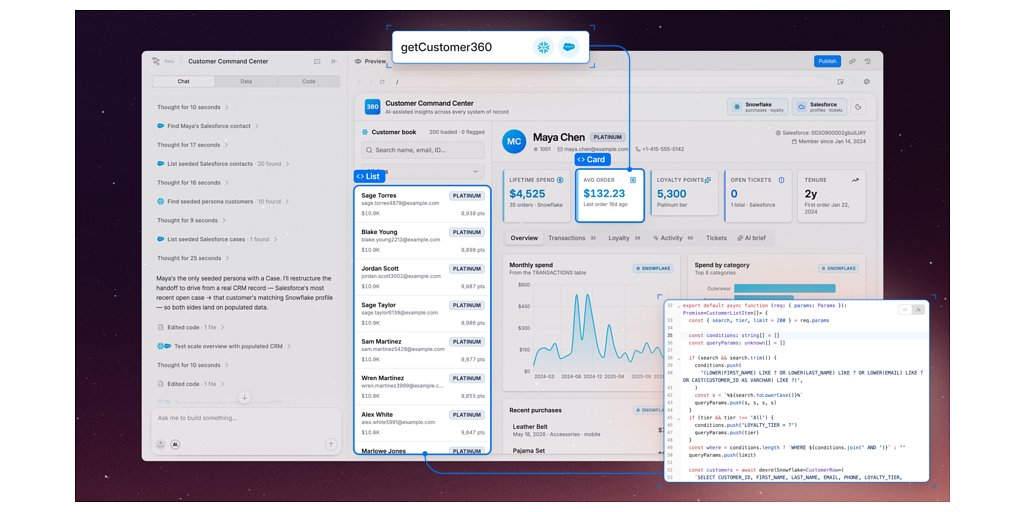
Retool's solution is built on a simple yet powerful premise: security and governance should live underneath the application, not within it. The platform is designed to act as a universal deployment and execution layer. An application can be built in Retool's own new AI-native builder, generated by an external tool like Claude Code, or even imported from an existing React codebase. The moment it lands in Retool, it automatically inherits the organization's entire governance framework.
This means that permissions, which are attached to data sources like databases and APIs, are enforced universally. Audit trails are automatically generated. And resource-level access policies are applied without any manual intervention, regardless of how the app was coded. This approach effectively brings 'shadow AI' into the light, placing it within a managed and secure environment where it can be monitored and controlled.
This strategy is bolstered by key strategic partnerships. An integration with the data cloud giant Snowflake allows Retool to extend its governance model directly to the data layer. "By combining Retool’s capabilities with Snowflake, we are designing a path for customers to turn conversational prompts into production-ready applications at lightning speed and with complete peace of mind,” said Unmesh Jagtap, Director of Product at Snowflake.
Furthermore, a multi-year strategic collaboration with Amazon Web Services (AWS) provides Retool with the enterprise-grade infrastructure, scalability, and market reach necessary to serve its growing list of over 10,000 organizations, which includes names like Amazon, Stripe, and Brex. These alliances signal a broader ecosystem shift, where governance is becoming a collaborative effort between platform, data, and cloud providers.
As enterprises continue their frantic race to adopt AI, the conversation is shifting from 'can we build it?' to 'how do we manage what we've built?'. The allure of 'vibe coding' and instant application generation will not fade. The challenge, therefore, lies not in restricting these powerful new tools, but in building a foundational layer of trust and control that allows innovation to flourish safely.