
- €1 million contract awarded by the European Space Agency (ESA) to Pilot Photonics for light-based data management technology.
- Optical Frequency Generator Unit (OFGU) enables signals from 8GHz to 220GHz, far beyond congested lower bands.
- Ireland's space-active companies have grown by over 300% in the past decade, with €170 million planned investment in ESA programs through 2030.
Experts would likely conclude that Pilot Photonics' light-based technology represents a foundational shift in satellite communications, addressing critical challenges of bandwidth congestion, payload reconfigurability, and orbital sustainability through innovative photonic solutions.
Beyond the Signal: How Light-Based Tech is Rebuilding Our Digital Sky
DUBLIN, June 4, 2026 – A €1 million contract awarded by the European Space Agency (ESA) to a Dublin-based innovator, Pilot Photonics, might seem like a niche industrial development. But to see it merely as a business transaction is to miss the larger story. This investment in a technology that uses light to manage data traffic is a crucial step toward rebuilding the invisible infrastructure that now underpins modern society. It’s a story about foresight, national ambition, and the complex systems we must engineer to sustain our increasingly connected world.
The Digital Traffic Jam Above Our Heads
For decades, we have looked to the skies for connection, beaming signals to and from satellites for everything from navigation to global broadcasting. Today, that reliance has deepened into a fundamental dependency. Remote work, high-definition streaming, and the nascent worlds of augmented and virtual reality are not just conveniences; they are burgeoning sectors of the global economy. Yet the very infrastructure enabling this digital existence is straining under the load.
Our current satellite systems, built on legacy radio frequency (RF) electronics, are hitting a wall. The orbital highways are becoming congested as thousands of new satellites join constellations like OneWeb and Starlink. Traditional frequency bands are now akin to a crowded city street during rush hour, leading to interference and signal degradation. This digital traffic jam puts a hard ceiling on our collective capacity for growth and innovation. The demand is clear: we need more bandwidth, more flexibility, and a more sustainable way to manage our orbital assets. Without a systemic upgrade, the promise of ubiquitous, high-speed global connectivity remains just out of reach.
An Answer Written in Light
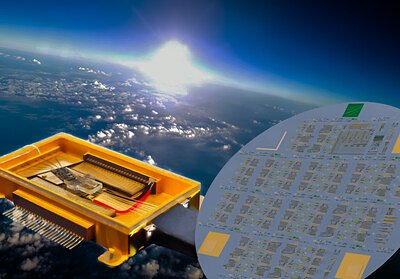
This is where the work of Pilot Photonics becomes so critical. The company’s Optical Frequency Generator Unit (OFGU) represents a paradigm shift, moving away from bulky, power-hungry electronics and toward the elegant efficiency of integrated photonics. Instead of generating radio frequencies with traditional circuits, the OFGU uses laser light on a tiny chip to produce a vast range of stable, clean signals from 8GHz all the way up to 220GHz—a spectrum far beyond the congested lower bands.
This move to light-based technology directly addresses the three core challenges facing the satellite industry. First, it opens up higher, unused frequency bands, creating new lanes on the orbital highway. Second, it enables something the industry calls “payload reconfigurability,” allowing satellite operators to redirect bandwidth and power on the fly from the ground. A satellite can be dynamically reassigned to serve a disaster-stricken area one day and a data-hungry metropolis the next, dramatically increasing the value and lifespan of these billion-dollar assets.
Finally, and perhaps most importantly for the long-term health of our orbital environment, the technology is a champion of what engineers call SWaP-C: Size, Weight, Power, and Cost. Photonic chips are exponentially smaller, lighter, and more power-efficient than their electronic counterparts. Reducing a satellite’s weight significantly lowers launch costs, a key economic barrier, while reducing its power consumption extends its operational life. This isn’t just an incremental improvement; it’s a foundational change that makes orbital networks more scalable and economically sustainable.
A Nation's Bet on the New Space Economy
The success of Pilot Photonics is not an isolated event. It is a powerful testament to Ireland’s quiet but determined ascent as a key player in the European space economy. Over the past decade, Ireland has strategically cultivated a thriving ecosystem of space-active companies, which has grown by over 300%. With a national strategy in place and a planned investment of €170 million in ESA programs through 2030, the nation is punching well above its weight.
“This significant ESA contract is further evidence of Ireland's growing capability in the space economy,” noted Barry Jennings, National Delegate to ESA at Enterprise Ireland. His statement underscores a deliberate, multi-year effort to foster exactly this kind of innovation. By coordinating industrial and research participation through agencies like Enterprise Ireland, the country has built a distinctive presence in highly specialized fields like photonics, microelectronics, and advanced materials. The €1M contract is not just funding for a company; it is a return on a national investment in building systems that support high-tech jobs and sovereign capability.
Hardening Innovation for the Void
Developing a groundbreaking technology in a lab is one thing. Ensuring it can survive the brutal conditions of space is another challenge entirely. The €1M contract is specifically for “space-proofing” the OFGU—a painstaking process of testing and validating the hardware against extreme temperature swings, radiation, and the violent vibrations of a rocket launch.
“This project will accelerate the OFGU's readiness for space, culminating in space-environment validation after which early demonstrations in orbit can commence,” explained Dr. Amol Delmade, the OFGU Product Lead at Pilot Photonics. This phase is where innovation meets the unforgiving reality of physics, and it’s a critical step in de-risking the technology for commercial adoption.
The ESA’s support signals a much broader strategic pivot. “Photonic technologies are becoming increasingly important for space,” said Dr. Nikos Karafolas, a Technical Officer at the agency. This project, building on previous EU initiatives like PhotonHub Europe, is part of a long-term vision to integrate photonics across European space missions. It’s a recognition that the future of scientific discovery, Earth observation, and secure communications will depend on the very technologies being refined in labs in Dublin and across the continent.
The journey of this photonic engine, from an idea to a space-hardened reality, is a powerful illustration of how progress is made. It requires corporate ingenuity, supportive public policy, and a shared understanding of the complex challenges we must solve to build a more resilient and connected world. As Pilot Photonics works to bring its vision of an “Everything over Optical™” era to life, it’s clear that the light from this small chip will cast a very long shadow, shaping our digital future from the ground all the way to orbit.