
- 80% of organizations are not seeing tangible bottom-line impact from their AI investments (McKinsey, 2024).
- 50% of global executives report a 1-5% return on their AI initiatives (Forbes, 2025).
- ActivTrak's AI Insights aims to unify behavioral data across employees, applications, and AI tools to measure ROI.
Experts agree that the disconnect between AI spending and measurable value is a critical challenge, requiring better metrics and centralized tools to evaluate AI's true business impact.
Beyond the Hype: New Tools Tackle the Billion-Dollar Question of AI ROI
AUSTIN, TX – April 08, 2026 – As organizations pour billions into artificial intelligence, a critical question echoes through boardrooms: Is any of it actually working? Despite the frenzy of adoption, a vast majority of businesses are flying blind, unable to connect their massive AI investments to tangible improvements in productivity or profit. Addressing this growing accountability gap, Austin-based ActivTrak today announced AI Insights, a new analytics suite designed to give leaders a data-driven view of how AI is being used—and if it’s delivering real value.
The announcement comes at a pivotal moment. The era of unchecked AI experimentation is rapidly drawing to a close, replaced by a demand for measurable returns. While companies are deploying AI tools at a breakneck pace, the methods for measuring their impact remain startlingly primitive. Most organizations rely on fragmented data from individual tools, leaving them with no clear picture of how AI is reshaping workflows, influencing employee productivity, or affecting the bottom line.
The Billion-Dollar Blind Spot
The disconnect between AI spending and measurable value is one of the most significant challenges facing modern enterprises. Recent industry studies paint a stark picture: a July 2024 McKinsey survey found that over 80% of organizations are not seeing tangible bottom-line impact from their AI investments. Similarly, a 2025 Forbes AI study revealed that over half of global executives report a meager 1-5% return on their AI initiatives.
Experts suggest the problem is rooted in a fundamental mismatch between the technology and the metrics used to evaluate it. Many companies focus on superficial activity metrics like adoption rates rather than concrete business outcomes. The rapid, often decentralized adoption of AI tools has outpaced financial visibility, making it nearly impossible to connect cost to value.
This is the problem ActivTrak aims to solve. "Work has fundamentally changed. It's now people and AI, side by side, sharing tasks in ways that were hard to anticipate two years ago," said Heidi Farris, CEO of ActivTrak, in the company's announcement. "But organizations still lack a clear way to measure what that shift actually means. ActivTrak work intelligence gives leaders a complete, objective view of AI adoption and impact — from early usage patterns to real business outcomes."
A System of Record for the AI Era
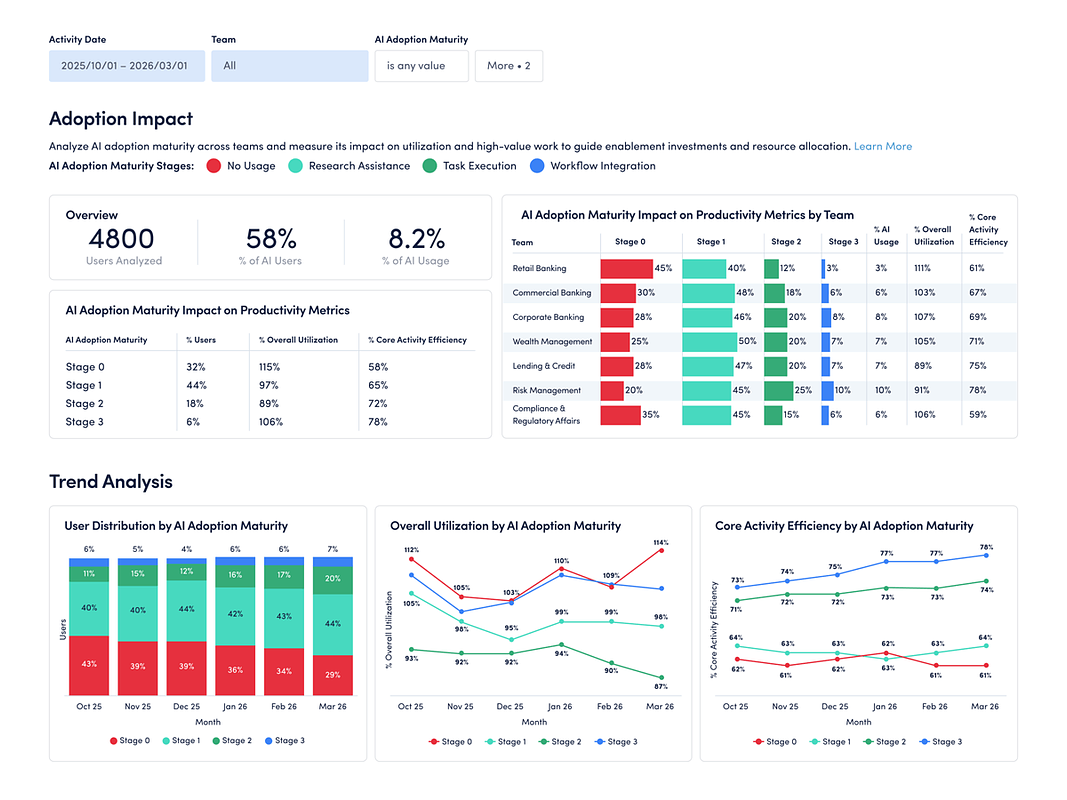
ActivTrak's AI Insights proposes to act as a central system of record by unifying behavioral data captured across employees, applications, and the AI tools they use. Instead of siloed reports, the platform offers a system-level view of how, where, and by whom AI is being leveraged. The new capabilities are broken down into five core areas: measuring AI usage, governing tool access, benchmarking adoption maturity, analyzing productivity impact, and optimizing for ROI.
This holistic approach is designed to answer critical questions that currently vex leadership. For instance, the platform can identify which AI tools are gaining traction and which are sitting idle, providing a clear basis for optimizing software licenses. It can also connect AI usage to changes in work patterns, revealing whether a new tool is genuinely reducing manual effort or simply adding another layer of complexity.
"Most organizations are making AI decisions without a clear understanding of what's actually changing," stated Javier Aldrete, ActivTrak's Chief Product Officer. "They're scaling tools without knowing what's working. What's needed is a behavioral baseline that shows where AI is used and where it delivers value. That's what makes smarter decisions possible."
Taming the 'Wild West' of Workplace AI
Beyond ROI, the proliferation of AI tools has created a significant governance and security challenge. Employees, eager to boost their efficiency, are independently adopting a wide array of AI applications, many of which are not vetted or approved by their IT departments. This phenomenon, often called 'shadow AI,' exposes organizations to significant risks, including data leakage, intellectual property loss, and non-compliance with privacy regulations.
ActivTrak's new offering directly addresses this by providing comprehensive visibility into all AI tools being used across the company, whether they are sanctioned or not. This allows IT and security leaders to identify unapproved applications, understand their usage patterns, and enforce corporate policies to mitigate risk. By providing a clear map of the entire AI landscape within the organization, the platform helps tame the digital 'Wild West' and brings a much-needed layer of control to the rapid expansion of AI.
The Unseen Watcher: Navigating Privacy in the AI Workplace
While the promise of data-driven AI management is compelling, the technology is not without its critics. The prospect of monitoring employee tool usage raises immediate and significant concerns about privacy and the potential for a 'big brother' work environment. Employee advocacy groups and privacy experts caution that such tools could erode trust, increase stress, and lead to 'productivity theater,' where employees focus on appearing busy to the monitoring software rather than performing meaningful work.
These ethical considerations are a major hurdle for any company in the workforce analytics space. ActivTrak emphasizes that its platform is "built on a privacy-first data foundation." The key to ethical implementation, according to industry best practices, lies in transparency and a focus on aggregated, anonymized data. Rather than scrutinizing individual employees, the goal should be to understand team-level trends, optimize processes, and identify coaching opportunities. Success depends on whether companies use these insights to empower their workforce, not police them.
As AI continues to integrate itself into every facet of business, the demand for accountability will only intensify. The launch of platforms like AI Insights signals a maturation of the market—a shift away from blind adoption and toward strategic, data-informed optimization. For businesses navigating the complexities of the AI revolution, the ability to see what's truly working will be the ultimate competitive advantage.
Topics & Related
AI & Machine Learning
Artificial Intelligence
Generative AI
Related Company Pulse