
- 70% automation: By the end of 2027, conversational AI agents will automate approximately 70% of customer service interactions in enterprises.
- $80 billion market: The conversational AI market is projected to exceed $80 billion by 2034.
- 48-hour deployment: Orvera AI claims it can build and deploy a customer’s first AI agent within 48 hours.
Experts view Orvera AI’s rebrand as a strategic response to the industry’s shift toward agentic AI, positioning the company as a leader in autonomous, goal-oriented AI systems that enhance customer service efficiency and quality.
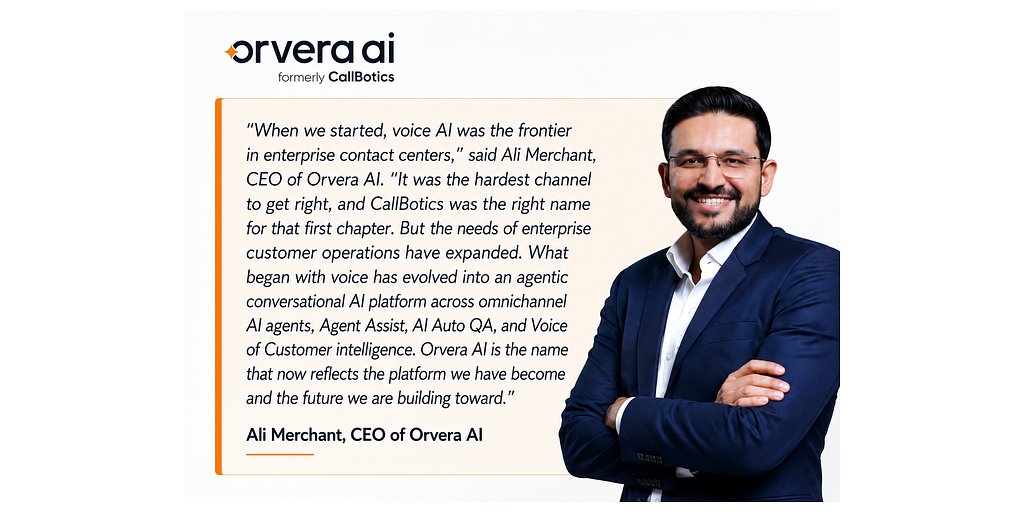
Beyond the Bot: Orvera AI Rebrand Signals Shift to Agentic Customer AI
SAN FRANCISCO, CA – May 29, 2026 – The company formerly known as CallBotics announced today it has rebranded to Orvera AI, a move that signals a significant strategic shift not just for the company, but for the broader enterprise customer service landscape. The rebranding repositions the firm as an “Agentic Conversational AI Platform,” moving decisively away from the limited vocabulary of “bots” and toward a future of more autonomous, intelligent, and integrated AI systems.
This evolution reflects a critical turning point in the industry. For years, enterprises have experimented with chatbots and voicebots to deflect simple customer queries. However, the market is now demanding solutions that can handle complex, multi-step interactions from start to finish. Orvera AI’s rebrand is a direct response to this demand, positioning itself at the forefront of a new paradigm where AI doesn't just answer questions, but acts as a true agent to solve problems.
“CallBotics was the right name for our first chapter in voice AI,” said Ali Merchant, CEO of Orvera AI, in a statement. “But the needs of enterprise customer operations have expanded. What began with voice has evolved into an agentic conversational AI platform across omnichannel AI agents, Agent Assist, AI Auto QA, and Voice of Customer intelligence. Orvera AI is the name that now reflects the platform we have become and the future we are building toward.”
The Evolution Beyond the 'Bot'
The term “agentic AI” marks a departure from the reactive, often scripted nature of first-generation chatbots. An agentic system is designed to be proactive and goal-oriented. Instead of merely following a decision tree, it can understand a user's ultimate goal, break it down into necessary steps, plan a course of action, and execute workflows across multiple systems—all while maintaining context in a conversation.
Industry analysts like Gartner distinguish between simple “AI assistants” that help with tasks and true “task-specific AI agents” that can operate independently to resolve complex issues without human intervention. Orvera AI's platform is firmly aimed at this more advanced category. It operates on a unified architecture that integrates multilingual natural language understanding with agentic planning and workflow execution. This allows its AI agents to manage intricate customer journeys seamlessly across voice, chat, and email.
While the company built its reputation with a deep specialization in Voice AI—historically the most challenging channel to automate effectively—its platform now provides a consistent, intelligent experience regardless of how the customer chooses to interact. This omnichannel capability is crucial as enterprise buying committees increasingly seek a single, unified platform to manage all customer communication channels through one comprehensive solution.
A New Era of Human-AI Synergy
Despite the power of its automation, Orvera AI’s strategy is not one of mere replacement. A core component of its platform is designed to create a powerful synergy between human and artificial intelligence, augmenting the capabilities of contact center representatives rather than making them obsolete. This hybrid approach is rapidly becoming a key trend, with Gartner predicting that nearly three-quarters of customer service organizations will implement agent-assist solutions by the end of next year.
The platform's Agent Assist feature provides human agents with real-time support during complex customer calls. It can surface approved knowledge from a database, suggest the next-best action, provide cues for escalation, and generate summaries automatically. This frees agents from cumbersome manual searches and note-taking, allowing them to focus entirely on delivering empathetic and effective problem-solving.
Complementing this is the AI Auto QA function, which audits 100% of human-handled conversations. Traditionally, quality assurance in contact centers has been a manual, time-consuming process involving a small, random sample of calls. By automating this process, Orvera AI provides leadership with consistent, comprehensive visibility into service quality, compliance adherence, and agent performance across every single customer interaction. This not only ensures higher standards but also provides invaluable data for targeted coaching and training.
Navigating a Crowded and Shifting Market
Orvera AI enters this new chapter in a dynamic and competitive market. Established giants like LivePerson, Genesys, and NICE Cognigy, along with specialized players like Amelia, are all racing to integrate generative AI and agentic frameworks into their offerings. Forrester has noted that the market is clearly moving from scripted bots to more sophisticated, agent-driven systems capable of orchestrating complex tasks.
In this environment, Orvera AI is leveraging several key differentiators to stand out to enterprise buyers. Its deep roots in Voice AI remain a significant advantage in a domain where nuance and accuracy are paramount. Furthermore, its commitment to enterprise-grade security and compliance—maintaining SOC 2 Type II and HIPAA compliance while operating in alignment with GDPR—is a critical requirement for clients in highly regulated industries such as financial services and healthcare.
Perhaps its most aggressive market differentiator is the promise of rapid deployment. The company claims it can build and deploy a customer’s first AI agent within 48 hours, including a no-cost, white-glove implementation service with every enterprise deployment. In an industry where AI projects can often be plagued by long timelines and hidden costs, this focus on speed-to-value could be a decisive factor for businesses eager to see a swift return on their technology investment.
The Road to 70% Automation
The strategic repositioning of Orvera AI is timed to capitalize on a massive industry-wide transformation. Industry research projects that by the end of 2027, conversational AI agents will automate approximately 70 percent of customer service interactions within enterprises that have deployed such solutions. This projection, supported by trends identified by major analyst firms like Gartner and Juniper Research, points to a market undergoing exponential growth, with some estimates projecting the conversational AI market to exceed $80 billion by 2034.
This automation wave is not merely about deflecting calls to an IVR system. It’s about successfully resolving a growing volume of complex requests and transactions through intelligent, self-sufficient AI agents. Platforms like Orvera AI are the engines designed to power this shift, promising not only significant operational cost reductions—which IBM suggests can be up to 30%—but also a more consistent and satisfying customer experience.
As enterprises look to future-proof their operations, the focus will increasingly be on holistic platforms that can automate, augment, and analyze customer interactions at scale. Orvera AI's rebrand is a clear declaration that it intends to be a central player in building that future, one intelligent agent at a time.