
- $100M+ investment: Procare Ambulance secures significant private capital infusion from Prodos Capital, Manolin Investment Group, and other investors.
- 100% customer retention: Procare has maintained perfect client retention since its founding in 2005.
- First licensed private MIH program: Procare's 'Procare Home Response' is the only commercial MIH program in Maryland.
Experts view this partnership as a transformative model for healthcare delivery, emphasizing its potential to reduce hospital readmissions, improve patient outcomes, and lower costs through mobile, preventative care.
Beyond the Ambulance: How Private Capital is Fueling a Healthcare Revolution
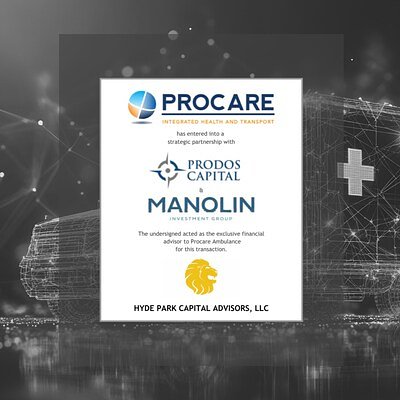
NASHVILLE, TN – June 01, 2026 – A standard press release crossed the wires today, announcing a "strategic partnership" between Procare Ambulance, a Mid-Atlantic medical transport provider, and a pair of private investment firms. On the surface, it’s a familiar story of capital meeting opportunity. But dig deeper, and the deal reveals a seismic shift in the American healthcare landscape—one where the ambulance is no longer just a vehicle for emergencies, but a mobile hub for sophisticated, preventative care, and where private capital is betting big on moving healthcare out of the hospital and into the living room.
The transaction sees Procare Ambulance, a Baltimore-based provider known for its sterling reputation, joining forces with Prodos Capital and Manolin Investment Group. A consortium of other investors, including Tecum Capital, Genesis Park Capital, and SharpVue Capital, are providing the growth capital. This infusion of cash and expertise is earmarked for geographic expansion and fleet upgrades, but the real story lies in the deal's primary catalyst: accelerating Procare’s Mobile Integrated Health (MIH) program. This partnership is less about buying more ambulances and more about funding a new paradigm of patient care.
The New Frontier: From Transport to Treatment
For most, the sight of an ambulance signifies a trip to the hospital. Mobile Integrated Health flips that script. MIH utilizes the skills of paramedics and advanced medical technology to provide non-emergency, preventative, and post-discharge care directly in a patient's home. It’s a model designed to tackle some of the healthcare system's most intractable problems: chronic disease management, hospital overcrowding, and costly readmissions.
Procare is at the vanguard of this movement. Its "Procare Home Response" service is the first and only licensed private commercial MIH program in Maryland. It targets high-risk patients with conditions like COPD, congestive heart failure, and diabetes, providing in-home services that were once the exclusive domain of a hospital ward. This includes cardiac monitoring, administering IV fluids and medications, advanced wound care, and point-of-care lab testing, all conducted in coordination with the patient's physician via telemedicine.
The potential impact is transformative. As hospital systems face increasing financial penalties for patient readmissions, they are desperately seeking partners who can help manage patient care after discharge. Douglas Song, Founder of Prodos Capital, highlighted this in his comments on the deal. "We are particularly excited about the Company's MIH program, which we believe represents a significant and differentiated growth opportunity as healthcare systems increasingly look to partners that can help reduce readmissions and improve patient outcomes outside the hospital setting," he stated.
This sentiment is echoed by the new operating partner, Dr. Thom Mayer, who sees MIH as a game-changer. "The MIH program in particular has enormous potential to meaningfully improve outcomes for patients, reduce the burden on hospital systems, and create sustainable value for the communities Procare serves," Dr. Mayer commented. By treating patients at home, Procare not only improves their comfort and recovery but also frees up hospital beds and reduces the strain on emergency departments, contributing to the "Triple Aim" of modern healthcare: better patient experience, improved population health, and lower per-capita costs.
The Capital Injection: Why Investors Are Lining Up
The Procare deal is a bellwether for a much larger trend. Private investment firms are pouring capital into what they see as the critical infrastructure of a new healthcare economy. The factors are clear: a rapidly aging population, the systemic shift toward value-based care, and the relentless pressure to control costs. Companies that can deliver efficient, scalable solutions are becoming prime investment targets.
"We continue to see a significant increase in investor interest across the medical transportation and broader mobile healthcare services sectors," noted Michael Johnson, Managing Director at Hyde Park Capital, the firm that advised Procare on the transaction. He cited "strong underlying demand, favorable demographic trends, [and] the increasingly important role providers like Procare play within the evolving healthcare ecosystem."
For Prodos Capital and Manolin Investment Group, Procare represents an ideal platform. It's a founder-led business with an unblemished record—boasting 100% customer retention since its 2005 inception—and deep, trusted relationships with major regional healthcare institutions. This isn't a turnaround project; it's an opportunity to pour fuel on a fire that's already burning bright.
The capital will allow Procare to aggressively pursue its growth strategy. This includes a significant geographic expansion into Virginia, where the regulatory framework also supports MIH programs, provided agencies meet stringent performance standards. It also means investing heavily in the tools of the trade: a larger, more advanced fleet, cutting-edge medical and telehealth technology, and, crucially, its workforce of highly trained clinicians. "This transaction positions us to continue investing in our people, expand geographically, strengthen our MIH capabilities, and build for the future," said Debbie Ailiff, Procare's founder.
A Blueprint for Growth: From Local Leader to Market Disruptor
Procare's journey from a single-location startup to the subject of a major private equity investment is a case study in building a durable, high-quality business. By focusing relentlessly on reliability and clinical excellence, the company earned the trust of the most demanding clients: the region's top hospitals and healthcare systems.
This new partnership provides the "institutional framework and capital resources to accelerate our geographic expansion," according to Procare CEO Mark Bucholtz. The goal is to transform a respected local leader into an undisputed regional powerhouse, setting a new standard for interfacility transport and mobile medicine.
The enhanced capabilities, particularly in MIH, position Procare to be a market disruptor. While traditional ambulance companies compete on transport times and contracts, Procare is competing on patient outcomes and system-wide cost savings. This value proposition resonates deeply with hospital administrators, insurers, and government payers. The company's pilot programs, such as a collaboration with Kaiser Permanente Mid-Atlantic and Luminis Health, demonstrate how deeply this model can be integrated into a health system's core strategy for managing patient populations.
By scaling its unique MIH services, the company is not just adding routes; it's creating a new, indispensable service category. This strategic differentiation, backed by a powerful consortium of investors, gives Procare a formidable advantage as it expands its footprint across the Mid-Atlantic and solidifies its role as a pioneer in the future of healthcare delivery. The investment validates a business built on quality and charts a course for a future where compassionate, high-quality care is delivered wherever the patient may be.