
- 500 tons of asphalt shingles diverted from landfills by Guaranteed Roof, equivalent to the weight of 250 cars.
- 11-15 million tons of asphalt shingles disposed of annually in U.S. landfills, contributing to 600 million tons of construction waste.
- Roof rejuvenation extends lifespan by up to 15 years, costing a fraction of full roof replacement.
Experts would likely conclude that roof rejuvenation technology represents a sustainable and economically viable alternative to traditional 'rip and replace' roofing practices, aligning with circular economy principles.
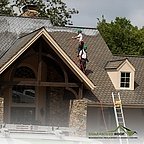
Beyond 'Rip and Replace': How New Tech Saves Roofs and Landfills
ALPHARETTA, GA – June 16, 2026
In the suburbs of Atlanta, a quiet milestone was reached that speaks volumes about a shift in how we maintain our world. Guaranteed Roof, a local company, announced it has prevented more than 500 tons of asphalt shingles from entering landfills. This figure, equivalent to the weight of roughly 250 cars, wasn't achieved through a new recycling program, but by preventing the waste from being created in the first place. The company is at the forefront of a growing movement that challenges the deeply entrenched “rip and replace” cycle of the roofing industry, armed with a bio-based technology that gives aging roofs a second life.
This isn't just a story about one company's environmental achievement; it's a look into a systemic change where technological innovation, economic pragmatism, and environmental stewardship are converging on one of the most overlooked parts of our homes: the roof over our heads.
The Hidden Waste Stream Above Our Heads
Every year, the United States disposes of an almost unfathomable amount of roofing material. According to data from the Environmental Protection Agency, asphalt shingles alone contribute between 11 and 15 million tons of debris to the nation's landfills annually. They are a primary component of the 600 million tons of construction and demolition (C&D) waste generated each year, a stream that dwarfs the volume of municipal solid waste produced by households.
Once in a landfill, an asphalt shingle is a remarkably stubborn guest. Composed of petroleum-based materials, fiberglass, and mineral granules, a shingle can take 300 to 500 years to decompose. Buried under layers of other debris with limited exposure to air, moisture, and sunlight, they effectively become a permanent geological layer of our own making. This slow breakdown process can also lead to the leaching of volatile organic compounds (VOCs) and heavy metals into the soil and groundwater, posing a long-term environmental risk. Furthermore, their decomposition can contribute to the formation of methane, a greenhouse gas far more potent than carbon dioxide.
For decades, the industry standard for an aging roof has been a complete tear-off and replacement. This approach not only generates immense waste but also consumes vast quantities of new resources. The 500 tons diverted by Guaranteed Roof represents a small but significant victory against this tide of waste, demonstrating a viable path that keeps materials in use and out of the ground.
The Science of a Second Life
The technology enabling this shift is a process known as roof rejuvenation. At its core is a scientifically formulated treatment that addresses the root cause of shingle aging. Over time, the petrochemical oils that give asphalt shingles their flexibility and waterproofing capabilities evaporate due to relentless UV exposure and harsh weather cycles. The shingles become brittle, lose their granular coating, and eventually crack, leading to leaks and the perceived need for a full replacement.
Guaranteed Roof utilizes Roof Maxx, a plant-based bio-oil treatment made from soy. This fluid is sprayed directly onto the existing roof. The micro-beads of oil are designed to penetrate the asphalt core of the shingle, replacing the lost petrochemical oils. This process restores the material’s original flexibility and durability, effectively turning back the clock on the aging process. A single application is guaranteed to add five years to a roof's functional lifespan. With the potential for up to three treatments over time, a roof's life could be extended by as much as 15 years.
This approach represents a fundamental pivot from replacement to restoration. Instead of waiting for a system to fail completely, rejuvenation acts as a form of preventative maintenance, preserving the massive initial investment of materials and energy embodied in the existing roof. It’s a solution that works with the existing infrastructure rather than demolishing it.
A Tipping Point for the Circular Economy
The success of roof rejuvenation is a powerful example of the circular economy in practice. It disrupts a linear model of 'take, make, dispose' and replaces it with one focused on extending the lifecycle of assets. For the roofing industry, this is a profound change.
"Our mission has always been to disrupt the traditional 'rip and replace' mentality that dominates the roofing industry," said Matthew Weeks, CEO of Guaranteed Roof, in a recent statement. "Reaching the 500-ton mark proves that sustainability and fiscal responsibility go hand-in-hand."
This intersection of sustainability and savings is the engine driving consumer adoption. As construction costs continue to rise, homeowners are increasingly receptive to alternatives that offer financial relief without compromising quality. A full roof replacement can be one of the most expensive maintenance items for a homeowner, often costing tens of thousands of dollars. Rejuvenation services typically cost a fraction of that price. By opting to restore their existing roof, customers are not only reducing their environmental footprint but also making a sound financial decision.
Weeks's observation that they are "fundamentally changing how the community views the lifecycle of a roof" points to this larger shift. The 500-ton milestone is not just a corporate metric; it's a market signal that consumers are ready to embrace more intelligent, sustainable, and cost-effective systems for maintaining their homes.
The Homeowner's New Calculus
For property owners, this technology introduces a new and crucial decision point in home maintenance. The choice is no longer simply when to replace a roof, but whether to replace it at all. The ideal candidate for rejuvenation is a roof that is showing signs of aging—such as granule loss or reduced flexibility—but has not yet suffered catastrophic failure or widespread structural damage.
This preventative approach requires a change in mindset, moving from reactive repairs to proactive preservation. By treating a roof that is 10, 15, or 20 years old, homeowners can pause the degradation process and add years of functional life, deferring the massive cost and disruption of a full replacement. It transforms the roof from a disposable component into a durable, long-term asset.
The rise of services like those offered by Guaranteed Roof suggests that the systems we rely on are becoming smarter and more sustainable, not through some far-off futuristic technology, but through the clever application of science to overlooked problems. It proves that sometimes the most impactful innovations aren't the ones that require building something new, but the ones that teach us how to better care for what we already have.