
- 5 million households participated in the 'Ek Ped Ek Zindagi' afforestation campaign.
- 44 million people reached across 13 states through the 'Mitti Ke Ganesh' water pollution initiative.
- 8.5 lakh winter garments distributed in the 'Vastradaan' clothes donation program.
Experts would likely conclude that Dainik Bhaskar's Golden Peacock Award validates its innovative, participatory CSR model as a benchmark for media-driven societal change.
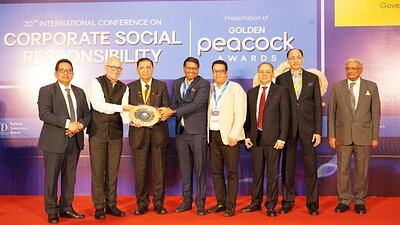
Beyond Headlines: Dainik Bhaskar's CSR Leadership Earns Golden Peacock
MUMBAI, India – February 20, 2026 – Dainik Bhaskar Group, a titan in the Indian media landscape, has been awarded the prestigious Golden Peacock Award for Corporate Social Responsibility. The honor, presented at a gala event at the Hotel Taj Lands End on February 19, recognizes the conglomerate's extensive and innovative efforts to leverage its vast platform for profound community and environmental impact. While the award itself is a significant corporate milestone, it is the story behind the win—a tale of citizen-led movements and purpose-driven media—that highlights a potential shift in the role of media in modern society.
The Gold Standard of Responsibility
The Golden Peacock Award is more than just a trophy; it is widely regarded as one of India's most credible benchmarks for corporate excellence. Instituted by the Institute of Directors (IOD) in 1991, the award scheme for CSR is known for its rigorous, three-tier independent assessment process. It seeks to identify and honor organizations that not only demonstrate ethical behavior and financial success but also actively contribute to sustainable development and the well-being of the wider community. Winning this award places Dainik Bhaskar among a select group of companies that have successfully integrated social good into their core operational fabric, demonstrating measurable outcomes and transparent leadership. The award's stringent criteria ensure that it is a true measure of an organization's long-term commitment rather than a nod to superficial or short-term philanthropic gestures.
Mobilizing Millions for Meaningful Change
The foundation of Dainik Bhaskar's win lies in a series of large-scale, participatory campaigns that have transformed readers from passive consumers of news into active agents of change. These initiatives go far beyond traditional corporate charity, instead focusing on an "advocacy model" that uses the group's media channels to inform, educate, and mobilize millions.
One of the most notable campaigns is 'Ek Ped Ek Zindagi' (One Tree, One Life). To combat deforestation, the group embedded seeds directly into its newspapers, which were distributed to over 5 million households. This innovative approach allowed readers to directly participate in afforestation from their homes, a campaign that even garnered praise from Prime Minister Narendra Modi.
Similarly, the 'Mitti Ke Ganesh' (Clay Ganesha) initiative tackled water pollution associated with religious festivals. By championing the use of eco-friendly clay idols over those made from Plaster of Paris, the campaign reached an estimated 44 million people across 13 states. It encouraged behavioral change at a massive scale, promoting home immersion of the idols and using the resulting water for gardening.
The group's commitment to public welfare is also evident in its 'Vastradaan' (Clothes Donation) program. In its 2026 iteration, the initiative collected and distributed over 8.5 lakh winter garments to underprivileged communities, a fourfold increase from the previous year. A powerful digital video campaign supporting the drive achieved nearly 30 million views, demonstrating the effective fusion of print, digital, and on-ground action. Other campaigns, such as 'Save The Birds' and 'Dene Ka Sukh' (Joy of Giving), further underscore a consistent, long-term strategy of civic engagement.
The Strategic Power of Purpose-Led Media
This award validates Dainik Bhaskar's position not just as a media leader but as a powerful force for societal change. The group's claims of market leadership—as India's most circulated daily newspaper according to the Audit Bureau of Circulations (ABC) and the world's third-largest by circulation per the World Association of Newspapers and News Publishers (WAN-IFRA)—are central to understanding the impact of its CSR strategy. With a readership of 14 crore across its platforms, the organization possesses an unparalleled ability to shape public discourse and inspire collective action.
Speaking on the occasion of the award, Girish Agarwal, Director of Dainik Bhaskar Group, stated, "This recognition strengthens our belief that media can be a powerful force for societal transformation. At Dainik Bhaskar Group, our commitment to community and sustainability is deeply rooted in our values and we will continue to build initiatives that deliver meaningful and lasting impact."
This philosophy represents a strategic alignment of business and purpose. By embedding social responsibility into its identity, the media house enhances its brand reputation, builds deeper trust with its vast readership, and creates a competitive advantage. In an increasingly crowded media market, demonstrating a genuine commitment to the communities it serves can be a powerful differentiator, fostering loyalty that transcends the daily headlines.
A Rising Tide in the Media Industry
Dainik Bhaskar's achievement occurs within a broader context of India's media giants increasingly embracing corporate social responsibility. The Times Group, another major conglomerate, has long been active in this space with initiatives like 'Teach India,' which provides English language training to underprivileged youth, and by hosting national CSR summits. This industry-wide trend reflects a growing understanding that with great influence comes great responsibility.
However, Dainik Bhaskar's approach, characterized by its focus on creating scalable, replicable, and highly participatory mass movements, sets a distinct benchmark. Rather than solely funding projects, the group has successfully weaponized its core asset—its communication platform—to act as a catalyst for change. The Golden Peacock Award acknowledges this unique model, which proves that a newspaper can do more than report on the world's problems; it can actively mobilize its readers to help solve them. This recognition serves not only as an accolade for the group but also as an inspiration for the entire media industry, showcasing a potent model for how to integrate profit, purpose, and public good.