
- $69 billion: Projected market size for AI productivity tools by 2035
- 24/7 operation: Autonomous desktop AI designed to work continuously in the background
- Local-first approach: All user data stored locally by default for enhanced privacy
Experts view PetClaw AI as a significant step toward action-oriented AI, but caution about potential over-reliance and the need for robust security measures in its local-first architecture.
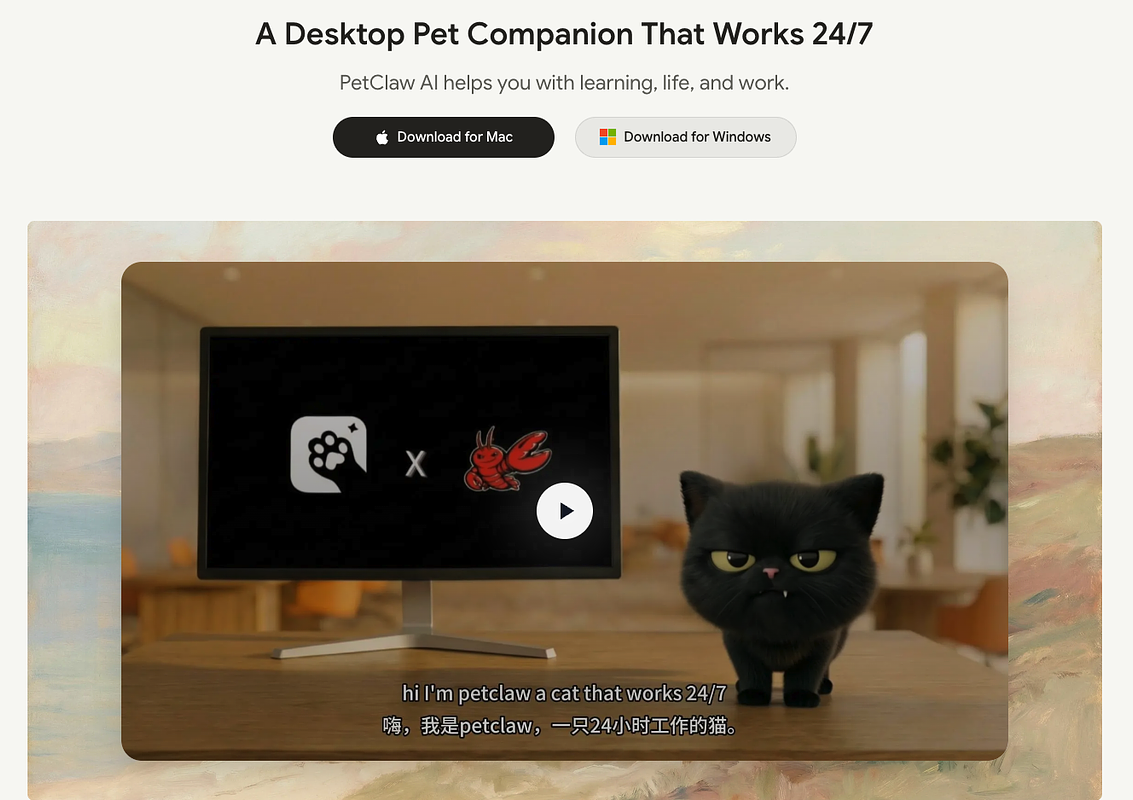
Beyond Chat: PetClaw AI Unleashes an Autonomous Desktop Assistant
SAN FRANCISCO, CA – March 20, 2026 – In a move signaling a significant evolution in personal computing, startup PetClaw AI today launched its autonomous desktop AI companion, a new kind of digital assistant designed to execute tasks directly on a user's computer rather than simply responding to queries. The software, presented to the user as a "desktop AI pet," promises to work 24/7 in the background, aiming to redefine productivity by automating complex workflows across multiple applications.
This launch positions PetClaw AI in a fiercely competitive and rapidly growing market for AI productivity tools, a sector projected to swell to over $69 billion by 2035. The company is betting that users are ready to move beyond conversational AI like ChatGPT and embrace "action-oriented AI" that can become a true digital collaborator.
A New Breed of AI: From Conversation to Action
For years, the primary interface for AI has been the chat window. PetClaw AI aims to break that mold. Unlike tools that primarily generate text or code in a silo, PetClaw is designed to directly interact with a user’s digital environment. According to the company, it can manage email in Gmail, handle messages across disparate platforms like WhatsApp and Discord, and even assist developers with projects on GitHub.
This represents a broader industry trend towards so-called "AI agents"—autonomous systems capable of perceiving their environment and taking action to achieve goals. Tech giants are already staking their claims, with Microsoft integrating its Copilot deeply into Windows and Google announcing its own multi-tasking "Project Mariner" agent. The field is also populated by a vibrant open-source community, with projects like Hyperwrite and OpenClaw demonstrating similar ambitions to give AI direct control of a user's desktop.
"PetClaw represents a shift from conversational AI to action-oriented AI," said founder David Mose in the company's announcement. "Our goal is to create intelligent desktop assistants that help users complete tasks efficiently while maintaining a simple and intuitive experience."
The system works through a straightforward installation that requires no coding or complex API configuration. Users can then issue instructions via text or voice commands. The AI’s long-term memory allows it to learn user preferences and habits over time, theoretically making it a more effective partner with continued use.
The Promise of 24/7 Productivity
The appeal of an always-on assistant that can handle tedious and repetitive work is undeniable for busy professionals, freelancers, and small businesses. PetClaw AI promotes advanced workflows such as generating market research reports by gathering data from the web, monitoring social media trends for content creators, and even creating user-generated content (UGC) for marketing campaigns.
Early use cases described by the company suggest significant time savings. For instance, the AI could autonomously summarize a lengthy online discussion from a Discord channel, identify key action items, and draft follow-up emails, all while the user focuses on a more strategic task. This vision of a seamless human-AI collaboration, where the AI handles the operational "drudgery," is the core of PetClaw's value proposition.
However, the introduction of such powerful, persistent automation also raises important questions about the future of work. Experts caution against the potential for over-reliance on these tools, which could lead to the atrophy of fundamental professional skills. There is also the psychological impact of delegating significant portions of one's daily tasks to a non-human agent and the inherent learning curve required to effectively manage and trust such a system. The ultimate balance between newfound freedom and potential dependency will likely be a defining aspect of the user experience.
The Local-First Approach to Privacy and Security
In a market saturated with cloud-based AI, PetClaw AI is making a strategic and potentially decisive bet on privacy. The company states that all user data is stored locally on the user’s machine by default, a feature that directly addresses one of the biggest anxieties holding back wider AI adoption: data security.
By processing and storing information on the user’s own hardware, the system aims to prevent sensitive personal or corporate data from being uploaded to third-party servers, where it could be vulnerable to data breaches or used for model training without explicit consent. This "local-first" architecture stands in stark contrast to many competing services that rely on sending data to the cloud for processing. It aligns with a growing demand for on-premises solutions, which captured the largest revenue share in the AI market in 2024 as organizations prioritized data control.
While this approach offers clear privacy advantages, it also introduces new considerations. The security of the AI's data becomes intrinsically linked to the security of the user's own computer. Furthermore, the claim of local storage must be carefully navigated when the AI interacts with inherently cloud-based services like Gmail or Discord. The technical implementation of how PetClaw securely authenticates and exchanges data with these platforms without compromising its local-first promise will be a critical point of scrutiny for cybersecurity experts.
Building an Ecosystem with the Skill Store
To ensure the AI companion remains versatile and future-proof, PetClaw AI is launching with a "Skill Store." This feature allows users to install new capabilities, expanding the agent's functionality much like an app store for a smartphone.
The initial skills mentioned—ranging from financial monitoring and automated data collection to video generation and literature organization—suggest an ambition to cater to a wide array of professional and creative needs. The success of this platform-based approach will hinge on the company's ability to foster a thriving ecosystem. This involves not only developing compelling first-party skills but also providing tools and incentives for third-party developers to contribute.
The extensibility offered by a skill store is a powerful strategy, but it also re-introduces security questions. Each new skill, particularly those from third-party developers, will need to be vetted to ensure it adheres to the platform's core privacy principles and does not create new vulnerabilities. As PetClaw AI enters the market, its ability to balance this extensibility with its foundational promise of secure, local-first operation will be crucial to earning and maintaining user trust.