
- Founded in 2023, Astravolt enters North American market in 2026
- Nova 1200 Pro introduces semi-solid state battery technology
- HELIOS robots aim to replace fixed EV charging infrastructure
Experts view Astravolt's AI-driven energy ecosystem as a promising but unproven concept that will require significant technological execution and regulatory navigation to succeed.
Astravolt's AI Gambit: A Plan to Power Everything from Phones to Cities
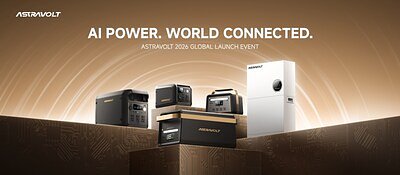
SAN JOSE, CA – February 06, 2026 – In the heart of Silicon Valley, a startup named Astravolt today announced its formal entry into the North American market with a vision as audacious as it is complex: to fundamentally rewire our relationship with electricity. The company, founded just three years ago in 2023, isn't just launching another battery pack; it's proposing an “all-scenario intelligent energy ecosystem” built on a foundation of “AI + Robotics + Digital Energy.”
At a launch event showcasing its inaugural product line, Astravolt introduced its core strategy, dubbed “Active Intelligence.” The concept aims to transform energy storage from a collection of passive, isolated devices into a single, interconnected, and predictive network. According to the company, these devices will no longer just hold a charge; they will sense usage patterns, predict future needs, and autonomously optimize energy flow in real-time.
“Energy storage has historically operated as isolated, passive hardware,” said Kenneth Jing, a Technical Expert at Astravolt, during the presentation. “Our vision is to transform these systems into intelligent, connected devices that learn usage patterns, predict demand, and optimize performance over time.”
From Power Banks to a 'Home Energy Brain'
Astravolt’s ecosystem begins at the personal level with the Nova Series of portable power stations. These are positioned not as simple batteries, but as “intelligent mobile companions.” The lineup includes the quiet, compact Nova 300 for casual use, the high-capacity Nova 3000 for RVs and off-grid living, and the flagship Nova 1200 Pro. This professional-grade model introduces semi-solid state battery technology, a chemistry that promises enhanced thermal stability and safety—a critical feature for emergency responders or field researchers who rely on dependable power in extreme conditions.
From the individual, the ecosystem expands into the home, where the company aims to create what it calls the “home energy brain.” The APOLLO series offers a plug-and-play solar storage solution designed for urban balconies, allowing apartment dwellers to generate and store their own power. This system, coupled with the HALO whole-home energy storage unit, forms a household microgrid. Astravolt claims its AI will automatically manage this grid, charging from solar or the grid when electricity is cheapest and providing seamless, millisecond-level backup power during an outage. The goal is to transform homes from passive consumers into active energy managers, delivering not just cost savings but a new level of energy independence.
The Urban Power Grid, Reimagined
The company’s ambition scales dramatically at the community and urban level. Astravolt envisions a future where its network of distributed home and personal batteries can be aggregated into “virtual power plants” (VPPs). These VPPs could enable neighborhood energy sharing or be dispatched by utility operators to help balance the city-wide grid, turning thousands of individual batteries into a shared community asset.
Perhaps the most futuristic element of this vision is the HELIOS mobile storage and charging robot. This autonomous, high-power charging station is designed to completely upend the current EV charging model. Instead of drivers hunting for an available plug, the HELIOS robot would be summoned to a parked vehicle, effectively delivering a fast charge to the user’s doorstep. For cities, these robots could be flexibly deployed in parking garages, at event venues, or in dense urban cores without the need for costly and disruptive construction of fixed charging infrastructure. During periods of peak demand, a fleet of HELIOS robots could even act as a mobile grid-balancing resource.
An Ambitious Vision Meets Market Reality
Astravolt is entering a fiercely competitive landscape. The portable power market is dominated by established brands like EcoFlow and Jackery, while the residential energy sector is a battleground for giants like Tesla, Enphase, and Generac. To succeed, Astravolt is betting on its integrated ecosystem and advanced technology as key differentiators.
The concept of using AI to manage energy is a powerful and growing trend. Utilities and tech firms are increasingly leveraging predictive algorithms to manage grid loads and integrate renewable sources. Likewise, semi-solid state batteries represent a tangible next step in battery evolution, with several manufacturers racing to commercialize the technology for its safety and energy density benefits. Astravolt’s strategy appears to be to integrate these emerging technologies into a single, seamless user experience that spans every aspect of a consumer's life.
However, the company’s grand vision is currently long on promise and short on independent validation. While the underlying technological concepts are sound, the specific performance of Astravolt's proprietary AI and the real-world safety benefits of its semi-solid state battery have yet to be tested by third parties. The company's success will depend on its ability to execute on this complex technological roadmap and prove its systems are more than just a clever concept.
The Hurdles of a Connected Future
The greatest challenge facing Astravolt may not be its competitors, but the sheer complexity of the North American energy market itself. The vision of a unified energy ecosystem runs directly into a wall of fragmented regulations, aging infrastructure, and entrenched interests.
Creating virtual power plants that can interact with the grid requires navigating a labyrinth of rules set by federal bodies like FERC and dozens of state-level utility commissions. Standards for how distributed resources like home batteries connect to the grid, and how their owners are compensated, are inconsistent and constantly evolving. Furthermore, a unified cloud platform managing energy from a person’s phone to a city’s infrastructure raises significant data privacy and cybersecurity questions that will require robust solutions and regulatory approval.
Technically, the North American grid itself will need significant modernization to support the kind of dynamic, two-way energy flow Astravolt’s system is designed for. The company’s plan to build the “connective infrastructure for distributed energy,” as Kenneth Jing stated, is a monumental undertaking that hinges on the cooperation of utilities, regulators, and consumers alike. Whether this young company can successfully navigate these hurdles and turn its ambitious blueprint into a functioning reality will be the ultimate test of its vision.