
- 5-day production: Artlist created a Super Bowl ad in just 5 days, challenging the industry's traditional multi-month timelines.
- $8M+ media buy: A 30-second Super Bowl ad slot costs upwards of $8 million, with production often adding millions more.
- AI tools used: Artlist leveraged proprietary tools like Nano Banana Pro, Seedance 1.5, and Kling 2.6 for rapid, high-quality video generation.
Experts view Artlist's 5-day AI Super Bowl ad as a disruptive force in advertising, demonstrating the potential of AI to democratize high-stakes video production while sparking debate over the role of human creativity in an AI-driven future.
Artlist's 5-Day AI Super Bowl Ad Shakes Up the Advertising Industry
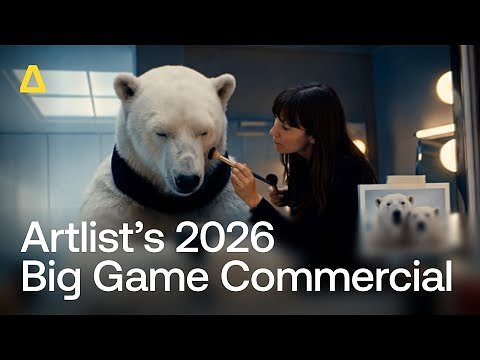
TEL AVIV, Israel – February 04, 2026 – In a move that sent ripples through the advertising and creative industries, AI video creation platform Artlist debuted a Big Game commercial that was conceived, produced, and executed in-house in under five days. The campaign serves as a bold, real-time demonstration of the company's AI capabilities, challenging the very foundation of high-stakes advertising production, which traditionally involves months of planning and multi-million dollar budgets.
The 30-second spot, which aired during the highly anticipated 2026 broadcast, acts as both a product showcase and a meta-commentary on the ad world itself. It playfully parodies other major commercials already in rotation from brands like Fanatics, Bud Light, and Pepsi, presenting a "behind-the-scenes" perspective on their creation. By doing so, Artlist not only highlights its technology but also implicitly questions the necessity of protracted and costly production cycles.
"We didn't just want to make an ad; we wanted to prove the speed of execution and show that high-end video production is possible with Artlist," said Shahar Aizenberg, CMO at Artlist, in a press release. "The future of video creation is here, it is fast, and it is accessible to everyone."
A New Playbook for High-Stakes Ads
The contrast between Artlist's approach and the industry standard is stark. Big Game commercials are legendary for their seven-figure production budgets and timelines that stretch across months, involving large crews, extensive location shoots, and complex post-production workflows. The media buy alone for a 30-second slot can cost upwards of $8 million, with production often adding millions more.
Artlist's five-day sprint from concept to completion represents a potential paradigm shift. By leveraging its own platform, the company claims to have achieved broadcast-quality results "far quicker and cheaper" than conventional methods. The campaign's core message is that speed is the new standard, AI can deliver production-quality output, and creativity is no longer gated by access to Hollywood-level resources. This move positions the company's technology as a disruptive force, capable of democratizing an exclusive corner of the marketing world.
The ad's content—parodying its contemporaries—is a strategic choice, designed to spark conversation and showcase the AI's ability to rapidly iterate on existing, high-profile concepts. This reactive capability suggests a future where brands can respond to cultural moments and competitor campaigns with unprecedented agility, turning advertising from a long-planned monologue into a fast-paced dialogue.
The Technology Behind the Speed
The rapid production was made possible by Artlist's integrated suite of proprietary AI tools. According to reports, the creative team utilized a combination of advanced models to bring their vision to life. This included "Nano Banana Pro for image generation and visualization," alongside "Seedance 1.5, and Kling 2.6 for motion and video scenes." These specific tools were reportedly chosen for their capacity to generate a cinematic aesthetic with high fidelity, character consistency, and fluid motion that could adhere to the precise style guides required for a national commercial.
Beyond generative video, the Artlist platform functions as an all-in-one creative ecosystem. The company has expanded significantly from its origins as a music licensing service. Its platform now includes an AI voiceover tool offering dozens of voices across multiple languages, AI-powered editing assistants for software like Premiere Pro, and vast libraries of high-quality stock footage, music, and sound effects. This integration allows a small in-house team to manage the entire workflow, from asset sourcing and scene generation to final editing and sound design, without relying on a sprawling network of external vendors.
This vertical integration of creative assets and AI generation tools is central to Artlist's value proposition. It competes not only with standalone AI video generators like RunwayML and Synthesys but also with established creative software giants like Adobe, whose Sensei AI is deeply embedded in its Creative Cloud suite. By showcasing a high-profile, end-to-end project, Artlist is making a powerful statement about the maturity and readiness of its comprehensive platform.
A Divided Response: Democratization vs. Disruption
While the technological feat is impressive, the campaign enters a cultural landscape deeply ambivalent about the role of AI in creative fields. The promise of democratizing high-end video production for independent creators and small businesses is a compelling narrative. However, it is met with significant apprehension from professional artists and creatives who see the technology as a disruptive, and potentially existential, threat.
Online forums and social media discussions reveal a polarized reaction. Some users have expressed frustration with Artlist's pivot towards AI, with one creative professional stating their intent to cancel their subscription over the company's promotion of "AI usage instead of real artists' work." Others have been critical of the quality of current AI tools, with one anonymous user describing them as "so so bad" and unable to follow complex prompts, suggesting a gap between marketing claims and user experience.
This sentiment is part of a broader backlash against AI in advertising. A discussion surrounding previous AI-generated campaigns for global brands highlighted a perception that they often lack the "quality, emotion, and storytelling" of human-led work. One artist in an online forum described the trend as "disrespectful," feeling that it devalues the craft and skill of human creators. The 2026 Super Bowl ad season was already being described by some critics as "underwhelming," creating a complex environment for Artlist's AI-generated spot to land in—one where traditional methods are faltering, but the proposed alternative is viewed with deep suspicion by many.
The Human Element in an AI-Generated World
Artlist's campaign ultimately forces a crucial question: What is the role of human creativity in an age of powerful generative AI? The company itself acknowledges this tension, stating that while AI provided the power, "human creativity made it unforgettable." This suggests a collaborative future where AI acts as a powerful tool wielded by a skilled creative director, rather than a full replacement for human ingenuity. The ability to generate visuals rapidly is one thing, but the core idea, the strategic insight, and the emotional hook still originate from a human mind.
The industry may be on the cusp of a significant labor shift. Repetitive and time-consuming production tasks could become largely automated, freeing up human talent to focus on strategy, concept development, and creative oversight. This could lead to the rise of new roles, such as the "AI prompt engineer" or the "creative technologist," who specialize in translating human vision into machine-executable commands.
However, the concerns over job displacement for editors, animators, and producers are real and growing. The debate is no longer theoretical; it is playing out in real-time with campaigns like Artlist's Big Game spot. The balance between leveraging AI for efficiency and preserving the nuanced, often unpredictable, spark of human artistry will be the central challenge for the creative industry in the years to come. As the technology continues to evolve at a breakneck pace, the entire ecosystem—from global agencies to freelance artists—is being forced to adapt and redefine its value in a world where a Super Bowl ad can be created in less than a week.