
- Denmark's data center market projected to reach $2.9 billion by 2030 (CAGR of 11.44%)
- Nordic data center construction market forecasted to hit $7.83 billion by 2030
- Arelion upgrades include enhanced subsea cable landing station and boosted network capacity in Denmark
Experts would likely conclude that Arelion's strategic investments in Danish network infrastructure are critical for supporting the Nordic region's rapid growth in AI-driven data center demand, positioning the area as a premier digital hub with sustainable advantages.
Arelion Fortifies Nordic AI Superhighway with Danish Network Upgrades
STOCKHOLM, Sweden – April 20, 2026 – Global internet carrier Arelion has announced a series of significant investments in its Danish network infrastructure, a strategic move designed to accommodate the exponential growth of Artificial Intelligence workloads and the rapid expansion of data centers across the Nordic region. The upgrades, which include enhancing a key subsea cable landing station and boosting network capacity, solidify Denmark’s pivotal role as a digital crossroads for Northern Europe.
Denmark's Rise as a Premier Digital Hub
The Nordic region is rapidly becoming a global magnet for digital infrastructure investment, and Denmark is at its heart. While traditional European data center hubs like Frankfurt, London, Amsterdam, and Dublin (FLAP-D) face growing constraints from grid limitations and regulatory hurdles, the Nordics offer a compelling alternative. This is driven by a unique combination of abundant, low-cost renewable energy, a naturally cool climate ideal for cost-effective data center cooling, and strong political stability.
Denmark, in particular, leverages these advantages with a national data center market projected to skyrocket to $2.9 billion by 2030, growing at a compound annual growth rate (CAGR) of 11.44 percent. The country's ambitious green energy policies and high proportion of wind power make it a prime destination for hyperscalers and enterprises with stringent sustainability goals. This environment has attracted massive investments, including Apple's large, clean-energy-powered data center in Foulum and new developments like the atNorth DEN01 campus near Copenhagen, which will feature advanced heat-reuse systems.
This boom is fueled by the insatiable appetite of AI for data and processing power. The Nordic data center construction market is forecast to hit $7.83 billion by 2030, with AI-ready facilities expected to constitute the vast majority of new capacity. Arelion's infrastructure enhancements are a direct response to this trend, providing the critical connectivity these power-hungry, data-intensive facilities require to function.
Building the Backbone of the AI Revolution
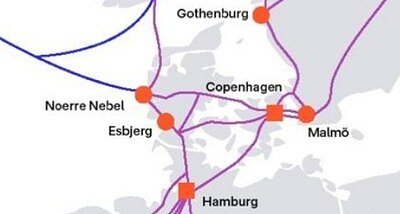
Arelion's investment focuses on several key areas to create a more robust, scalable, and resilient network. At the forefront is the upgrade of its cable landing station in Nørre Nebel on the west coast of Jutland. The site is now fully prepared to support additional subsea cable landings, with pre-installed front haul, back haul, and subsea horizontal directional drillings (HDDs). These underground conduits are essential for landing multiple, diverse fiber optic cables with minimal environmental impact, future-proofing the site for long-term growth as a major international data gateway.
From this landing point, the company is enhancing capacity across its entire Danish network. It is leveraging a unique subsea cable system that creates a northern route from Aarhus to Copenhagen, providing a direct, high-capacity link. Simultaneously, a southern route offers critical redundancy, passing through Esbjerg to Kolding and then on to Copenhagen. Kolding is being established as a key junction, providing resilient routes south to Germany and east towards the capital.
These terrestrial and subsea enhancements directly connect new data center developments to what Arelion terms its "Nordic AI superhighway." The recently completed connection to the atNorth DEN01 Copenhagen data center is a prime example of this strategy in action. Complementing these Danish upgrades, new optical systems have been deployed between Amsterdam and Kolding. This addition enables more efficient traffic routing and provides a crucial diversity bypass option for Hamburg, a traditionally congested network point, thereby improving latency and reliability for customers.
The Strategic Play for AI Dominance
This series of investments is a calculated strategic maneuver by Arelion to solidify its position as a leading connectivity provider in one of the world's fastest-growing tech regions. As global tech giants like Microsoft, Google, and OpenAI pour billions into Nordic AI infrastructure, the demand for underlying network services that can offer high capacity, low latency, and guaranteed performance has never been greater. By proactively building out this capacity, Arelion is positioning itself as the carrier of choice for enterprises and wholesale customers deploying next-generation AI applications.
"These upgrades to our Danish network reflect our broader commitment to strengthening digital infrastructure across the Nordics, helping us support enterprise and wholesale customers with low-latency, fully diverse connectivity and predictable performance as they deploy AI applications," said Johan Ottosson, VP Strategy & Product Management at Arelion. "Our continued investment ensures the capacity needed to keep pace with accelerating demand for AI-driven services, providing a scalable and secure foundation for both training workloads and latency-sensitive inference use cases."
The focus on both AI training—which involves moving massive datasets—and latency-sensitive inference—which requires near-instantaneous response times for real-time AI applications—shows a deep understanding of the market's evolving needs. In a competitive landscape that includes other major fiber operators like GlobalConnect, Arelion's emphasis on route diversity, bypassing bottlenecks, and directly connecting to major cloud and data center ecosystems provides a distinct value proposition.
By strengthening the foundational layer of the internet, these investments do more than just facilitate data transfer; they enable the next wave of innovation. The development of sophisticated AI models, the expansion of cloud services, and the growth of the digital economy across Northern Europe all depend on the unseen, yet indispensable, subsea and terrestrial networks being fortified today.