
- 75% of organizations struggle with data quality and availability (Forrester, Deloitte reports)
- Arango Contextual Data Platform 4.0 to be unveiled at NVIDIA GTC 2026 on March 17
- NVIDIA VSS blueprint uses ArangoDB for video intelligence applications
Experts agree that bridging the 'business context gap' with unified data platforms is critical for AI's success in enterprise environments.
Arango Tackles AI’s Context Gap with New Platform at NVIDIA GTC 2026
SAN FRANCISCO, CA – March 10, 2026 – As enterprises rush to deploy intelligent AI agents, a critical but often overlooked barrier is emerging: the "business context gap." This chasm between powerful AI models and fragmented enterprise data is where many ambitious AI projects falter. Arango, a specialist in multimodel data platforms, is set to address this challenge head-on at the upcoming NVIDIA GTC 2026 conference, where it will unveil its next-generation solution, the Arango Contextual Data Platform 4.0.
The company will demonstrate how a unified contextual data layer can empower AI agents to reason, decide, and act reliably across complex business environments, moving them from promising experiments to production-ready assets.
The 'Business Context Gap': AI's Hidden Hurdle
The race to integrate AI has revealed a fundamental weakness in many corporate data infrastructures. While large language models (LLMs) and AI agents possess remarkable capabilities, their effectiveness is severely hampered when they cannot understand the intricate web of relationships, hierarchies, and historical states within an organization's data. This "business context gap" is a primary reason AI systems can produce inaccurate or nonsensical outputs, often referred to as "hallucinations," eroding trust and hindering widespread adoption.
Industry analysts have increasingly highlighted this issue. Recent reports from firms like Forrester and Deloitte point to an "execution gap" where, despite access to advanced AI tools, organizations are operationally unprepared for deployment due to lagging data infrastructure. Studies show a majority of organizations struggle with data quality and availability, often relying on brittle, fragmented architectures. These systems, frequently composed of separate databases for graph, document, and vector data, create a complex "Frankenstack" that is difficult to maintain, introduces latency, and fails to provide a holistic view for AI agents.
As the initial hype around generative AI subsides, pressure is mounting for tangible business results, exposing the limitations of these siloed data approaches. The consensus is clear: for AI to become a truly transformative force, it needs a foundational data layer that provides unified, trustworthy context.
Arango's Answer: A Unified Contextual Data Layer
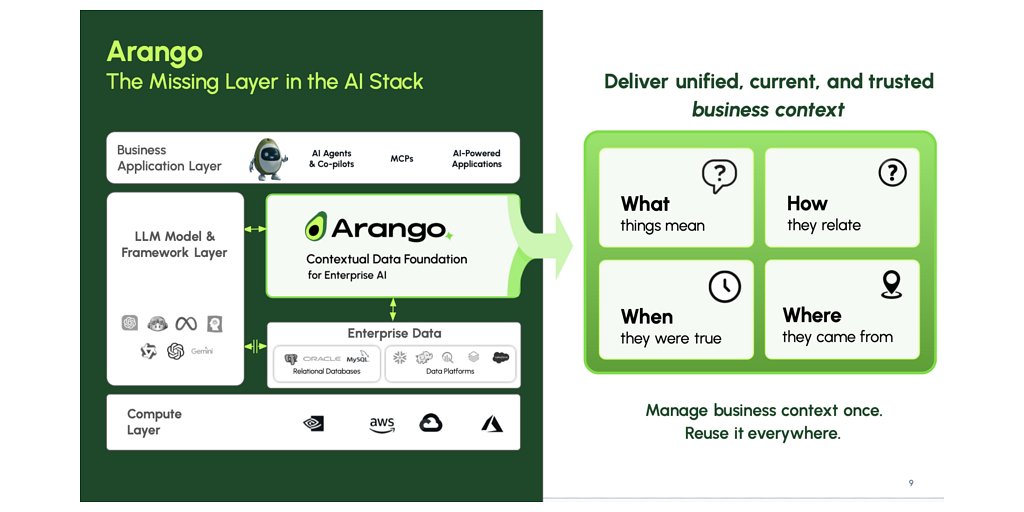
Arango proposes a solution with its Contextual Data Platform, a unified, natively multimodel system designed to bridge this gap. The platform's core innovation is its ability to manage graph, vector, document, key-value, and search functionalities within a single, integrated engine. This eliminates the need for organizations to stitch together multiple disparate databases and pipelines, simplifying the AI data stack and reducing operational overhead.
By providing this unified layer, the platform enables AI systems to understand not just individual data points, but what they mean, how they relate, and where they came from. The upcoming Arango Contextual Data Platform 4.0, set for unveiling on March 17 at GTC, is expected to advance these capabilities significantly. Pre-announcements suggest a focus on features critical for modern AI, including:
- Context-Aware GraphRAG: An advanced form of Retrieval-Augmented Generation that leverages the interconnected nature of graph data to provide more accurate, explainable, and contextually rich answers from LLMs.
- Multimodal Ingestion: The ability to handle diverse data types—from text and logs to images and video—creating a comprehensive knowledge base for AI agents.
- Natural Language Querying: A feature allowing users to interact with complex data using plain language, which the platform translates into optimized queries.
"Enterprises are deploying AI agents that must reason, decide, and act across complex business environments – but without the right business context across enterprise data, they cannot succeed,” said Shekhar Iyer, CEO of Arango. “At NVIDIA GTC, we’re excited to meet with AI leaders and builders and demonstrate how a contextual data layer helps make AI systems reliable and production-ready.”
Context in Action: From Chip Design to Video Intelligence
The practical applications of such a contextual layer are vast and are already being realized by Arango's customers. NVIDIA itself utilizes the platform within its Video Search & Summarization (VSS) blueprint. In this solution, ArangoDB stores knowledge graphs generated from video streams, allowing AI agents to perform complex, multi-hop reasoning across camera feeds to deliver explainable insights for industries like retail and manufacturing.
Another key partner, GenAI startup Articul8, leverages the platform to serve regulated industries like finance and healthcare. By unifying graph, document, and vector data on a single governed platform, Articul8 can build explainable AI applications that meet strict compliance requirements, reducing complexity and accelerating time to value. Similarly, identity security provider Linx Security uses Arango to power its Identity and Access Management (IAM) platform, unifying security data in a flexible identity graph to make fast, scalable decisions.
These examples, along with applications in cybersecurity investigations, clinical trial intelligence, and supply chain digital twins, illustrate a common theme: a unified contextual data layer is essential for AI agents to perform mission-critical tasks that require deep, interconnected knowledge.
A Crowded Field and a Strategic Alliance
Arango is not alone in identifying the need for better AI data infrastructure. The market is bustling with activity as various companies vie to become the foundational data layer for the AI era. Graph database leaders like Neo4j are heavily promoting knowledge graphs for contextual AI, while document database giants like MongoDB have integrated vector search and other AI-centric features. Search-focused platforms like Elasticsearch and real-time engines like Redis are also carving out roles as critical components for RAG and agent memory.
This competitive landscape underscores the importance of the problem. Amid this activity, Arango's strategic alignment with NVIDIA through its membership in the NVIDIA Inception Program provides a significant advantage. This program offers startups access to NVIDIA's cutting-edge GPU technology, technical expertise, and marketing support, fostering deep integration within the accelerated computing ecosystem. The collaboration on the NVIDIA VSS blueprint is a direct result of this partnership, showcasing how Arango's data platform can be optimized for GPU-accelerated workloads.
At GTC 2026, visitors to Booth 3421 will see these integrations firsthand. Demonstrations will include an Integrated Circuit Design Knowledge Graph for tracing chip designs and an infrastructure security solution for root cause analysis, all powered by the contextual data platform. With the full unveiling of Platform 4.0 scheduled for mid-conference, the event promises to be a pivotal moment for the company as it makes its case for providing the essential data context that will power the next wave of enterprise AI.
Topics & Related
AI & Machine Learning
Software & SaaS
Generative AI
Large Language Models
Revenue
Related Company Pulse