
- 4X Faster AI Training: Apera Forge now completes asset training in as little as six hours, a significant reduction from previous timelines.
- 99.9% Reliability: The system achieves greater than 99.9% reliability in object recognition before physical deployment.
- 0.3-Second Vision Cycle Time: Apera AI's 4D Vision technology delivers vision cycle times as fast as 0.3 seconds in real-world conditions.
Experts in industrial automation likely conclude that Apera AI's advancements in faster AI training, enhanced user control, and robust real-world performance are accelerating the adoption of intelligent robotics in manufacturing, addressing key industry pain points like speed, reliability, and ease of deployment.
Apera AI Slashes Robot Deployment Time with 4X Faster AI Training
VANCOUVER, BC – January 28, 2026 – Apera AI, a company on a mission to cure ‘robot blindness,’ has unveiled a significant software update that promises to drastically accelerate the adoption and optimization of intelligent robots in manufacturing. The release of Apera Vue 9.52 and a major upgrade to its Apera Forge AI training platform aims to make complex, vision-guided robotic deployments faster, more predictable, and significantly more powerful for engineers on the factory floor.
The announcement comes as manufacturers face mounting pressure to automate in the face of labor shortages and global competition. While industrial robots are increasingly common, their effectiveness often hinges on their ability to see and interpret complex, unstructured environments—a long-standing challenge that Apera AI's 4D Vision technology seeks to solve.
"In 2026, 4D Vision-guided robotics has become the fastest path to higher uptime and global competitiveness for major manufacturers," said Sina Afrooze, CEO and Founder at Apera AI, in a statement accompanying the release. "With our latest release, we continue to bridge the gap between advanced AI and the factory floor. Physical AI is helping our customers transform problematic robotic stations and build new lines into high-speed, autonomous assets that drive millions in savings, unlocking line performance."
The Speed Revolution in Robotic Deployment
The centerpiece of the announcement is a dramatic increase in the speed of Apera Forge, the company's no-code simulation and AI training studio. Apera AI claims that asset training is now up to four times faster, capable of completing in as little as six hours. This represents a significant reduction in the simulation-to-deployment pipeline, a critical metric for manufacturers looking to minimize downtime and rapidly adapt production lines.
Traditionally, training a robot’s vision system for a new part or application could be a lengthy process of trial and error. Apera Forge circumvents this by training an AI neural network with synthetic, digitally-rendered parts through millions of simulated cycles. This process allows the system to achieve greater than 99.9% reliability in object recognition before it is ever deployed on the physical factory floor. By compressing this training period from days into a matter of hours, the company is directly addressing a key industry pain point: the need for faster return on investment in automation technology.
Industry analysts note that for AI-based robotics to gain widespread adoption, technology providers must demonstrate clear and rapid ROI. The ability to quickly build, validate, and de-risk a vision-guided application in simulation and then deploy it with high confidence in under 24 hours could be a powerful incentive for manufacturers who have been hesitant to adopt more complex automation.
Smarter Robots, Simpler Control
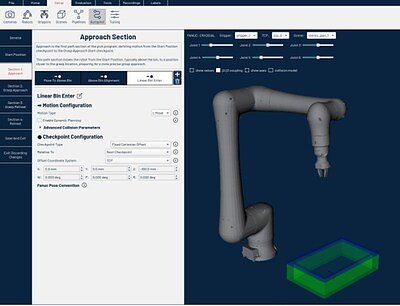
Alongside the training speed boost, the new Apera Vue 9.52 software introduces a suite of features designed to give engineers more granular control and deeper diagnostic insights. Chief among these is the new "Programmable Autopilot," an enhancement to the platform's robot guidance tool.
While the previous Autopilot optimized for the lowest possible cycle time, the new programmable version allows users to customize a robot's pathing to meet specific safety and complexity requirements. Engineers can now define multi-step, collision-free paths by selecting different movement types (such as joint or linear moves) for each segment of the robot's motion. They can also add multiple waypoints to fine-tune the approach and retreat from a part, ensuring the robot can clear bin walls and avoid other obstacles with greater predictability.
This move towards enhanced user control may address earlier feedback from some system integrators who desired more in-house flexibility to modify robot programs without relying on the vendor. The update also includes new diagnostic tools, such as 2D and 3D visualizations for Tool Center Point (TCP) calibration and a histogram that displays a robot's mechanical errors. These features are designed to speed up installation and simplify troubleshooting, allowing operators to quickly validate gripper accuracy and identify when a robot requires maintenance or re-calibration.
Overcoming Real-World Manufacturing Hurdles
Apera AI has built its reputation on enabling robots to handle difficult real-world conditions that often stump traditional 3D vision systems, such as shifting bins, changing ambient light, and complex part geometries. The new release continues this focus with "Range Finding Pipelines," a feature specifically designed for challenging de-racking applications where parts are stored in large, often unstructured racks.
Used with an eye-in-hand camera mounted on the robot's arm, this feature allows the robot to autonomously find the optimal distance and position before capturing an image. This ensures high-quality data for the vision system, leading to more performant and repeatable results even when dealing with racks that may have shifted or are not perfectly uniform. This directly tackles a persistent issue in automation, where systems must adapt to environments that are not as pristine or predictable as a lab setting.
The company's approach, which it brands as "4D Vision," combines 3D imaging with the fourth dimension of AI-powered analysis to deliver vision cycle times as fast as 0.3 seconds. This speed and reliability in imperfect conditions has already been validated in demanding environments. In a previous case study with Ford, project engineers praised the system's accuracy and ease of setup, noting it was able to locate parts in a lab setting in less than two days—a testament to the platform's user-friendliness.
The Dawn of 'Physical AI' on the Factory Floor
These technical upgrades are part of a larger vision the company describes as "Physical AI"—empowering robots with human-caliber perception and intelligence to operate in the physical world. This concept aligns with the broader Industry 4.0 trend toward smarter, more autonomous factories. As the global industrial robotics market continues its robust growth, with installations doubling in the last decade, the intelligence guiding these machines becomes the key differentiator.
The ability to not only see but to understand and navigate a complex environment is what separates a simple machine from an autonomous asset. Apera AI's focus on faster training, greater user control, and robustness in real-world conditions reflects a maturing market where customers expect automation to be both powerful and accessible.
"With our latest release, our goal was making the deployment and installation process fast and simple. We're continuing to advance our state-of-the-art AI vision model training, ensuring our pose estimation is the best in the world," stated Jamie Westell, Director of Engineering at Apera AI. "Combined with our 4X faster AI training in Apera Forge, we are delivering the fastest, most reliable path to production in the industry." As manufacturers continue to integrate AI, solutions that reduce complexity and accelerate time-to-value are poised to define the next generation of industrial automation.