
- 53% adoption: Generative AI reached 53% adoption in just three years (Stanford HAI’s 2026 AI Index).
- 112 million users: Brave browser, which influenced Anuma’s privacy approach, has over 112 million monthly active users.
- 10,000 beta users: Anuma tested its platform with over 10,000 users during its beta period.
Experts would likely conclude that Anuma’s privacy-first architecture addresses critical gaps in AI data ownership and portability, offering a viable alternative to proprietary ecosystems dominated by tech giants.
Anuma Launches Private AI Layer to Unify Models, Protect User Memory
SAN FRANCISCO, CA – April 27, 2026 – As generative artificial intelligence becomes deeply embedded in daily life, a new startup named Anuma is making a bold challenge to the industry's status quo. Launching to the public today, Anuma offers a single subscription service that unites leading AI models like ChatGPT, Claude, and Gemini under one roof, but its core innovation lies in what it promises to protect: user memory.
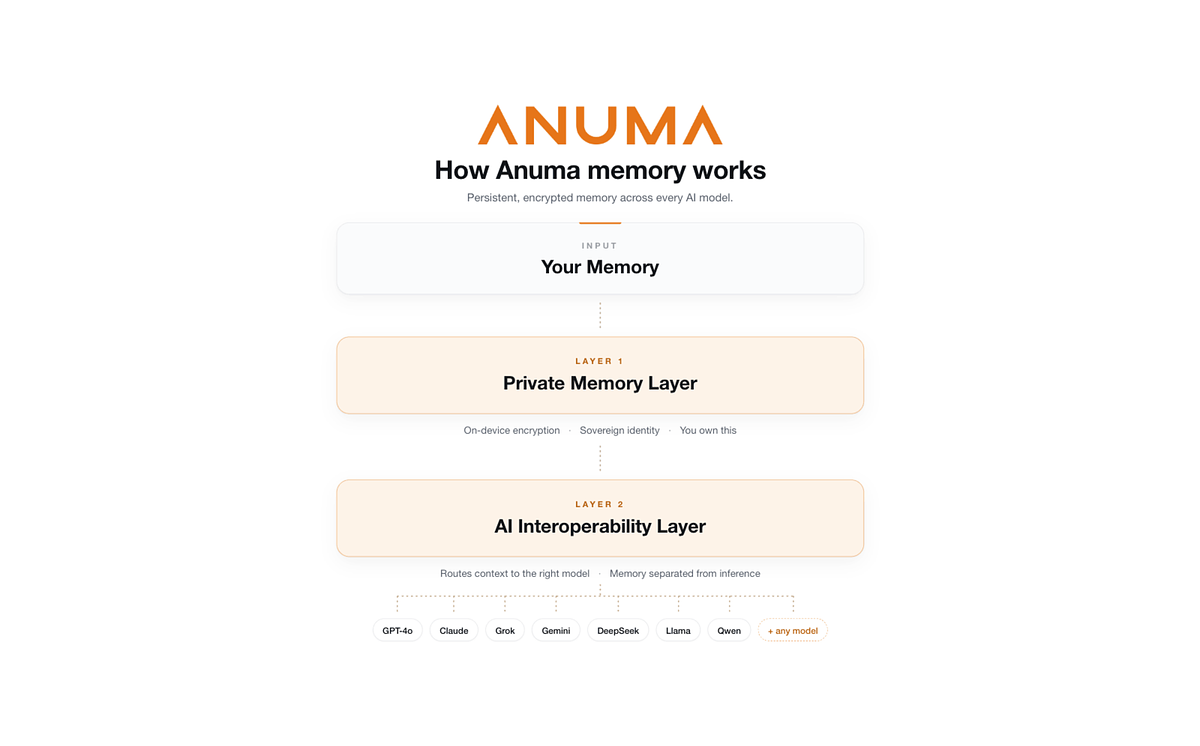
The platform introduces a persistent, encrypted memory vault that is owned by the user, stored on their device, and carries context across every integrated AI model. This architecture directly confronts the growing unease surrounding data privacy and vendor lock-in, where user conversations are often absorbed into proprietary ecosystems, used for model training, or even scrutinized in legal proceedings.
After a beta period involving over 10,000 users, Anuma is betting that users want the power of sophisticated AI without surrendering ownership of their personal and professional histories.
A New Battleground for Data Privacy
The meteoric rise of generative AI—reaching 53% adoption in just three years according to the Stanford HAI’s 2026 AI Index—has outpaced the development of trust and data portability. Users are increasingly caught in a trade-off: gain access to powerful tools but cede control over the data they provide. Recent reports have amplified these concerns, with legal experts warning that chatbot conversations can become evidence in court, and major AI labs like Anthropic and OpenAI increasingly walling off their top models within proprietary systems.
This is the environment Anuma was built to disrupt. The company’s philosophy is deeply influenced by one of its core contributors, Ankur Nandwani, who previously co-created the Basic Attention Token (BAT) that powers the privacy-centric Brave browser. That browser, which now boasts over 112 million monthly active users, proved that a significant market exists for products that prioritize user privacy by default.
Nandwani sees a direct parallel between the surveillance economy of the web and the emerging AI landscape. “Brave was created because the browser had become a surveillance tool and users had no real say in it,” Nandwani stated. “AI is heading in the same direction. A lot of people want the benefits of the best models without giving up ownership of their memory, and Anuma gives them that choice.”
How Anuma Puts Privacy First
Anuma's claim to be a “privacy-first” platform is not just a policy but an architectural commitment. Unlike competitors that may offer privacy through opt-out settings or data anonymization, Anuma is designed so that it cannot access user content. The platform’s “one memory” system operates on a local-first principle, storing all user data—including conversations, files, preferences, and project details—on the user’s device by default.
Sensitive data within this memory vault is encrypted at the field level using 256-bit AES-GCM encryption. The encryption keys are a critical piece of the puzzle; they are derived from the user's cryptographic wallet signature and exist only in the device's memory during an active session. The keys are never stored on disk or sent to Anuma’s servers, rendering the company incapable of decrypting user data even if it were compelled to or its servers were breached.
This stands in stark contrast to many AI aggregators. Platforms like Quora's Poe, for instance, note in their policies that chat content is shared with AI model providers who may use it for training. Anuma’s model ensures that by default, a user’s private history stays private. Users can opt for an encrypted cloud backup, but only indecipherable data blobs are stored, with the keys remaining solely in the user's possession. This gives users granular control, allowing them to review, edit, export, or completely delete their memory vault at any time.
Unifying the Fractured AI Landscape
Beyond its privacy safeguards, Anuma’s primary draw for many users will be the sheer convenience it offers. The current AI ecosystem is fragmented, forcing users to juggle multiple subscriptions and start from scratch every time they switch between tools optimized for different tasks—such as Claude for creative writing, DeepSeek for coding, or Gemini for multimodal analysis.
Anuma solves this by allowing users to switch between models mid-conversation with a single click, carrying the entire conversational context with them. This seamless transition eliminates the tedious process of re-explaining projects or providing background information. The platform also features a “Council Mode,” which sends a single prompt to several models simultaneously, allowing users to compare answers side-by-side or receive a synthesized response.
The service is accessible on the web and through SMS and iMessage, with native iOS and Android apps coming soon. Pricing is structured to undercut the cost of maintaining separate subscriptions, with a free tier offering 100 credits per month and paid plans starting at $9.99.
“Today’s AI products want to trap your context inside their own ecosystem,” said Nandwani in the company’s announcement. “We built Anuma so your memory stays yours, no matter which model you use.” The platform's success will ultimately serve as a referendum on this vision, testing whether the demand for data ownership can carve out a significant space in an industry dominated by tech giants.