
- Conversion rates up to 2x the industry average (typically 2-4%) with Swap's AI agents
- 3x longer time on site compared to standard e-commerce journeys
- Up to 20% reduction in returns for apparel brands using virtual try-on
Experts agree that Swap's AI-powered agentic storefronts represent a significant shift in e-commerce, offering brands higher conversion rates, better data control, and a more personalized shopping experience—challenging the dominance of large tech platforms in online retail.
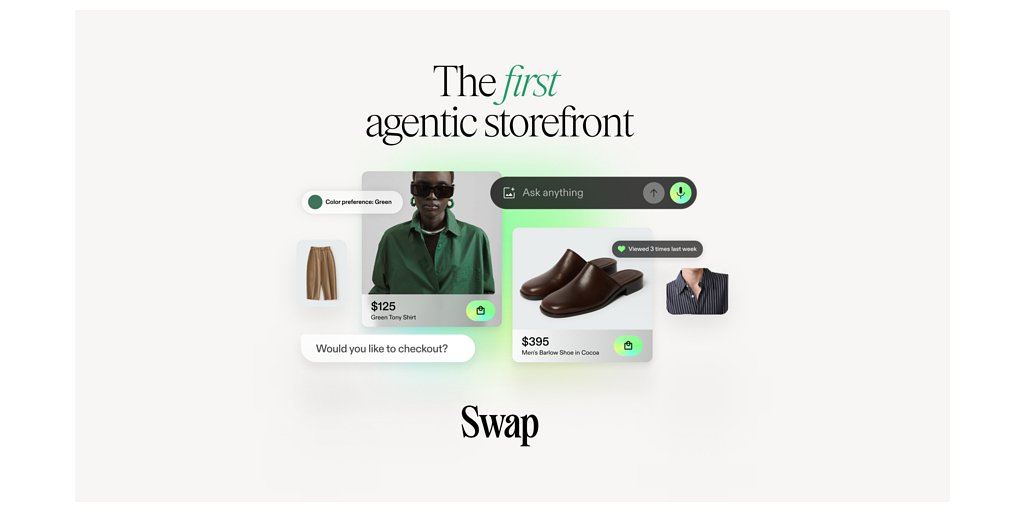
Swap's AI Agents Double Sales, Offer Brands an Escape from Big Tech
NEW YORK, NY – May 12, 2026 – A new front has opened in the battle for the future of online retail, pitting brands directly against the large technology platforms that seek to mediate the shopping experience. Startup Swap has launched the first “agentic storefront,” an AI-powered sales channel that operates on a dedicated site, separate from a brand’s main dot-com, and is already delivering conversion rates up to twice the industry average.
Leading brands including SIMKHAI, Retrofête, and Studio Nicholson have partnered with Swap to deploy this new technology, which guides shoppers through a fully branded, interactive journey from discovery to virtual try-on and checkout. The launch represents a significant counter-move to the prevailing trend of Large Language Models (LLMs) building their own commerce experiences, which often prioritizes user engagement on the LLM platform over direct sales and data ownership for the merchant.
“We believe Swap Storefront is the next evolution of commerce, and the results prove it,” said Sam Atkinson, Co-Founder and CEO of Swap, in a statement. The company's model promises to give brands the power of advanced AI without forcing them to sacrifice control over their customer relationships, a critical pain point in the digital age.
Beyond the Static Page: The 'Agentic' Shopping Experience
For decades, e-commerce has been defined by static product grids and passive browsing. Swap’s agentic storefront aims to demolish that paradigm. Instead of clicking through categories, customers are greeted by a dynamic AI agent trained specifically on the brand's products and ethos. This agent acts as a personal stylist, engaging customers in a natural conversation to understand their needs, preferences, and intent.
This technology goes far beyond a simple chatbot. It leverages what is known as “agentic AI”—systems designed not just to respond to queries, but to proactively take action to achieve a goal. In this context, the goal is to create a seamless and successful shopping journey. The AI can recommend products, curate outfits, and, crucially, facilitate a live virtual try-on, allowing a shopper to see how a garment fits on their own body in real time, all within a single, uninterrupted flow.
“Our new agentic experience powered by Swap will bring the warmth of a personal styling conversation from our stores into the digital space,” noted Jonathan Simkhai, Founder and Creative Director at SIMKHAI. This sentiment captures the core ambition: to replicate the high-touch, personalized service of an in-store expert at digital scale.
The Data Sovereignty Battle: A Merchant-First AI Model
The most disruptive aspect of Swap’s model may not be the user-facing technology, but the foundational principle of data ownership. As AI becomes more integrated into daily life, consumer-facing LLMs have begun to incorporate shopping features, creating a new layer between brands and their customers. This model often requires brands to cede control of the customer interaction, the resulting data, and ultimately, a portion of the revenue.
Swap introduces a different framework. By hosting the agentic storefront on a dedicated .ai destination owned by the brand, it ensures that every customer interaction, preference, and purchase signal remains the exclusive property of the merchant. This directly addresses growing industry concerns over data sovereignty and the power of third-party platforms.
“Consumers are using LLMs more every day and increasingly want that same interactive, guided experience when they shop,” Atkinson explained. “Swap Storefront puts that power directly in the hands of brands, helping them meet that demand while strengthening direct customer relationships.” This merchant-first approach is designed to prevent the dilution of brand identity and ensure that the AI serves the brand, not an intermediary platform.
Driving Dollars: Quantifying the Impact of AI Commerce
While the technology is innovative, the business results are what have captured the industry's attention. Swap reports that its agentic storefronts are delivering conversion rates up to twice the industry average, a staggering figure in a sector where typical e-commerce conversion rates hover between 2% and 4%. A doubling of this rate places participating brands in an elite performance category.
Further metrics bolster the case. Time on site is reportedly three times longer than on standard e-commerce journeys, indicating a much deeper level of customer engagement. Perhaps most impactful for apparel brands is a reduction in returns by up to 20%. This metric is particularly significant given that e-commerce return rates, especially in fashion, can reach as high as 40%, severely eroding profit margins. The integration of virtual try-on technology is a key driver here, as it has been independently shown to reduce returns by giving customers greater confidence in their sizing and fit before purchase. For example, Swap partner Manors Golf reported return rates of just 6-8%, a figure they described as “unheard of in apparel.”
Another partner, Studio Nicholson, saw a 45% year-over-year revenue increase and a 77% e-commerce growth in the first quarter of 2025 after adopting Swap's platform for post-purchase operations, demonstrating the tangible financial benefits of this integrated approach.
The Brand Voice in the Age of AI
In a crowded marketplace, brand identity is paramount. A common fear with AI is that it will lead to homogenized, robotic interactions that strip away a brand's unique character. Swap’s launch partners, however, suggest the opposite can be true when the technology is implemented correctly.
The platform allows for deep customization, enabling brands to control how their AI agent looks, sounds, and sells. “Swap Storefront is the first AI we've used that amplifies that point of view rather than dilutes it,” stated Aimee Smale, Founder and Creative Director at Odd Muse. In a move that underscores this potential for personalization, Smale is personally voicing her brand’s AI agent.
This ability to infuse a brand’s personality directly into the AI is a powerful differentiator. It ensures the customer experience remains authentic and aligned with the brand's values, at a scale that would be impossible to achieve with human stylists alone. The platform's ability to integrate directly with existing commerce stacks, including Shopify, payment processors, and logistics systems, further lowers the barrier to entry, allowing brands to adopt this new channel without a costly and disruptive overhaul of their backend infrastructure. As agentic commerce gains momentum, brands are now faced with a clear choice: build their own AI-driven future or risk becoming just another product inside someone else's.