
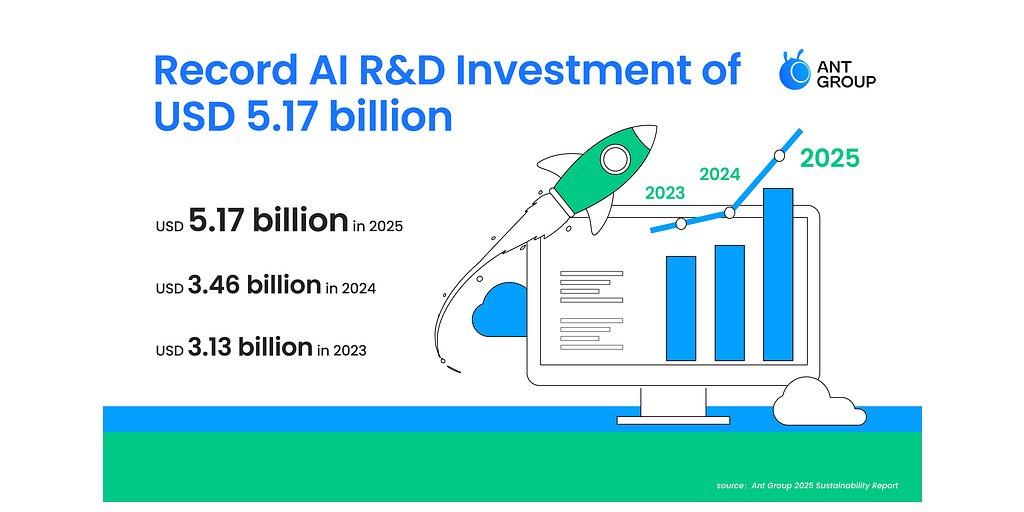
- $5.17 billion: Ant Group's record R&D investment for 2025, marking five straight years of increased spending.
- 55.32% reduction: Operational carbon emissions cut since 2020, with five consecutive years of operational carbon neutrality.
- 100 million users: Ant's AI-native health app, AQ, connecting patients with 5,000+ medical institutions.
Experts would likely conclude that Ant Group's ambitious AI and sustainability initiatives represent both technological progress and a strategic realignment to navigate regulatory pressures, though they raise significant concerns about power concentration and ethical oversight.
Ant Group's $5B AI Gambit: Progress or Unprecedented Power?
HANGZHOU, China – June 17, 2026 – Ant Group, the Chinese digital technology behemoth, has unveiled a sustainability report that reads more like a declaration of its future ambitions. The company announced a record USD 5.17 billion investment in research and development for 2025, coupled with claims of dramatic cuts in carbon emissions. The report paints a picture of a corporation harnessing artificial intelligence for the common good—from bridging healthcare gaps to building a greener planet.
Yet, beneath the polished narrative of shared prosperity lies a more complex reality. For a company that has spent the last several years navigating intense regulatory headwinds, this massive push into the core fabric of daily life—health, commerce, and finance—raises profound questions about the concentration of power. As the company’s own leadership wrote in their joint address, “Does technological advancement necessarily lead to shared prosperity? The answer lies not in the technology itself, but in the people who use it.” It is a question that bears rigorous examination.
A Two-Pronged Push: AI Ambition and Green Credentials
At the heart of the announcement is the staggering R&D figure, marking the fifth straight year of increased spending. This capital is fueling a three-pronged strategy focused on foundational AI models, AI-driven services, and health solutions. Simultaneously, Ant Group is burnishing its environmental credentials, reporting a 55.32% reduction in operational carbon emissions since 2020 and its fifth consecutive year of operational carbon neutrality.
These are not just abstract numbers. The company attributes the emissions reduction to tangible technological breakthroughs, primarily its self-developed Theta AI infrastructure. By optimizing how its AI models are run, the system reportedly increased GPU utilization 2.3 times, cutting a massive 139,545 tCO2e from its data center footprint. Furthermore, the firm now powers 65% of its data centers with clean energy. This aggressive pursuit of green computing suggests a genuine effort to decouple technological growth from environmental cost—a critical challenge for the entire tech industry.
However, it's impossible to view these initiatives outside the context of Ant Group's recent history. After its blockbuster IPO was halted by Chinese regulators in 2020, the company underwent a significant restructuring. This pivot towards sustainability and “shared prosperity” can be seen as a strategic realignment, aimed at demonstrating its value to society and appeasing regulatory bodies. The commitment appears real, but it is also a politically astute move for a company of its scale and influence.
The AI Doctor and Cashier Will See You Now
Nowhere is Ant's ambition more apparent than in its direct-to-consumer applications. Its AI-native health app, AQ, has reportedly surpassed 100 million users. The platform connects patients with over 5,000 medical institutions and has deployed “AI Doctor Agents”—virtual doctors trained on the expertise of over 2,000 Chinese physicians—to provide free health guidance to nearly 7 million people.
On the surface, this is a laudable effort to address healthcare disparities in a vast country. Yet, it also places Ant Group at the center of one of the most sensitive areas of a person's life. The integrity of the AI's advice and the security of a user's health data become paramount. While the company touts its reach, critical questions about the reliability of AI-driven diagnostics and the ethical guardrails governing this data trove remain.
Even more transformative is the evolution of its flagship platform, Alipay. With the launch of its AI agent “Ah Bao,” Ant is ushering in what it calls the “agentic economy.” This isn't just a chatbot; it's a vision where AI agents, embedded in everything from apps to smart glasses, execute tasks and transactions on behalf of one billion users. To support this, the company has rolled out a full-stack AI payment infrastructure, with its “AI Pay” service already surpassing 300 million transactions.
This represents the first commercially scaled AI-native payment system in the world, a significant technical and commercial milestone. At its core is a newly developed “Agentic Commerce Trust Protocol.” While details are sparse, this protocol is meant to be the bedrock of trust for an economy run by algorithms. But it also centralizes immense transactional power and data within a single corporate ecosystem. As AI agents begin to make autonomous purchasing decisions, the potential for subtle manipulation, biased recommendations, and an opaque flow of capital is enormous. The promise of convenience must be weighed against the reality of ceding human agency to a corporate-controlled AI.
Forging the Tools of a New World Order
Ant Group is not just building applications; it is building the foundational tools that will shape the next decade of technology. In 2025, it open-sourced its Ling series of foundational models, including Ling-2.6-1T, a massive trillion-parameter model designed for complex coding and reasoning. By offering such powerful tools to the public, Ant accelerates innovation across the industry, but it also strategically positions its own architecture as a potential global standard.
This ambition extends beyond the digital realm. Robbyant, the company's embodied AI division, has open-sourced a full stack of models for building AI that can perceive and interact with the physical world. Its LingBot-World model claims industry-leading performance in understanding and predicting real-world video. This signals a clear intent to move from fintech into robotics and autonomous systems, placing Ant Group squarely in the geopolitical race for AI supremacy against American tech giants.
In her official statement, Chief Sustainability Officer Sabrina Peng wrote, “We will continue to use technology to bring small and beautiful changes to the world.” It’s a humble, reassuring sentiment. Yet, the technologies described in this report are anything but small. They are tectonic plates, shifting the very ground of commerce, healthcare, and human interaction. Ant Group is presenting a compelling vision of a technologically advanced and sustainable future, but it is a future built on its own terms and powered by its own systems. The prosperity it generates may well be shared, but the power will be anything but.