
- Top reason for moving interstate: Being closer to family (29%), surpassing a new job or company transfer (26%) for the first time. - Oregon's inbound moves: 65% of all moves handled by United Van Lines were inbound, with Eugene-Springfield metro area at 85%. - New Jersey's outbound moves: 62% of moves were outbound, but 21% of inbound movers were aged 18-34.
Experts conclude that Americans are prioritizing family proximity and quality of life over purely economic incentives, reflecting a lasting impact of the pandemic and a search for more balanced lifestyles.
America on the Move: Family and Affordability Reshape the Nation's Map
ST. LOUIS, MO – December 29, 2025 – A fundamental shift is underway in American migration, with the desire to be closer to family now outpacing a new job as the primary reason for moving interstate. This is a key finding from the 49th Annual National Movers Study released today by United Van Lines, which paints a picture of a nation re-evaluating its priorities in the face of economic headwinds and the enduring legacy of a post-pandemic world.
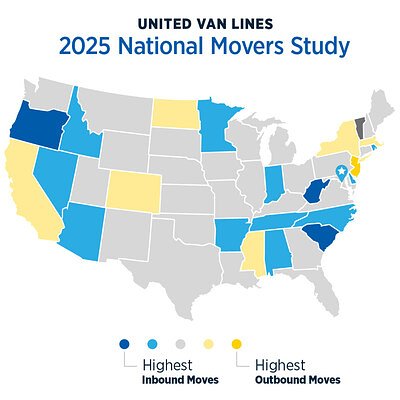
The annual report, a closely watched barometer of domestic relocation trends, reveals a complex tapestry of movement defined not just by economics, but by a growing search for a different quality of life. For the first time, Oregon has claimed the top spot for inbound moves, while New Jersey continues its long-running streak as the leading outbound state. Yet, beneath these headlines, a deeper story is unfolding: a broad migration toward smaller cities, a cooling of once-dominant southern migration magnets, and a generational divide in who is moving where, and why.
The 'Why' Behind the Move: A Shift in American Priorities
For decades, the promise of a better job or a corporate transfer was the quintessential driver of the American move. The 2025 data signals a profound change in that calculus. According to the study, the top motivation for relocating to another state was to be closer to family (29%), edging out a new job or company transfer (26%) for the first time. Retirement (14%) remains a significant factor, rounding out the top three drivers.
This reordering of priorities reflects a more intricate decision-making process, where personal fulfillment and social connection weigh heavily against purely economic incentives. It suggests that for many, the isolation experienced during the COVID-19 pandemic has had a lasting impact, reinforcing the value of proximity to loved ones and community support networks.
"For most Americans, interstate relocation is no longer a linear calculation, it's a complex decision balancing multiple competing factors," said Michael A. Stoll, an economist and professor at The University of California, Los Angeles. Stoll noted the continued movement from northern regions to the South, but highlighted the dominance of smaller metro areas. "This reflects a legacy of COVID-era preferences for lower-density living, combined with the reality that housing costs continue to drive people toward more affordable regions."
The trend underscores a search for a more balanced lifestyle. "The data reveals Americans are seeking a different pace of life, and destinations like Oregon, the Carolinas and the south are delivering it," commented Eily Cummings, Vice President of Corporate Communications at United Van Lines.
A Tale of Two States: Oregon's Boom and New Jersey's Complex Exodus
Nowhere are these shifting dynamics more apparent than in the study's top inbound and outbound states. Oregon emerged as the nation's leading destination, with 65% of all moves handled by the company being inbound. The state's appeal is particularly strong in the Eugene-Springfield metro area, which registered an 85% inbound rate. This region, nicknamed "Silicon Shire," is attracting professionals to its burgeoning tech and healthcare sectors. However, this popularity comes at a steep price. Oregon is grappling with a severe housing crisis, with home prices 24% higher than the national average and rents climbing steadily. The influx of new residents is placing immense pressure on a housing market that was already struggling, creating a significant affordability challenge that tempers the state's otherwise rosy picture.
Meanwhile, New Jersey tells a more nuanced story. For the eighth consecutive year, it leads the nation in outbound moves (62%), largely driven by retirees seeking a lower cost of living and relief from high property taxes. However, to label this a simple exodus would be a mistake. The study reveals that the Garden State is simultaneously attracting a new generation of residents, with 21% of its inbound movers aged 18-34. These younger professionals and families view the state as a "launch pad" for their careers, drawn by its proximity to major economic hubs. This demographic churn, confirmed by broader U.S. Census data showing population growth fueled by international migration, paints a picture of a state in transition rather than one in decline.
The Shifting Map: Beyond Traditional Migration Magnets
The move toward smaller cities and towns is a defining feature of the 2025 report. Beyond Eugene-Springfield, other smaller metros like Wilmington, North Carolina (83% inbound) and Dover, Delaware (79% inbound) are experiencing a surge in new residents. This decentralization marks a departure from pre-pandemic patterns that favored large, dense urban centers.
Perhaps most telling is the changing status of traditional migration powerhouses. Florida and Texas, long the undisputed champions of domestic migration, are now classified as "balanced" states, with inbound and outbound traffic nearly equal. Researchers suggest this equilibrium is a direct result of their own success; soaring housing costs and strained infrastructure are beginning to diminish their appeal. In Florida, for example, rapid population growth has overwhelmed aging utility systems and created crippling traffic congestion in major coastal cities, forcing state and local governments to confront massive investment deficits.
Other states mirroring the inbound trend include West Virginia (62%), South Carolina (61%), and Delaware, while New York (58%) and California (58%) continue to see significant net departures, driven by similar concerns over cost of living and lifestyle. In a notable reversal, Illinois, a state that has been on the top outbound list for over a decade, is now considered a balanced state, suggesting a stabilization of its population flows.
Policy and Planning in the Face of a Moving America
These demographic shifts are presenting significant challenges and opportunities for state and local governments. In Oregon, the housing crunch has become a top political priority, with the governor's office pushing to nearly double the historical rate of new housing construction to alleviate the supply crisis. Officials are aiming to add 36,000 new units annually and streamline permitting processes to accommodate the influx.
In New Jersey, a different set of policy tools is being deployed. To counteract the out-migration of retirees and the wealth they take with them, the state government has focused on property tax relief programs and new retirement savings initiatives. At the same time, zoning reforms are being explored to encourage the development of more diverse and affordable housing options to retain the younger, career-focused demographic.
As Americans continue to vote with their moving vans, the ability of state and local governments to adapt their housing, infrastructure, and economic policies will be the deciding factor in which regions thrive and which struggle in this new era of American migration.