
- Only a fraction of AI projects fully meet ROI expectations
- JPMorgan Chase's Contract Intelligence Platform (COiN) reduced legal document analysis from 360,000 hours annually to seconds
Experts agree that meaningful AI transformation requires process redesign rather than isolated task automation.
AI's ROI Problem: You're Automating Tasks, Not Transforming Work
ARLINGTON, Va. – June 23, 2026 – In boardrooms and on factory floors, the mandate is clear: adopt AI. Yet, a growing number of organizations are investing heavily in artificial intelligence only to see frustratingly incremental returns. A new blueprint from global advisory firm Info-Tech Research Group argues that the problem isn’t the technology—it’s the strategy. Companies are limiting AI’s impact by applying it to automate isolated tasks instead of fundamentally redesigning the business processes that drive value.
This finding lands at a critical moment. As the initial hype cycle for generative AI matures into a pragmatic push for ROI, leaders are demanding more than just short-term efficiency gains. The research suggests that the path to transformative value requires moving beyond simply layering AI onto legacy workflows and instead rebuilding those workflows with AI at their core.
The Micro-Productivity Trap
Info-Tech's central argument—that task-level automation yields limited results—is validated by a strong industry consensus. Research from firms like McKinsey, Gartner, and Forrester consistently shows that the most successful AI adopters are those who reimagine entire processes end-to-end. One study highlights a common “micro-productivity trap,” where optimizing individual activities with AI fails to generate organization-wide impact because the broader, often inefficient, workflow remains untouched. It’s the digital equivalent of installing a jet engine on a horse-drawn cart.
“AI will not transform organizations unless it transforms how work actually happens,” says Mahmoud Ramin, research director at Info-Tech Research Group. “Applying AI to individual tasks may create short-term efficiency, but meaningful value comes from redesigning entire workflows so intelligence is embedded where decisions are made, handoffs occur, and outcomes are shaped.”
This misalignment is a common source of failure. Another leading consultancy reports that only a fraction of AI projects fully meet ROI expectations, often because they are expected to automate complex tasks without being properly integrated into the systems and processes they are meant to improve. The message is clear: automating a broken process just helps you do the wrong thing faster. True transformation demands a deeper, more structural change.
A Playbook for Process-First AI
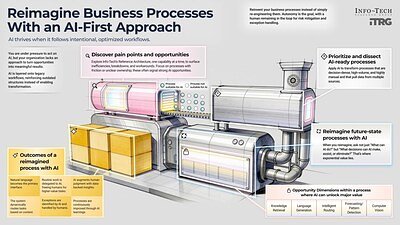
To address this gap between potential and practice, Info-Tech’s blueprint, Reimagine Business Processes With an AI-First Approach, provides a structured, three-phase methodology for leaders to follow.
Phase 1: Discover Pain Points and Opportunities. The framework begins by assembling a cross-functional team to inventory key business processes. Each process is then assessed for its AI suitability, potential value, and associated risks. This initial step ensures that efforts are focused on areas with the highest potential impact, rather than on disjointed, ad hoc experiments.
Phase 2: Prioritize and Dissect AI-Ready Processes. Once a long list of opportunities is identified, the next phase involves shortlisting the strongest candidates. Teams then map these current-state workflows to pinpoint the specific bottlenecks, decision delays, and friction points where AI can deliver the most value. This diagnostic step is crucial for understanding the root causes of inefficiency before prescribing a solution.
Phase 3: Reimagine Future-State Processes With AI. In the final phase, organizations use a set of “AI opportunity dimensions”—such as knowledge retrieval, pattern detection, or intelligent routing—to redesign the workflow from the ground up. This isn't about tweaking the existing process; it's about asking how the process would work if it were designed for AI from the start. The blueprint provides tools like a Process Reimagination Canvas to document the new, AI-enabled workflow in a clear, executive-ready format.
From Theory to Execution
The difference between task automation and process redesign becomes tangible when looking at real-world examples. Failures are often rooted in a narrow focus. Consider the wave of customer service chatbots that frustrated users by lacking context or the delivery company whose AI was hacked to swear at a customer. These tools were bolted onto existing service models without a deep rethinking of the customer journey. Similarly, Amazon’s ambitious “Just Walk Out” technology reportedly struggled with high operational costs because it still required significant human oversight to function, undermining the value of the automation itself.
In contrast, successful AI implementations demonstrate a commitment to process transformation. JPMorgan Chase didn’t just automate a single legal task; its Contract Intelligence Platform (COiN) redesigned the entire document analysis workflow, processing legal agreements in seconds—a task that previously required 360,000 hours of lawyer time annually. Likewise, Kaiser Permanente’s use of ambient listening AI to automatically document doctor-patient conversations didn’t just speed up typing; it fundamentally altered the clinical documentation process, freeing physicians to focus on patients.
These successes share a common thread: the organizations didn't just ask, “What task can we automate?” They asked, “How can we redesign this entire value chain with intelligent systems?”
The Strategic Imperative for Redesign
Adopting a process-first mindset is more than an operational tactic; it is a strategic imperative that requires significant organizational groundwork. Success depends on foundational prerequisites, including high-quality data, a modern IT infrastructure, strong change management capabilities, and unwavering leadership buy-in. Without these elements, even the best-laid plans can stall in the “proof-of-concept trap.”
Ultimately, the research from Info-Tech and its peers urges a critical shift in perspective. Leaders must move from a tool-first to a process-first approach, ensuring that technology serves strategy, not the other way around.
“Organizations often ask which AI use cases to prioritize, but the better question is which processes should change and why,” explains Ramin. “Leaders should focus on redesigning workflows before investing further in tools, so AI is applied where it can meaningfully improve decisions, reduce friction, and deliver sustained value.”