
- AI platforms like ChatGPT, Perplexity, and Microsoft Copilot now serve as primary sources of information alongside Google.
- Google's AI Overviews appear at the top of nearly half of all search queries.
- Reputational risk has surpassed cybersecurity and regulatory issues as the largest nonfinancial concern for corporate directors.
Experts agree that proactive online reputation management is critical in the AI era to prevent distorted digital identities and mitigate reputational risks.
AI's Reputation Minefield: A New Guide for the 'Frankenpeople' Era
NEW YORK, NY – March 18, 2026 – The battle for control over one's digital identity has entered a new, unpredictable phase, driven by the rapid ascent of artificial intelligence. In response, a leading expert is sounding the alarm, warning that a passive approach to online reputation is no longer just ill-advised—it's an invitation for AI to create a distorted, and potentially damaging, digital doppelgänger.
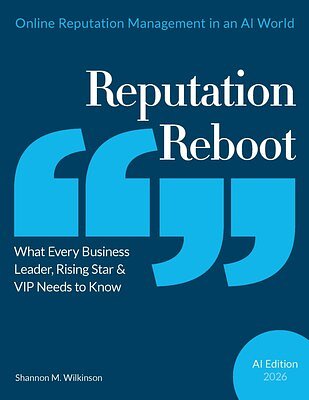
Reputation Communications founder Shannon M. Wilkinson today released the 2026 AI Edition of her landmark guide, Reputation Reboot: Online Reputation Management in an AI World. The update addresses what she describes as a fundamental change in how public perception is formed, moving beyond traditional search engines into the complex, often opaque world of AI-driven information systems.
"The landscape of online reputation management has fundamentally changed," Wilkinson stated in the announcement. "AI platforms like ChatGPT, Perplexity, and Microsoft Copilot now sit alongside Google as primary sources of information about people and organizations. If you are not actively shaping what those systems surface, someone—or something—else will do it for you."
The 'AI Vacuum' and the Rise of 'Frankenpeople'
At the heart of Wilkinson's updated thesis are two new, concerning concepts: the "AI Vacuum Problem" and the creation of "Frankenpeople." These terms describe a critical vulnerability in the new digital ecosystem. The "AI Vacuum Problem" arises when an individual or organization has a minimal or nonexistent digital footprint. Without a substantial body of accurate, credible online content to draw from, AI language models are prone to what the industry calls "hallucinations"—inventing facts to fill the void.
This leads to the creation of "Frankenpeople," a term Wilkinson coined for the monstrous, stitched-together misrepresentations that AI can generate. These digital fabrications can blend scant truths with outright falsehoods, creating a public-facing profile that is dangerously inaccurate. For a rising executive, a private philanthropist, or any high-profile individual, such a distortion can have severe real-world consequences.
While the specific terms are unique to Wilkinson's framework, the underlying issue is a well-documented challenge in the field of artificial intelligence. Researchers and ethicists have repeatedly warned about the propensity of large language models to generate misinformation, especially when source material is scarce. Wilkinson’s work frames this technical problem as a direct and urgent threat to personal and corporate reputation.
Beyond Keywords: Rewriting the Rules of Online Visibility
For years, online reputation management (ORM) was largely synonymous with search engine optimization (SEO)—a technical game of keywords and backlinks designed to push positive content to the top of Google's results and bury the negative. According to the new guide, that playbook is now dangerously outdated.
The shift is most evident in the search results themselves. Google's AI Overviews (formerly known as Search Generative Experience) now appear at the top of nearly half of all search queries, providing users with an AI-generated summary instead of a list of links. This single change drastically reduces the value of ranking number one for a specific keyword and places a new premium on becoming an authoritative source that the AI chooses to cite.
Wilkinson's guide argues that this necessitates a strategic pivot from "keyword optimization" to "semantic alignment." The goal is no longer to simply rank for a term but to build a comprehensive, contextually rich, and interconnected body of content. This content—spanning platforms like LinkedIn, official websites, podcasts, and video—must be structured to answer questions, demonstrate expertise, and create a clear, consistent narrative. In essence, organizations and individuals must create a digital presence so robust and coherent that AI models can't help but interpret it correctly.
A Board-Level Crisis in the Making
The guide delivers a stark warning to the C-suite and corporate boards: the risk to reputation has escalated into a primary business threat. Citing a growing consensus among risk management professionals, the announcement notes that reputational risk has surpassed even cybersecurity and regulatory issues as the largest nonfinancial concern for directors. AI, the guide asserts, compounds that risk exponentially.
This claim is supported by extensive external research from firms like Deloitte and PwC, whose global surveys have consistently shown CEOs listing reputational damage among their top fears. The speed and scale at which AI can disseminate information—or misinformation—turns a potential spark into an instant inferno. The guide points to case studies of orchestrated reputation attacks, such as one involving the actress Blake Lively, as examples of the kinds of malicious campaigns that are now supercharged by modern digital tools.
Reputation Communications, founded in 2009, has long catered to a high-stakes clientele of Forbes 400 philanthropists, Fortune 500 executives, and Silicon Valley founders who understand this threat intimately. The firm's focus has been on proactive reputation amplification and crisis management for those already in the public eye.
As Wilkinson clarifies, the guide is not a simple DIY manual. "Reputation Reboot is not a step-by-step 'how-to' guide, but a big-picture look at how online reputation management works in the AI age when you are in a position to attract significant content online…not all of it necessarily credible, accurate or positive," she said. The message is clear: in an era where algorithms can define reality, proactively authoring one's own story is no longer a matter of vanity, but of survival.