
- Global data center electricity use is projected to more than double by 2030, driven by AI (IEA).
- AI-powered GPU racks can demand 30 kW to over 100 kW, compared to 5-10 kW for traditional servers.
- Major grid upgrades can take 5-10 years, while hyperscale data centers can be built in under two years.
Experts agree that advanced lithium-ion battery systems are essential for stabilizing AI data centers, ensuring reliability amid volatile power demands and bridging gaps until grid upgrades are completed.
AI's Power Crisis: How Advanced Batteries Stabilize Data Centers
WASHINGTON, D.C. – April 14, 2026 – The artificial intelligence revolution, while promising unprecedented technological leaps, is creating a voracious and volatile appetite for electricity that is pushing the world's data centers—and the power grids that support them—to their limits. In response, a new generation of power infrastructure is emerging, with advanced battery technology at its core. This month, industry leaders will converge at Data Center World 2026, where companies like Ampace are set to showcase solutions designed to tame the wild power demands of AI.
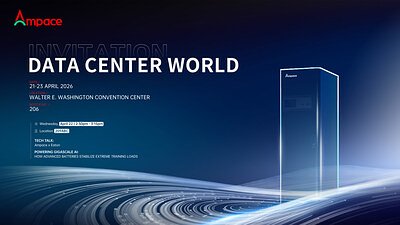
From April 21-23, Ampace will exhibit its latest AI-ready battery systems, aiming to address the critical stability challenges facing modern data centers. The company’s presence underscores a pivotal industry shift: the Uninterruptible Power Supply (UPS) is evolving from a simple backup device into a dynamic, intelligent energy buffer, essential for the continuous operation of compute-intensive AI workloads.
The Gigawatt Challenge: AI's Unprecedented Power Thirst
The scale of AI's energy consumption is staggering. According to the International Energy Agency (IEA), global data center electricity use is on track to more than double by 2030, with AI as the primary driver. This surge is creating a new class of "gigawatt-era" data centers, where a single campus can consume as much power as a small city. This demand is driven by the hardware itself; while traditional server racks operate at 5-10 kilowatts (kW), racks filled with AI-powering GPUs can demand anywhere from 30 kW to over 100 kW.
Beyond the sheer volume of power, the nature of AI workloads presents a more insidious challenge: volatility. Training large language models involves massive, rapid fluctuations in power draw. These sudden spikes and dips, occurring in milliseconds, place immense stress on power infrastructure that was largely designed for the steady, predictable loads of conventional computing. This dynamic behavior can destabilize UPS control loops and ripple outward, threatening the stability of the entire electrical grid.
This creates a significant timing mismatch. While a hyperscale data center can be built in under two years, major grid upgrades can take five to ten years. Consequently, data center operators face long and uncertain wait times for grid interconnections, forcing them to seek more resilient and self-sufficient power solutions on-site.
Beyond Backup: The Rise of Intelligent Battery Systems
To solve this, the industry is reimagining the role of energy storage within the data center. For years, lead-acid batteries have been the default for UPS systems, providing short-term power during a utility outage. However, their slow response times and significant physical footprint make them ill-suited for the new demands of AI. Advanced lithium-ion batteries are now taking center stage, offering a combination of high energy density, rapid charge and discharge capabilities, and a much longer operational lifespan.
These are not just backup systems; they are active power-conditioning tools. At Data Center World, Ampace will feature its PU-200 power infrastructure system, which is engineered specifically to absorb the sudden load spikes from AI clusters and deliver a smooth, consistent power output. By acting as a high-speed buffer between the grid and the servers, these battery systems can insulate sensitive AI hardware from power fluctuations, ensuring system reliability and preventing performance degradation.
This capability allows data centers to maintain real-time stability under the highly variable loads of AI training and inference, a critical requirement for facilities housing multi-million-dollar GPU clusters. The modularity and smaller footprint of lithium-ion solutions also enable data center operators to scale their power infrastructure in tandem with their computing needs, a key advantage in the fast-evolving AI landscape.
Strategic Alliances in the Race to Power AI
Addressing a challenge of this magnitude requires deep collaboration across the technology stack. A highlight of the upcoming conference will be a joint TECH TALK session featuring Ampace and power management giant Eaton. Titled "Powering Gigascale AI: How Advanced Batteries Stabilize Extreme Training Loads," the discussion signals a crucial partnership between battery innovators and established leaders in UPS architecture.
Eaton has long been a proponent of lithium-ion technology for critical infrastructure, and its work on grid-interactive UPS systems allows data centers to not only consume power but also contribute to grid stability. The collaboration with Ampace represents a focused effort to integrate cutting-edge battery cells directly into power systems designed to handle the most extreme AI workloads. This synergy is vital for creating a cohesive and reliable power chain, from the grid connection down to the individual server.
The broader industry is engaged in a similar race. Competitors like Vertiv, ABB, and Delta Electronics are all rolling out comprehensive solutions for AI-ready data centers, combining high-density power distribution, advanced liquid cooling, and intelligent monitoring software. This competitive and collaborative environment is accelerating innovation, leading to more efficient and resilient infrastructure capable of supporting the next wave of AI development.
As AI continues its exponential growth, the foundation it is built upon must evolve. The focus is shifting toward holistic systems that integrate power, cooling, and grid services. The next generation of data centers will rely on advanced battery systems not just for continuity, but for the moment-to-moment stability required to unlock the full potential of artificial intelligence. These innovations are becoming the essential, unseen enablers of the AI era, ensuring the lights stay on for the technology that is reshaping our world.