
- Speed: Capable of reaching speeds up to 13 km/h.
- Weight: Approximate weight of 6.6 kg (may exceed airline carry-on limits when packed).
- Battery: 73.26 Wh removable lithium battery, compliant with IATA regulations.
Experts would likely conclude that while the Airwheel AI Suitcase represents a significant technological advancement in travel convenience, its practical usability is severely limited by inconsistent global regulations and real-world safety concerns.
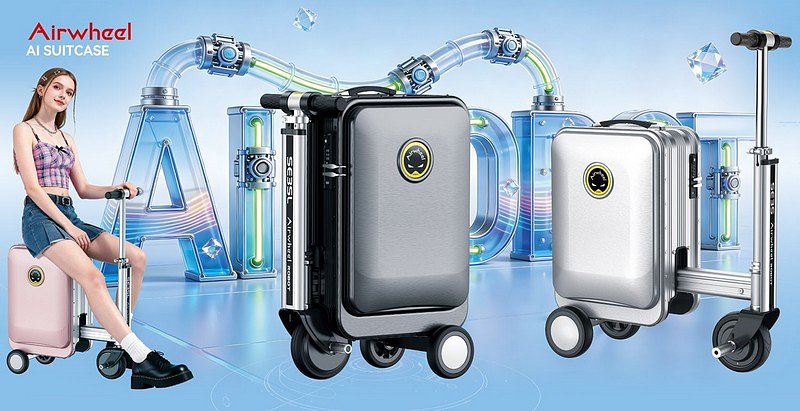
Airwheel’s AI Suitcase: The Future of Travel Hits a Regulatory Bottleneck
BRUSSELS, BELGIUM – June 18, 2026 – In the relentless quest to solve the traveler's “last three kilometers” problem—the exhausting trek through sprawling airport terminals and transit hubs—a new contender has emerged. Airwheel, a company with a deep portfolio of patents in smart mobility, has unveiled its AI Suitcase, billing it not merely as luggage, but as a “next-generation intelligent travel terminal.” The device promises to transform the drudgery of travel by integrating a personal electric vehicle, a global tracking device, and a mobile power source into a single, carry-on-sized package. It’s a compelling vision of effortless, technologically enhanced movement.
Yet, as with many innovations that promise to disrupt established norms, the AI Suitcase is rolling into a complex and uncertain landscape. While the technology itself is a feat of engineering, its practical application collides with a patchwork of airline policies, airport safety rules, and the physical realities of crowded public spaces. This is the hidden cost of progress: a brilliant solution that may be ahead of the infrastructure and regulations needed to support it.
A Glimpse into an Automated Future
On paper, the Airwheel AI Suitcase is an impressive fusion of function and design. The company, a recipient of numerous international design accolades for its previous models, has packed a formidable set of features into a standard 20-inch cabin bag. The headline feature is its rideable capability. With a single touch, a telescopic handle and ergonomic seat deploy, transforming the suitcase into a personal mobility device powered by a high-performance brushless motor. Capable of reaching speeds up to 13 km/h and supporting a load of up to 95 kg, it offers a way to glide through long corridors at a pace significantly faster than walking.
The engineering appears robust. An aerospace-grade aluminum alloy frame provides structural integrity, while a 10 km travel range per charge is ample for navigating even the largest airports. Crucially for air travel, its 73.26 Wh lithium battery is both removable and well under the 100 Wh limit stipulated by the IATA and other aviation authorities, ensuring it can be legally carried into the cabin. A discreet USB port turns the suitcase into a mobile power hub for charging phones and tablets, a welcome utility during long layovers.
Perhaps its most compelling smart feature is the native integration with Apple’s Find My network. By leveraging the global ecosystem of billions of Apple devices, travelers can track their luggage with a high degree of accuracy nearly anywhere in the world. This moves beyond the limitations of simple Bluetooth trackers, offering a genuinely powerful tool against loss or theft and positioning the AI Suitcase as a truly intelligent asset. Combined with app-based controls for speed, lighting, and security alerts, the device represents the pinnacle of the smart luggage trend.
The Hidden Costs of Convenience
For all its technological prowess, the AI Suitcase carries baggage of a different sort. The first hidden cost is its weight. The press release lists an approximate weight of 6.6 kg, which is impressively light for a motorized device. However, many international airlines impose carry-on weight limits as low as 7 kg. Once packed for a three-to-five-day trip, the AI Suitcase could easily tip the scales, forcing travelers into unexpected checked baggage fees—a frustrating penalty for an item designed to stay with you.
Further scrutiny is warranted for the “AI-powered” moniker. While the suitcase features an “intelligent speed control system” and an “intelligent power management system,” the press release offers little detail on what makes these systems artificially intelligent rather than simply well-programmed. Without evidence of machine learning or predictive capabilities, the “AI” label feels more like a marketing buzzword than a descriptor of its core technology. For the professional user, clarity trumps hype, and the tangible benefits here appear to stem from advanced automation, not true AI.
The most significant practical challenge, however, is its use in the real world. While gliding through an empty terminal is an appealing image, the reality of a bustling airport is one of dense crowds, unpredictable children, and fellow travelers rushing to their gates. Navigating such an environment on a motorized vehicle, no matter how intuitive its controls, introduces new safety risks and potential for collisions. The convenience for one traveler could easily become a hazard for many others.
A Collision with Regulatory Reality
This brings us to the most critical barrier for the AI Suitcase: the inconsistent and often restrictive web of global regulations. While Airwheel has meticulously engineered the suitcase to be compliant for carriage—with its removable, sub-100Wh battery—this does not guarantee its usability as a vehicle. Being allowed to bring a device on a plane is not the same as being allowed to ride it through the airport.
Our investigation reveals a stark divide in policy. Some airports, like Japan's Haneda, have reportedly prohibited riding such devices inside terminals due to safety concerns. More pointedly, Singapore Changi Airport has previously banned certain small lithium battery-powered personal transportation devices from being brought on board at all, specifically naming the “Airwheel” brand in its advisories. While the AI Suitcase’s removable battery may navigate this specific rule, the underlying caution from airport authorities is clear.
This regulatory patchwork places the buyer in a precarious position. A business traveler might invest in the AI Suitcase for its promise of efficient mobility, only to find its primary feature banned at their departure airport, arrival destination, or both. As one industry analyst noted, “The technology is moving faster than the rules. Until there is a globally harmonized standard for personal mobility devices in transit hubs, consumers are taking a gamble.” This lack of standardization is the single greatest threat to the value proposition of rideable luggage.
Ultimately, the Airwheel AI Suitcase is a sophisticated piece of technology that perfectly encapsulates a 21st-century dilemma. It offers a tangible solution to a common problem, executed with impressive engineering and a thoughtful design that includes genuinely useful features like Apple Find My integration. Yet, its core function is hamstrung by a world not yet ready for it. For now, it remains a product caught between the future it envisions and the logistical realities of the present, making it a powerful statement on innovation but a risky investment for the pragmatic global traveler.