
- 37% of business leaders will use AI to replace workers by the end of 2026 (Gartner).
- 300 million jobs globally could be impacted by AI by 2028 (Goldman Sachs).
- Only 16% of the workforce has meaningfully integrated AI into daily work (McIntosh's research).
Experts agree that AI will transform the labor market, creating new roles while displacing others, but emphasize the need for reskilling to bridge the skills gap.
AI Tool Predicts Your Job's End Date: Hype or Harbinger?
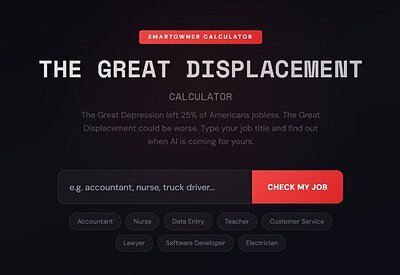
FRANKLIN, TN – February 13, 2026 – A new, free online tool is making a bold and unsettling promise: to tell you the exact year your job will be eliminated by artificial intelligence. Launched by AI consultant Scott McIntosh, TheGreatDisplacement.ai invites any worker to enter their job title and receive a personalized displacement timeline, automation risk score, and a plan to stay ahead of the curve.
The calculator arrives amidst a swirling public debate, fueled by both excitement and deep-seated anxiety about AI's role in the future of work. McIntosh has coined the term "The Great Displacement" to describe what he predicts will be a mass transformation of the labor market, on a scale unseen since the Great Depression. The tool's projections are not pulled from thin air; they are reportedly synthesized from a formidable list of sources, including the World Economic Forum, Goldman Sachs, Gartner, and McKinsey.
"In 1929, nobody saw the crash coming. Today, we can see The Great Displacement building in real time," said McIntosh in a press release. He points to a critical gap: while AI's capabilities are growing exponentially, human adoption remains sluggish, with his research suggesting only 16% of the workforce has meaningfully integrated AI into their daily work. "I built this calculator because millions of people deserve to know what's coming — not to scare them, but so they can act while there's still time."
A Digital Crystal Ball for Your Career?
At its core, TheGreatDisplacement.ai functions as a stark digital oracle. Users are presented with a simple interface: type in a job, and receive a verdict. The underlying data draws from sobering predictions. Gartner, for instance, forecasts that by the end of this year, 37% of business leaders will use AI to replace workers. Goldman Sachs estimates 300 million jobs globally will be impacted by 2028.
While the pedigree of its data sources is impressive, the precise methodology used to translate these broad economic reports into a specific "displacement year" for a role like "accountant" or "graphic designer" remains a black box. This lack of transparency distinguishes it from more academic approaches. Researchers at institutions like MIT and Brookings often focus on "task exposure," meticulously analyzing the individual tasks within an occupation and assessing their susceptibility to automation by current AI models. Their findings are typically presented as a percentage of a job that is exposed to AI, rather than a definitive expiration date.
The appeal of McIntosh's tool lies in its directness. It cuts through the nuanced language of academic studies and consulting reports to offer a single, easily digestible, and potentially terrifying piece of information. For many, this directness may serve as a much-needed jolt, a catalyst for action in a world where the abstract threat of AI can be easy to ignore until it's too late.
The Business of AI Anxiety
The creation of a tool that quantifies career obsolescence inevitably raises questions about the motivations behind it. Scott McIntosh is not just an independent researcher; he is the founder of DigitalTreehouse, a Nashville-based AI automation agency that helps businesses implement AI solutions to improve efficiency—often by automating tasks previously done by humans. He also publishes SmartOwner, a daily AI newsletter with a growing subscriber base.
This context suggests a dual purpose for TheGreatDisplacement.ai. On one hand, it serves as a public awareness campaign, a genuine attempt to arm workers with foresight. On the other, it functions as a powerful marketing engine. By vividly illustrating the problem of AI-driven job displacement, the calculator naturally positions McIntosh and his companies as the solution. A business owner worried about their own operational efficiency, or an employee concerned about their future, might be more inclined to seek out the services of an AI automation agency or subscribe to an AI-focused newsletter after using the tool.
This dynamic is not unique. A burgeoning industry is forming around "AI readiness," offering everything from executive consulting to employee upskilling programs. These businesses thrive on the very uncertainty that tools like TheGreatDisplacement.ai highlight, positioning themselves as essential guides through the coming economic transformation.
A Divided Forecast for the Future of Work
While the calculator presents a definitive timeline of displacement, the broader consensus among economists and labor market experts is far more complex and divided. The narrative is not simply one of job destruction, but of profound transformation.
Reports from organizations like McKinsey and the World Economic Forum—the very sources cited by the calculator—also project the creation of millions of new roles. One forecast suggests that while 85 to 92 million jobs may be displaced globally by 2030, a staggering 97 to 170 million new roles requiring AI fluency are expected to emerge. The critical challenge, therefore, is not a simple lack of jobs, but a massive skills mismatch between the workforce of today and the needs of tomorrow.
Furthermore, recent analysis from PwC's Global AI Jobs Barometer suggests a more optimistic outlook. Their 2025 report, which analyzed billions of job ads, found that jobs requiring AI skills carry up to a 25% wage premium in some markets. It also noted that sectors most exposed to AI are experiencing nearly five times higher productivity growth. This suggests AI may function more as a powerful tool that augments human workers, boosting their value and creating new opportunities, rather than simply replacing them outright. Similarly, research from the Brookings Institution indicates that, to date, AI has been associated with firm growth and increased hiring, not widespread job loss.
The Global Race to Reskill
Regardless of whether one views AI as a job-killer or a job-transformer, the need for adaptation is undeniable. The "action plan" offered by TheGreatDisplacement.ai gestures toward this reality, but the response required is systemic, involving governments, educational institutions, and individuals.
Across the globe, initiatives are already underway to address this monumental challenge. In the United States, the Department of Labor has launched an "AI Action Plan" focused on promoting AI literacy, evaluating its labor market impact, and guiding the ethical development of AI in the workplace. The National Science Foundation is investing heavily in programs designed to build AI skills from K-12 through to the professional workforce.
Other nations are moving aggressively as well. The United Kingdom has expanded its "AI Skills Boost" program, aiming to provide millions of workers with foundational AI skills by 2030. Singapore's long-standing SkillsFuture program provides citizens with credits to pursue retraining courses, with a heavy emphasis on technology and digital fluency. These programs recognize that the most durable defense against displacement is the continuous acquisition of new, relevant skills—particularly those that complement AI, such as complex problem-solving, critical thinking, and emotional intelligence. For the individual worker, the message from nearly every corner is clear: the era of a single, lifelong career is over, and the future belongs to those who embrace continuous learning.