
- 94% of FMCSA audits result in at least one violation
- $27 million in fines issued in a single year due to compliance violations
- 28% of inspected heavy goods vehicles in the UK failed mechanical checks
Experts agree that AI-driven automation is becoming essential for managing fleet compliance, reducing administrative burdens, and mitigating costly regulatory violations in the transportation and logistics industries.
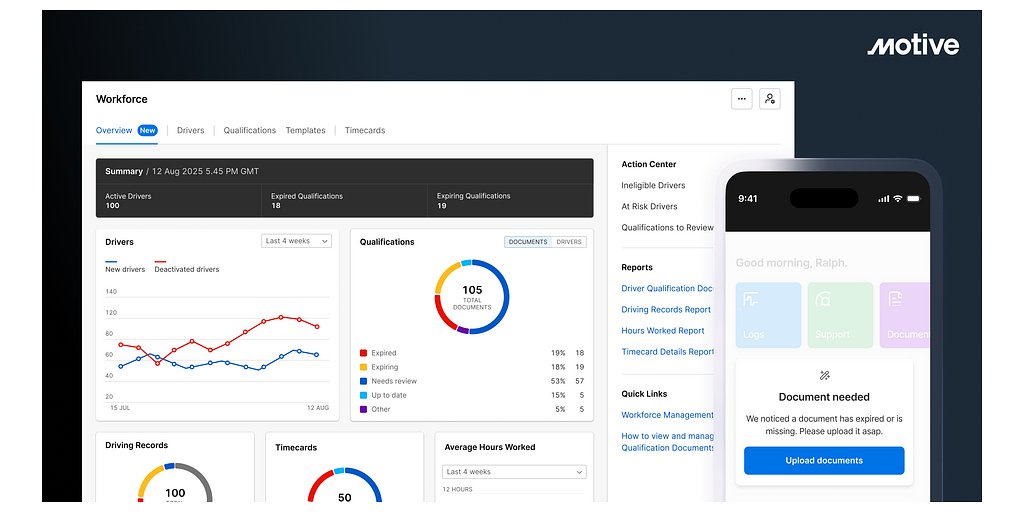
AI Shield: Motive Tackles Fleet Compliance Risks with Automation
LONDON – February 18, 2026 – Motive, an AI platform for physical operations, has unveiled advanced AI capabilities designed to automate the complex web of driver compliance and workforce management. The expansion of its Workforce Management product aims to provide a digital shield for an industry grappling with immense administrative burdens and the constant threat of costly regulatory violations.
For decades, the backbone of the physical economy—transportation, logistics, and construction—has run on a combination of engine power and paperwork. According to Motive, more than half of these organizations still rely on spreadsheets, paper files, and disconnected systems to manage critical workforce data. This announcement signals a significant push to replace antiquated processes with intelligent automation, promising to free up back-office teams and empower frontline workers.
The Crushing Weight of Paperwork and Penalties
The reliance on manual processes is more than an inefficiency; it is a major source of operational and financial risk. Fleet managers report spending significant portions of their week—some over eight hours—on manual data entry alone. This administrative overload, involving everything from commercial driving licences and medical cards to right-to-work documentation, is fraught with the potential for human error.
These errors have severe consequences in a tightly regulated environment. In the United States, Federal Motor Carrier Safety Administration (FMCSA) data reveals a stark reality: in recent years, a staggering 94% of agency audits have resulted in at least one violation. These infractions led to over $27 million in fines in a single year. Common violations frequently involve documentation, such as a driver operating without a valid commercial license or medical certificate, or failing to produce a record of duty status. In 2024, more than half of all audits uncovered serious "acute" or "critical" violations that directly impact a carrier's safety rating.
The problem is global. In the United Kingdom, the Driver and Vehicle Standards Agency (DVSA) conducts thousands of roadside checks annually. Recent data showed that nearly 28% of inspected heavy goods vehicles failed mechanical checks, and thousands of pounds in penalties were issued for non-compliance with driver hours and other regulations. For companies with documentation gaps, a routine check can quickly escalate into fines, operational shutdowns, and significant reputational damage.
"Workforce compliance and the administrative work to manage employees was previously a time-intensive and costly part of our operation," said Morgan Bedford, Country Business and Fleet Manager at Chyone Logistics, a Motive customer. "Motive has streamlined and automated these business processes, giving us confidence we’re compliant while freeing our team to focus on the work that actually drives performance and growth."
AI Enters the Back Office
Motive's enhanced platform directly targets these pain points with two core AI-powered features. The first, Driver Walkaround Checks for Driver Qualification Documents, integrates compliance verification directly into a driver's daily routine. The system can be configured to prevent a driver from starting their vehicle or changing their duty status if critical documents—like a licence or professional competence certificate—are missing or expired. Drivers are guided through a simple in-app upload process to resolve issues quickly, turning a potential compliance breach into a proactive, manageable task.
The second feature is a new Workforce Management Hub, which acts as a centralized command center. It connects individual driver profiles with all relevant workforce data, including compliance status, training records, and timecards. By applying AI, the hub provides managers with predictive insights to spot risks before they escalate. Instead of manually cross-referencing spreadsheets to prepare for an audit, managers can generate real-time reports, identify potential payroll discrepancies, or flag drivers who need updated training with minimal effort.
"UK organisations running fleet operations are wasting too much time managing administrative workforce processes like compliance documentation, timecards and training," stated Nyanya Joof, Regional Vice President of UK Markets at Motive. "Motive’s AI-powered Workforce Management helps organisations move beyond manual, paperwork-driven processes by reducing administrative work, strengthening compliance and keeping operations running safely and efficiently."
A Proactive Stance in an Era of Stricter Oversight
The platform's introduction comes as regulatory bodies are increasing their enforcement efforts. The FMCSA, for instance, has pivoted to more comprehensive on-site audits, leading to the discovery of more serious violations. In this climate, a reactive approach to compliance is no longer tenable. An expired license discovered during an audit is a costly failure, but an AI that flags it a month before expiration is a strategic advantage.
By automating these checks, the technology serves as a digital gatekeeper, ensuring that only qualified and fully compliant drivers are on the road. This directly addresses some of the most severe violations, such as allowing a driver with a suspended CDL to operate a vehicle—an infraction that can trigger immediate and severe penalties.
The system aims to transform how companies approach audits. Instead of a frantic scramble to gather scattered documents, the platform provides a single, verifiable source of truth. This shift from manual reconciliation to automated, continuous compliance monitoring allows businesses to maintain a constant state of audit-readiness, reducing stress and freeing up resources for strategic initiatives.
The Broader Shift to Intelligent Operations
Motive's announcement is part of a wider industry trend toward integrated, AI-driven platforms. Competitors like Samsara and Lytx have also heavily invested in AI, primarily for video telematics and driver safety coaching. Motive seeks to differentiate itself by focusing its new AI capabilities squarely on the administrative and compliance burdens of workforce management, a critical but often overlooked area of operations.
The ultimate vision is a unified system where managing people, vehicles, and equipment is no longer siloed. By providing a 360-degree view of their workforce, Motive empowers safety, operations, and finance teams to collaborate within a single platform. This integrated approach, powered by intelligent automation, represents a fundamental evolution from simple telematics to holistic operational management.
As the physical economy continues to face labor shortages, rising operational costs, and intensifying regulatory pressure, the adoption of such intelligent systems is becoming less of a luxury and more of a necessity for survival and growth.
Topics & Related
Artificial Intelligence
Generative AI
Machine Learning
Revenue
Software & SaaS
AI & Machine Learning
Related Company Pulse