
- $10M in client revenue driven by AI SEO
- 500% surge in organic traffic for Rush Analytics
- 30% reduction in cost per qualified lead for Rush Analytics
Experts agree that AI-driven SEO is revolutionizing digital marketing by shifting focus from vanity metrics to measurable revenue outcomes, with hybrid human-AI models proving most effective.
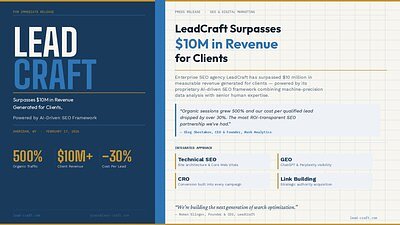
AI SEO Drives $10M in Client Revenue, Shifting Marketing Focus
SHERIDAN, Wyo. – February 18, 2026 – Enterprise SEO agency LeadCraft recently announced it has driven over $10 million in measurable revenue for its clients, a milestone it attributes to a proprietary framework that marries artificial intelligence with senior human expertise. The announcement sends a strong signal to the digital marketing industry, highlighting a decisive shift away from traditional vanity metrics like traffic and rankings toward a more accountable, revenue-focused approach to search engine optimization.
For years, businesses have struggled to draw a straight line from their SEO investment to their bottom line. LeadCraft's achievement suggests that the integration of AI is finally making that connection clear, auditable, and repeatable, challenging the status quo for agencies and their clients across sectors like SaaS, e-commerce, and finance.
The Performance-Driven Mandate
At the heart of LeadCraft's methodology is a simple but powerful equation: "Traffic + Conversion = Sales." This philosophy rejects the long-held practice of reporting on organic traffic growth as a standalone success metric. Instead, the agency builds its strategies around a client's specific key performance indicators (KPIs), ensuring every optimization is designed to influence the sales pipeline directly.
A compelling illustration of this model is the case of Rush Analytics, a B2B SaaS platform. Facing a competitive U.S. market, the company engaged LeadCraft to overhaul its search presence. The agency executed a full technical audit, restructured the site's content architecture, and launched targeted link acquisition campaigns, all guided by AI-assisted keyword clustering. Within a year, the results were dramatic: a 500% surge in organic traffic.
Crucially, the success was not measured in clicks alone. "LeadCraft didn't just grow our traffic—they showed us exactly how that traffic became revenue," said Oleg Shestakov, CEO and Founder of Rush Analytics, in a statement. He noted that alongside the traffic boom, the company's cost per qualified lead fell by over 30%, calling it the "most ROI-transparent SEO partnership" they had experienced. This outcome exemplifies the new standard of accountability, where every SEO action is mapped to a tangible business result, from marketing qualified leads (MQLs) to closed deals.
Beyond Google: The New Frontier of Generative Engine Optimization
While achieving dominance on Google remains a core objective, LeadCraft's strategy looks beyond traditional search engines to a rapidly emerging digital landscape shaped by artificial intelligence. The agency is a vocal proponent of 'GEO' (Generative Engine Optimization), a new discipline focused on ensuring visibility within AI-powered answer engines like ChatGPT, Google's AI Overviews, and Perplexity.
This forward-thinking approach acknowledges a fundamental change in user behavior. Millions are now turning to AI chatbots for answers, and these platforms are increasingly citing their sources. Being cited by an AI can place a brand directly in a consumer's consideration set, bypassing the traditional search results page entirely. "We're building the next generation of search optimization for a world where Google, ChatGPT, and Perplexity all matter," explained Roman Slingov, Founder and CEO of LeadCraft.
Optimizing for GEO requires a different playbook. It is less about targeting specific keywords to rank on a page and more about structuring content to become a trusted, citable source for AI models. This involves creating clear, factual, and comprehensive content, using detailed schema markup to help machines understand context, and building topical authority that signals expertise and trustworthiness (E-E-A-T). As AI-generated answers lead to more "zero-click searches," where users get information without visiting a website, appearing within these answers becomes paramount for brand visibility and influence.
A Crowded Field and the Irreplaceable Human Element
LeadCraft is not the only agency harnessing AI. The digital marketing landscape is now filled with firms claiming expertise in AI SEO and GEO, from boutique specialists to large-scale marketing platforms. Companies like Thrive Internet Marketing Agency, Victorious SEO, and Directive Consulting are all pioneering strategies to optimize for an AI-first world, each promoting their own blend of technology and strategic services.
This competitive pressure underscores a critical truth that industry experts consistently reiterate: AI is a tool, not a replacement for human strategy. While artificial intelligence can process data, identify patterns, and automate content generation at an unprecedented scale, it lacks the contextual understanding, creative intuition, and emotional nuance that define a brand's voice and build genuine customer trust. The most effective models, including the one LeadCraft champions, are hybrid systems.
In this model, AI handles the heavy lifting of data analysis, keyword clustering, and technical monitoring. This frees up human experts—the SEO leads, content strategists, and conversion rate specialists—to focus on higher-level tasks: interpreting the data, understanding customer intent, weaving a compelling brand narrative, and making strategic decisions that AI alone cannot. This human oversight is essential for navigating the complexities of brand alignment and avoiding the pitfalls of generic, low-quality AI-generated content that can alienate audiences and harm a brand's reputation.
Redefining Agency Accountability
The convergence of AI-driven analytics and performance-focused strategies is forcing a broader reckoning within the marketing services industry. For decades, the opaque nature of some digital marketing efforts has been a source of friction between clients and agencies. The ability to now track the impact of SEO from an initial query all the way to a final sale creates a new paradigm of transparency.
This shift empowers clients to demand more than just progress reports filled with charts on traffic and keyword rankings. They can now expect custom dashboards tied to real business outcomes, making the return on their investment clear and indisputable. By tying its success directly to the revenue it generates for clients, LeadCraft and other performance-oriented agencies are setting a new bar for accountability. This model not only fosters stronger, more trust-based partnerships but also pressures the entire industry to evolve beyond selling activities and start delivering measurable financial results. As technology continues to advance, this focus on provable ROI is likely to become the definitive measure of success in digital marketing.