
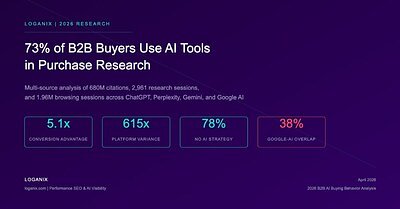
- 73% of B2B buyers now use AI tools like ChatGPT and Perplexity for research, with conversion rates 5.1x higher than traditional Google searches. - Only 22% of marketers track AI platform visibility, while 78% lack any strategy for AI search visibility.
Experts agree that the rapid adoption of AI search tools by B2B buyers has created a critical gap in marketing strategies, requiring immediate adaptation to new visibility and optimization paradigms.
AI Search Creates a Chasm Between B2B Buyers and Marketers
SEATTLE, WA – April 02, 2026 – A seismic shift is underway in the world of business-to-business purchasing, one that is leaving most marketing departments in the dark. Nearly three-quarters of B2B buyers—73%—now regularly use artificial intelligence tools like ChatGPT and Perplexity in their research process, according to a major new analysis. These AI-driven searches are not just casual queries; they result in conversion rates 5.1 times higher than traditional Google searches.
Despite this dramatic change in buyer behavior, an alarming 78% of marketers admit to having no strategy for visibility on these new AI platforms.
The findings come from the 2026 B2B AI Buying Behavior Analysis, a multi-source synthesis released by performance SEO firm Loganix. The report consolidates data from six independent studies conducted between late 2025 and early 2026, covering a massive dataset of 680 million AI citations and millions of user sessions. The picture it paints is one of a rapidly widening chasm between how businesses find and evaluate solutions and how their vendors are trying to reach them.
The Growing Disconnect
The data indicates B2B buyer adoption of AI has reached a critical mass. Buyers are using these tools to accelerate their research, generate vendor shortlists, compare pricing, and synthesize reviews—tasks that once required hours of manual browsing across multiple websites. A 2025 Forrester survey noted that 61% of the buying journey is completed before a buyer even contacts a vendor. AI tools are accelerating this trend, empowering buyers to become more informed and opinionated earlier than ever.
This creates a vast "dark funnel" where up to 97% of buyer research happens anonymously, long before a sales team is aware of a prospect's interest. While buyers have embraced this new efficiency, marketing departments are lagging dangerously behind.
The analysis reveals that only 22% of marketers are currently tracking their brand's visibility and traffic from AI platforms. Fewer than 26% have plans to develop content specifically to be cited by AI answer engines. This significant gap between buyer behavior and marketing strategy represents a critical vulnerability for brands that remain focused solely on traditional search engine optimization.
Beyond Backlinks: Rewriting the Rules of Digital Visibility
For two decades, digital visibility has been synonymous with ranking on Google, a game largely defined by keywords and backlinks. The rise of AI search is fundamentally rewriting that playbook.
A key finding from an Ahrefs analysis of 75,000 brands shows that unlinked brand mentions on authoritative web sources have a correlation of 0.664 with being cited by AI—approximately three times stronger than the correlation for backlinks (0.218). This suggests AI models are learning to associate brand authority with widespread discussion and presence, not just hyperlinked endorsements.
Furthermore, a high ranking on Google no longer guarantees a spot in an AI-generated answer. The overlap between Google's top 10 results and sources cited by ChatGPT is a mere 6.5%. According to a separate analysis by Ahrefs, two out of three AI citations come from pages a user would likely never see on Google's first page.
The challenge is compounded by the fragmented nature of the AI landscape. The platforms are not a monolith.
* Only 11% of domains cited by ChatGPT are also cited by Perplexity, according to a study by Averi.
* An analysis of 15,000 queries by Passionfruit found only 12% of cited sources matched across ChatGPT, Perplexity, and Google AI.
* Citation volumes for the same brand can differ by as much as 615x between platforms.
This divergence means a brand that is highly visible on one AI platform may be completely invisible on another, requiring a nuanced, multi-platform approach to what some are calling "Generative Engine Optimization" (GEO).
The High-Intent, Pre-Qualified AI User
While the challenge for marketers is steep, the reward for getting it right is substantial. Traffic from AI search platforms converts at an average rate of 14.2%, a staggering 5.1x advantage over Google organic's 2.8% baseline, according to an analysis by Exposure Ninja.
The reason for this high performance is that the AI has already done the heavy lifting for the user. By the time a user clicks a source link from an AI-generated summary, they are not just starting their research; they are often validating a curated recommendation. The AI has synthesized options, compared alternatives, and presented a solution, making the resulting click-through highly qualified and full of intent.
This high intent is reflected across platforms, with some variation. Claude users convert at the highest rate (16.8%), followed by ChatGPT (14.2%) and Perplexity (12.4%). These AI-referred visitors don't just convert more often; they are also more engaged. One study by SE Ranking found they spend 68% more time on websites compared to visitors from traditional organic search. The phenomenon is validated even in consumer contexts, with Karl Wells, Chief Revenue Officer of The Washington Post, reporting that visitors from AI platforms have a 4-5x higher subscription conversion rate.
The Race for AI Citation
As AI search engines move from simple "reference engines" to powerful "inference engines," the signals that determine visibility are evolving. The new optimization paradigm appears to be less about chasing algorithms and more about establishing broad, verifiable authority.
Research from Yext analyzing 6.8 million AI citations found that 86% of sources came from brand-controlled properties, such as company websites (44%) and structured business listings (42%). This contradicts a common assumption that AI primarily pulls from forums like Reddit, which accounted for only 2% of citations in that study. This highlights the critical importance of structured data—clear, machine-readable information about a brand's products, services, and locations—that AI models can easily ingest and trust.
While 72% of marketing leaders believe AI will surpass traditional SEO as the primary channel for visibility within three years, the current state of unpreparedness creates a clear opportunity. Brands that move now to understand their AI visibility, structure their data for machine consumption, and build brand authority across a diverse set of digital properties are positioning themselves to capture the high-intent traffic of tomorrow, leaving competitors who are still focused exclusively on yesterday's search rankings far behind.