
- World's First: First spine surgery using AI-powered robotic autopilot (Stealth AXiS™ Autopilot).
- Precision Gains: Previous robotic systems showed a 76% reduction in radiation exposure and an 11-fold reduction in revision surgery risk.
- Real-Time Tracking: LiveAlign™ technology provides continuous vertebra tracking, eliminating traditional 'blind spots'.
Experts agree that AI-powered robotic systems like Stealth AXiS™ Autopilot significantly enhance surgical precision, reduce risks, and improve patient outcomes, though high costs and learning curves remain adoption barriers.
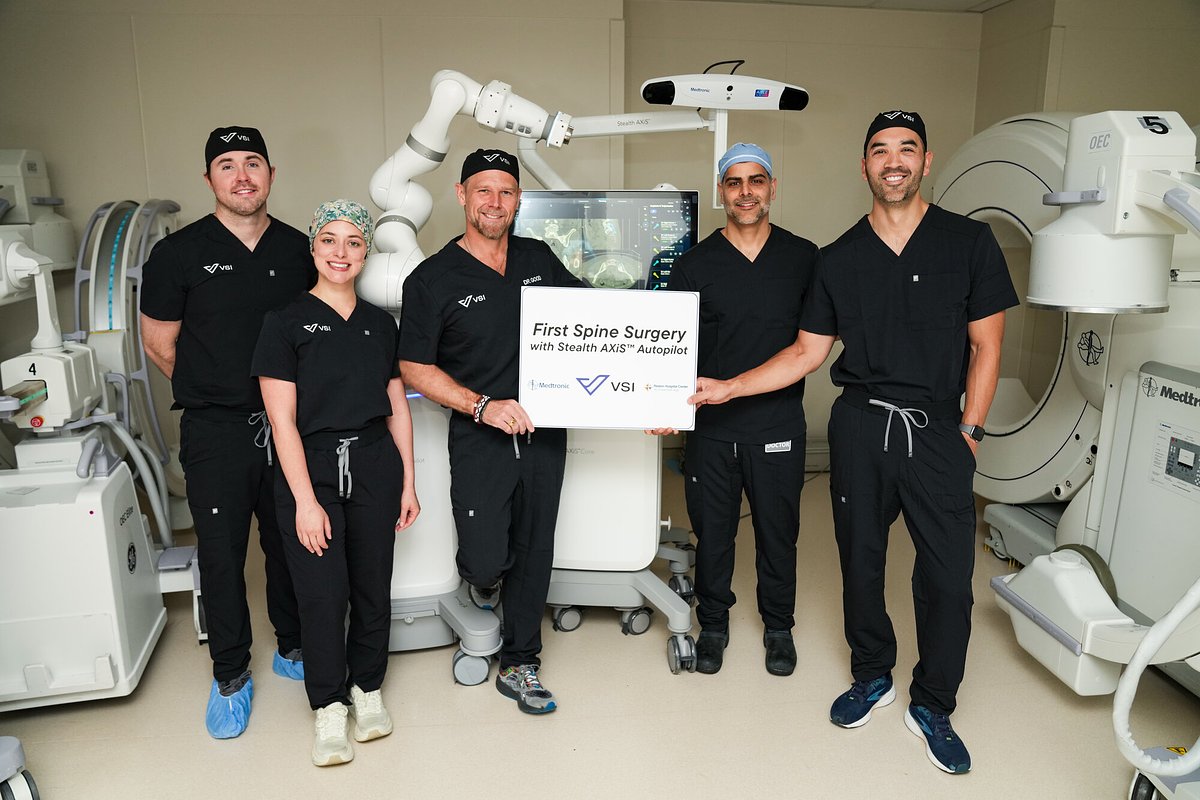
AI-Powered Robot Autopilot Used in World-First Spine Surgery
RESTON, Va. – April 21, 2026 – A team of surgeons in Virginia has successfully performed the world's first spine surgery using a new generation of robotic technology that combines artificial intelligence with real-time navigation, marking a significant milestone in the evolution of complex spinal procedures.
The groundbreaking surgery was conducted at HCA Virginia's Reston Hospital Center by Drs. Christopher Good, Colin Haines, and Ehsan Jazini of VSI, a nationally recognized spine center. The team utilized Medtronic's recently FDA-cleared Stealth AXiS™ Autopilot surgical system, a platform designed to enhance surgical precision, reduce risks, and improve patient outcomes through an unprecedented integration of technologies.
"This is more than an evolution of surgical technology; it's a shift in what patients can expect from spine surgery in the future," said Dr. Christopher Good, one of the lead surgeons. "At VSI, we're leading an era where precision and confidence are higher than ever, and that improves the surgical experience and, most importantly, optimizes recovery for our patients."
A New Era of Surgical Precision
The Stealth AXiS system represents a major leap from its predecessors. It is the first platform to merge AI-powered surgical planning, continuous segmental tracking, navigation, and robotics into a single, cohesive unit. At its core is the system's ability to provide what surgeons have long sought: a live, dynamic view of the patient's spine.
A key innovation, known as LiveAlign™, continuously tracks the position of each individual vertebra in real-time. This eliminates a traditional "blind spot" in spine surgery, where surgeons had to rely on intermittent imaging to account for subtle movements of the spine during a procedure. With the new system, the surgical team receives constant updates, ensuring that the robotic arm's guidance remains perfectly aligned with the pre-operative plan, even as the patient's spine shifts.
This technology is built upon Medtronic's established StealthStation™ navigation foundation and is a central piece of its new AiBLE™ smart ecosystem, which aims to connect devices and data throughout the entire surgical journey. The system, which received FDA clearance for spine procedures in February 2026, is designed to be modular, allowing hospitals to adopt and expand its capabilities over time.
Redefining Patient Recovery and Safety
The first patient to undergo this procedure had suffered from decades of debilitating back pain that did not respond to conservative treatments. The complex, multi-stage surgery involved a direct lateral interbody fusion (DLIF), a three-level posterior instrumented spinal fusion, a laminectomy, and a bilateral SI joint fusion. The use of the Stealth AXiS Autopilot was critical in managing the intricacies of such a procedure.
According to the surgical team, the system's integrated guidance enhanced accuracy, optimized the final alignment of the spine, and significantly reduced the patient's exposure to radiation from intraoperative imaging. These factors are believed to support a safer and more optimized recovery.
"This advancement in technology allows us to take an even more individualized approach to every surgery," stated Dr. Ehsan Jazini. Dr. Colin Haines added, "Each patient's spine is unique, and having real-time insight throughout the procedure helps us tailor each decision to the patient in front of us. Ultimately, it's enabling us to deliver safer care, minimize disruption to the body, and help patients return to the lives they want to live as quickly as possible."
While long-term outcome data on the new system is forthcoming, previous studies on robotic guidance in spine surgery have demonstrated substantial benefits. Research previously led by VSI on predecessor robotic systems showed a potential for a 76% reduction in radiation exposure, an 11-fold reduction in the risk of revision surgery, and a nearly 6-fold reduction in complications compared to traditional freehand techniques. The Stealth AXiS system was developed on this foundation, aiming to further amplify these safety and efficacy gains.
The Race for Robotic Supremacy in the OR
Medtronic's launch is the latest move in an increasingly competitive and innovative surgical robotics market. While the Stealth AXiS system sets a new benchmark with its integrated AI and real-time tracking, other major players are also pushing the boundaries of what's possible in the operating room.
Competitors include Globus Medical's ExcelsiusGPS™, which has been on the market since 2017 and is known for its rigid robotic arm and comprehensive navigation. Zimmer Biomet's ROSA® ONE Spine System also offers real-time dynamic tracking capabilities. Meanwhile, industry giant Stryker is preparing for the full commercial launch of its Mako Spine system, which leverages the haptic feedback technology that has made its Mako robots for hip and knee replacement highly successful.
The consensus among independent medical experts is that these technologies are collectively raising the standard of care. Robotic assistance has been shown in numerous studies to improve the accuracy of screw placement, a critical step in many fusion surgeries. This enhanced precision is linked to the lower complication and revision rates seen with robotic-assisted procedures. However, experts also note the high cost of these systems and the significant learning curve for surgical teams, which remain barriers to wider adoption.
A Legacy of Surgical Firsts
For VSI, this achievement is the latest in a long line of technological firsts. The center has cultivated a reputation for being at the forefront of surgical innovation. In 2019, Dr. Good performed the world's first surgery using the predecessor system, the Mazor X Stealth Edition™, also at Reston Hospital Center.
The institute's track record includes pioneering the use of augmented reality (AR) for various spine procedures, including laminectomies and hybrid surgeries combining disc replacement and fusion. They have also been credited with the first combined endoscopic and robot-guided surgery, among other milestones. This consistent drive to adopt and refine cutting-edge technology positions the center as a leader in a field where precision is paramount. The integration of AI and real-time data from the Stealth AXiS Autopilot represents the next logical step in this journey toward a more predictable and patient-centric approach to spine care.