
- $160B Secured: BitsLab protected $160 billion in on-chain value across 716 million user accounts in 2025.
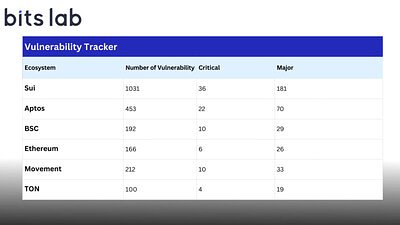
- 2,858 Vulnerabilities Neutralized: The firm identified and resolved 2,858 security flaws, including 101 critical and 399 major threats.
- $3.3B in Web3 Losses: The article highlights over $3.3 billion in losses from hacks and exploits in the Web3 ecosystem during the same period.
Experts would likely conclude that BitsLab's hybrid AI + Expert security model represents a critical advancement in Web3 defense, addressing the growing complexity and sophistication of cyber threats in the decentralized space.
AI Guardians: BitsLab Secures $160B in a Perilous Year for Web3
SAN FRANCISCO, CA – January 15, 2026 – As the Web3 ecosystem reeled from a year marked by over $3.3 billion in losses from hacks and exploits, AI-driven security firm BitsLab has released its 2025 annual summary, detailing its efforts to stem the tide. The report reveals the company audited 204 projects and neutralized 2,858 vulnerabilities, providing a stark look at the persistent risks lurking within the digital asset space while highlighting a new hybrid approach to security.
In a year of rapid technological evolution, BitsLab reports it has protected over $160 billion in on-chain value across 716 million user accounts. The firm’s performance underscores the critical role of advanced security in an industry where a single code flaw can lead to catastrophic financial losses. The findings arrive as the Web3 security market, valued at nearly $2.9 billion in 2025, is projected to surge, driven by the increasing frequency and sophistication of cyber threats.
The Rise of the 'AI + Expert' Paradigm
At the heart of BitsLab's 2025 strategy was a significant overhaul of its auditing process, marking a formal entry into the 'AI + Security' era. The company moved beyond traditional, manual-heavy audits to a hybrid model it calls "AI + Expert collaborative intelligent defense." This system is centered on the BitsLabAI Scanner, an engine trained on vast datasets of real-world vulnerabilities.
According to the company, the process begins with the AI scanner performing automated, high-coverage risk screening. This initial pass is then augmented with AI-assisted formal verification and penetration testing before a final, deep-dive review is conducted by human security experts. This tiered approach aims to combine the scale and speed of artificial intelligence with the nuanced judgment and intuition of seasoned professionals.
This shift addresses a troubling industry trend: a significant percentage of major exploits have historically occurred in smart contracts that had already passed professional security audits. This suggests that one-time, manual reviews are often insufficient to secure complex, interconnected protocols against novel attack vectors. By evolving auditing from a single-delivery service into a continuous intelligent defense system, BitsLab aims to provide more resilient protection for projects with a cumulative Total Value Locked (TVL) exceeding $164 billion. Of the 2,858 vulnerabilities the firm identified, 101 were classified as "Critical" and 399 as "Major," representing potentially devastating economic attack vectors that were neutralized before they could be exploited.
A Multi-Chain Fortress Across a Fragmented Web3
BitsLab's 2025 report also paints a picture of a targeted, multi-chain strategy designed to secure a diverse and fragmented digital landscape. The company demonstrated its most significant influence in the Move-language ecosystem, auditing 96 projects on the Sui (74) and Aptos (22) blockchains, thereby "consolidating absolute dominance" in this burgeoning sector. This specialization is managed under its dedicated brand, MoveBit, which the company calls the "AI Guardian" of the Move ecosystem.
Beyond its stronghold, the firm made substantial inroads into other critical areas of Web3 through its other specialized brands. ScaleBit, its multi-chain arm, audited 43 projects across mainstream EVM-compatible chains like BSC (31) and Ethereum (12), as well as extending its reach to Solana and Bitcoin. Meanwhile, TonBit, an officially certified security provider for the TON ecosystem, focused on the rapidly growing network, auditing six projects and notably helping resolve a critical vulnerability in the TON Virtual Machine.
This extensive cross-chain footprint, which also includes audits on emerging Layer-1 and Layer-2 networks like Monad, IOTA, and CKB, reflects a strategic response to the growing security challenges of an interconnected Web3. As assets and data flow between disparate blockchains, bridge protocols and cross-chain applications have become high-value targets for attackers, making comprehensive, multi-chain security expertise more critical than ever.
From Code to Click: Expanding the Security Frontier
Perhaps one of the most significant strategic moves for BitsLab in 2025 was its expansion from backend code security to front-end user protection. The company acquired KEKKAI, a well-known Japanese security plugin, and rebranded it as BitsLab Safe. This acquisition extends BitsLab's defensive perimeter from the protocol's underlying logic to the final point of user interaction—the click of a button.
BitsLab Safe is designed to combat the pervasive threat of phishing and fraud, which account for a substantial portion of user losses in the crypto space. The tool integrates AI-powered transaction simulation and phishing detection, warning users of potential risks before they sign a malicious transaction. This proactive defense mechanism addresses a critical vulnerability gap that smart contract audits alone cannot cover. By building a security matrix that spans "from code logic to asset interaction," the company is tackling the problem holistically.
This move is particularly timely, as AI-assisted phishing attacks saw a dramatic increase in 2025. By deploying its own AI to counter these threats at the user level, BitsLab is directly engaging in the escalating technological arms race between security providers and malicious actors.
Securing the Next Wave: AI Agents and Future Threats
Looking ahead, BitsLab's strategy appears aligned with the next frontier of Web3 innovation and its associated risks: the AI Agent economy. The company has positioned BitsLab Safe as a key tool for securing payment flows for x402 and AI Agents, anticipating a future where autonomous agents transact on-chain. This forward-looking approach aims to embed security into the foundational layers of this emerging ecosystem.
The company’s core mission to "Audit, Monitor, and Defend" reflects a broader industry shift toward continuous, adaptive security. In an environment where threats are constantly evolving and the complexity of on-chain systems is always increasing, a static, one-off audit is no longer sufficient. By integrating AI-driven scanning, expert oversight, and real-time user protection, BitsLab is helping to define a new, more dynamic standard for securing the decentralized world, ensuring that value can circulate freely and safely across interconnected chains.