
- 75% reduction in crash rates: Fleets using Samsara's AI tools saw a 75% drop in crash rates over 30 months.
- 5,000 coaching events in 30 days: Early adopters reported significant time savings with automated coaching.
- 45 risk factors monitored: Samsara's AI triages safety events based on 45 risk factors.
Experts agree that AI-driven fleet safety tools, when implemented with transparency and driver buy-in, significantly enhance safety outcomes and operational efficiency.
AI Co-Pilots: Samsara's New Tools Aim to Transform Fleet Safety
SAN FRANCISCO, CA – March 10, 2026 – Connected operations pioneer Samsara Inc. has unveiled a suite of new artificial intelligence features aimed at revolutionizing fleet safety, promising to scale personalized driver coaching and reduce accidents without overburdening managers. The announcement signals a significant advancement in an industry racing to leverage AI not just for monitoring, but for proactively shaping safer driving behavior from start to finish.
The new capabilities, built on the company's proprietary risk model, introduce AI-powered training for managers and automated, personalized guidance for drivers. By automating the review and triage of safety events, Samsara aims to free up fleet managers to focus on high-impact coaching while providing continuous support for drivers before, during, and after every trip.
“Safety is a continuous loop that requires support at every level of an organization,” said Johan Land, SVP of Product at Samsara, in the company's announcement. “By offering end-to-end coaching for both drivers and managers, we’re moving beyond just flagging isolated errors to providing a true partner for the frontline.”
Empowering Managers Through AI Simulation
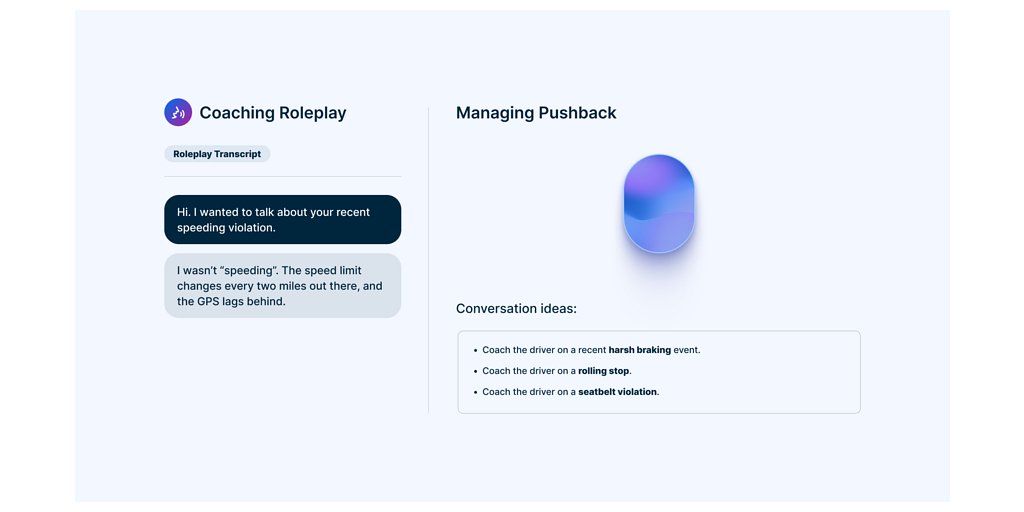
A core challenge for lean fleet operations is scaling effective safety coaching. Samsara's new tools directly address this by equipping managers with AI to refine their own skills. The new AI Role Play feature allows managers to practice difficult conversations by simulating real-world coaching scenarios with an AI “driver.” This virtual training ground is designed to build confidence and improve the quality of human-to-human feedback.
Complementing this is AI Guided Coaching Sessions, which provides managers with a structured framework for one-on-one meetings, helping to ensure conversations are effective and lead to tangible behavior change. This focus on training the trainer is a key differentiator, aiming to improve the human element of safety management.
Furthermore, the system automates the heavy lifting of data analysis. By monitoring over 45 risk factors, Samsara’s AI automatically triages safety events, classifying them by risk level. Lower-risk events are routed to drivers for automated self-coaching, while high-risk incidents are flagged for human intervention. This automated prioritization is already showing significant efficiency gains for early adopters.
“We pushed over 5,000 coaching events in a 30-day period to drivers,” noted Tosin Lediju, SH&E Manager at Ecolab, highlighting the time savings. “If you consider the time and effort that would have been spent reviewing all those events, that’s huge.”
A new Safety Program Overview dashboard serves as a command center, allowing managers to track their program's performance, measure risk reduction, and receive actionable recommendations to fine-tune their strategies.
The Human-AI Partnership on the Road
Beyond manager tools, Samsara is extending its AI support directly to the driver's cab. A new feature delivers automated, personalized audio briefings at the start of a shift. These briefings can alert drivers to potential risks like severe weather on their route, celebrate recent safety achievements, and reinforce positive habits, setting a proactive tone for the day.
This pre-shift support completes what Samsara calls an end-to-end coaching cycle: pre-shift audio briefings, on-the-road support with two-way audio, and post-trip analysis via an AI Avatar. The goal is to create a holistic safety ecosystem that supports drivers throughout their entire journey.
However, the increasing prevalence of AI dashcams and in-cab monitoring across the industry raises valid concerns among drivers regarding privacy and the psychological impact of constant surveillance. While the technology can exonerate drivers in no-fault accidents, the feeling of a “Big Brother” environment is a persistent apprehension. Industry experts emphasize that successful implementation hinges on transparency, clear communication about data usage, and fostering driver buy-in by positioning the technology as a supportive tool rather than a punitive one.
A Competitive and Data-Driven Landscape
Samsara's announcement enters a fiercely competitive market where rivals are also heavily investing in AI. Lytx recently announced its “Coach Assist” to help managers prepare for coaching sessions, while Geotab’s “Safety Center” leverages predictive analytics to anticipate collisions. Verizon Connect similarly uses AI dashcams with real-time in-cab alerts to correct unsafe behaviors as they happen.
What these platforms have in common is a foundation of data proving their efficacy. Independent research validates the safety claims of AI-driven telematics. Samsara's own global safety report found that fleets using its full suite of AI tools saw an approximate 75% reduction in crash rates over 30 months. Other industry studies have shown that pairing AI-powered dashcams with consistent coaching can reduce unsafe driving incidents by over 50%.
This proven impact has captured the attention of the insurance industry. Insurers are increasingly partnering with telematics providers to offer data-driven policies and premium discounts to fleets that demonstrate a commitment to safety. “Through our partnership with Samsara, we have seen a clear correlation between our insurance customers who leverage driver coaching and reduced crash rates,” confirmed Alasdair MacKechnie, Head of Auto Liability at Inigo. This synergy creates a powerful financial incentive for fleets to adopt advanced safety technologies, linking safer roads directly to a healthier bottom line.
As AI continues to integrate into frontline operations, the focus is shifting from simple data collection to creating intelligent, interactive systems that augment human capabilities. For the transportation industry, this means not only making roads safer but also redefining the future of work for the millions of people who power the global economy.
Topics & Related
AI & Machine Learning
Financial Services
Artificial Intelligence
Generative AI
Geopolitics & Trade
Revenue
Related Company Pulse