
- 800G Optical Transceiver Demand: Goldman Sachs forecasts 33.5 million units in 2026, up 58% from previous estimates.
- 1.6T Market: Projected to require 7 million units by 2026.
- Market Growth: Global optical transceiver market expected to rise from $15.27 billion (2024) to over $39 billion by 2031.
Experts agree that FICG's advanced optical technologies are critical for overcoming AI's data bottleneck, offering significant efficiency gains and scalability for next-generation data centers.
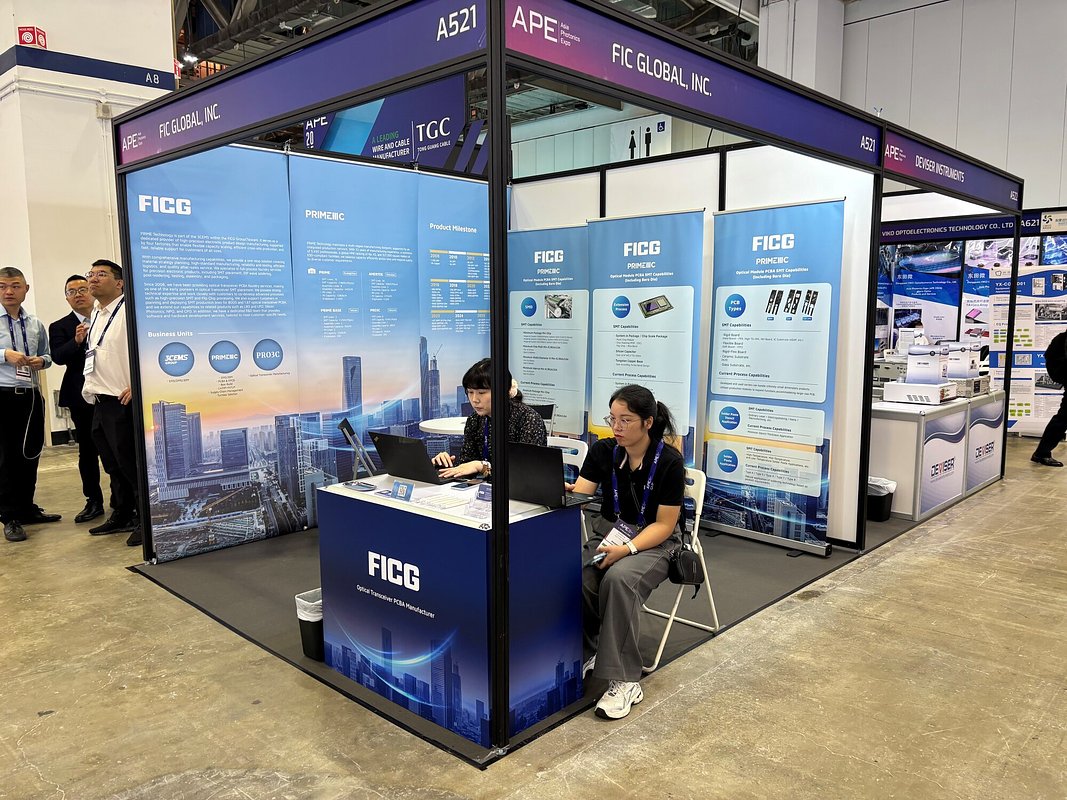
FICG's Advanced Optics Target AI's Data Bottleneck at APE 2026
SINGAPORE – February 03, 2026 – As the artificial intelligence revolution accelerates, creating an unprecedented demand for data processing, the foundational hardware that underpins our digital world is being pushed to its limits. At the Asia Photonics Expo (APE) 2026 this week, FIC Global, Inc. (FICG) is stepping into the spotlight, showcasing the advanced optical technologies designed to break through the looming data bottleneck and power the next generation of AI-driven data centers.
Operating under its optical communications brand, PRIME Technology, FICG is highlighting its high-speed optical transceiver manufacturing and advanced packaging capabilities at Booth A521. These components, while often unseen, are the critical arteries of the internet, and their evolution is paramount as the industry grapples with the dual challenges of skyrocketing bandwidth requirements and stringent energy efficiency targets.
The AI Data Deluge and the Need for Speed
The explosive growth of AI, from large language models with trillions of parameters to complex training workloads, has fundamentally reshaped data center architecture. These AI systems require massive clusters of GPUs and other specialized processors (XPUs) that must communicate with each other at lightning speed. This has created an urgent need for faster, more efficient network interconnects.
The industry is rapidly transitioning to meet this demand. While 400G transceivers have become the data center standard, the market is now in the midst of a broad deployment of 800G solutions, with early adoption of 1.6T technology already on the horizon. Market forecasts underscore this dramatic shift; Goldman Sachs recently increased its 2026 demand forecast for 800G optical transceivers by 58% to 33.5 million units, while projecting the nascent 1.6T market will already require 7 million units in the same year. The overall global optical transceiver market is on a steep trajectory, projected to grow from approximately $15.27 billion in 2024 to over $39 billion by 2031.
However, speed is only half of the equation. As data centers pack more computational power into the same physical footprint, managing power consumption and heat has become a critical challenge. The energy required to move data is a significant part of a data center's operational cost and environmental footprint. This has accelerated the push toward lower-power architectures and more deeply integrated optical components, where every picojoule-per-bit saved translates into substantial efficiency gains at scale.
FICG's Answer: Advanced Packaging and Manufacturing Prowess
With over 18 years of experience in the field, FICG is leveraging its deep manufacturing expertise to address these complex challenges. The company, an early adopter of Surface-Mount Technology (SMT) for optical transceivers, is now showcasing a suite of integrated advanced packaging capabilities essential for the 800G and 1.6T era.
At the heart of this strategy are several key technologies:
Flip-Chip Technology: By introducing flip-chip packaging into its high-speed manufacturing lines, FICG can create denser, more compact modules with shorter electrical paths. This directly contributes to improved signal integrity and lower power consumption, which are critical for next-generation transceivers.
Silicon Photonics (SiPh): FICG is integrating Silicon Photonics, a technology that fabricates optical components directly onto silicon wafers. SiPh offers game-changing benefits, including up to 40% lower power consumption and a 20% cost reduction compared to traditional optics, by leveraging mature semiconductor manufacturing processes.
Co-Packaged Optics (CPO): Looking toward the future of data center design, FICG is also advancing its capabilities in Co-Packaged Optics. CPO moves the optics from pluggable modules on the faceplate directly onto the same package as the main network switch chip. This dramatically shortens the distance data travels over copper traces, slashing power consumption. While pluggable modules operate at around 15 picojoules per bit (pJ/bit), CPO systems can achieve ~5 pJ/bit, with a clear roadmap to below 1 pJ/bit, representing a monumental leap in energy efficiency.
By integrating these technologies—along with established techniques like Chip-on-Board (COB)—FICG provides a comprehensive solution that spans from the individual chip to the fully assembled module. This integrated approach, supported by rigorous high-speed signal engineering and reliability testing, enables customers to shorten their qualification cycles and accelerate time-to-market for new, high-performance networking hardware.
Navigating a Competitive, High-Stakes Market
FICG is making its push in a dynamic and highly competitive market. The optical component space is populated by established giants like Coherent, Broadcom, and Cisco, as well as fast-moving specialists such as Innolight and Lumentum. Each is racing to provide the essential building blocks for the world's insatiable data appetite.
In this environment, FICG is positioning itself not just as a component provider, but as a strategic manufacturing partner. The company emphasizes its disciplined quality control systems and mature, high-precision manufacturing foundation as key differentiators. By helping customers improve volume production stability and quality consistency, FICG aims to be an indispensable part of the high-tech supply chain, ensuring that the groundbreaking designs of network architects can be reliably produced at the massive scale the AI industry demands.
Bolstering the Global Supply Chain for a Resilient Future
The strategic importance of a robust and geographically diverse supply chain has never been clearer. Recognizing this, FICG has been actively advancing its manufacturing facility in Malaysia. This expansion is a critical part of the company's strategy to enhance its global delivery capability and build resilience against potential disruptions.
The Malaysian facility is now equipped with the production readiness and quality management frameworks required for high-volume production. This site will complement FICG's existing production lines, providing greater capacity flexibility and delivery efficiency for its global customers. This move mirrors a broader industry trend, with other major players in the photonics sector also establishing or expanding their manufacturing footprint in Southeast Asia to de-risk their supply chains and be closer to key markets.
As industry professionals gather in Singapore for APE 2026, the discussions will undoubtedly center on the future of connectivity. The technologies being showcased by companies like FICG are the invisible backbone of that future, enabling the incredible advancements in artificial intelligence, cloud computing, and global communication that are reshaping our world. Their work in the intricate world of photonics and advanced packaging ensures that the flow of data can keep pace with the speed of innovation.