
- 16x Faster Resolution: AI automation reduces ticket resolution time to a median of 4.4 hours vs. 71 hours without automation.
- 22% Work Stoppage: One in five tickets blocks employee productivity, rising to 30% in fast-growth companies.
- 82% Sentiment Improvement: AI resolves tickets within 15 minutes to 4 hours, turning 93-97% of frustrated users into satisfied ones.
Experts agree AI is transforming IT help desks by automating routine tasks, significantly improving efficiency and employee satisfaction, while positioning IT as a strategic business enabler rather than a cost center.
AI Boosts IT Help Desks with 16x Faster Ticket Resolution
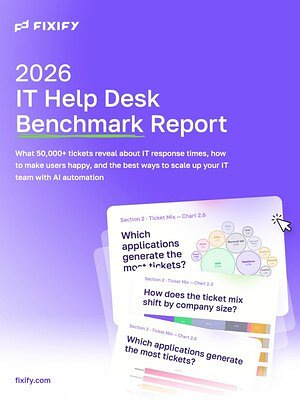
ARLINGTON, Va. – March 24, 2026 – A groundbreaking report released today reveals that artificial intelligence is dramatically reshaping the landscape of corporate IT support, resolving employee help desk tickets 16 times faster than traditional, human-led methods. The findings come from the 2026 IT Help Desk Benchmark Report published by Fixify, an AI-native IT automation provider. The comprehensive analysis, which examined over 50,000 real-world help desk tickets from more than 30 organizations over a 14-month period, provides some of the first concrete benchmarks on the tangible impact of AI in enterprise IT operations.
The report's headline statistic is stark: help desks with heavy AI automation (defined as automating 75-100% of tasks) achieve a median ticket resolution time of just 4.4 hours. In contrast, teams without significant automation take a median of 71 hours—nearly three full calendar days—to resolve similar issues. This vast efficiency gap highlights a pivotal shift in how businesses can manage internal support, reduce employee downtime, and boost overall productivity.
The Data Behind the Disruption
Fixify's analysis surfaces several critical themes that paint a detailed picture of the modern IT help desk. Beyond the 16x speed improvement, the report reveals that the nature and timing of IT issues are surprisingly predictable. Tuesdays are the busiest day of the week, accounting for 24% of all ticket volume, while July stands out as the busiest month, running 28% above average. The vast majority of requests, 82%, arrive during standard business hours, with volume peaking at 11:00 AM.
Critically for business leaders, the report quantifies the high stakes of slow IT support. One in five tickets (22%) is classified as a "work stoppage," meaning the employee cannot perform their job until the issue is resolved. This figure climbs to nearly one-third for companies with over 1,000 employees, illustrating a significant drain on productivity, especially in larger organizations.
The data also shows that two categories dominate IT support queues: Software & Applications and Onboarding & Offboarding together account for more than half of all ticket volume. Drilling down further, simple application assignment requests represent a staggering one in four tickets submitted. "That concentration of request volume is exactly where automation powered by natural language shines," said Pete Silberman, Co-Founder and CTO of Fixify, in the company's press release.
Augmentation, Not Replacement
While the efficiency gains are dramatic, the report suggests AI's primary role is not to replace human IT staff but to augment their capabilities. It allows skilled technicians to escape the deluge of repetitive, low-level tasks and focus on more complex, strategic initiatives. Industry experts agree, viewing the trend as a collaborative model where AI handles the high-volume, routine work, freeing human agents to apply their expertise to critical incidents and high-touch support scenarios.
"Everyone asks whether AI will make IT faster. The answer is yes — but not where people think," noted Matt Peters, Co-Founder and CEO of Fixify. "First response times are identical with or without automation. The 16x gap is entirely in resolution. AI doesn't pick up the phone faster. It closes the loop faster."
This speed directly impacts employee satisfaction. The report found that even frustrated users are recoverable. An overwhelming 82% of tickets that begin with negative user sentiment improve by the time of resolution. The sweet spot for turning a negative experience into a positive one is a resolution time between 15 minutes and 4 hours. Within this window, 93% to 97% of frustrated users leave satisfied, with over a third becoming actively positive. By automating the resolution of common problems, AI can consistently hit this target, improving morale and the perception of the IT department.
The High Cost of Inefficiency
The report's finding that 22% of tickets block employee productivity carries significant financial implications. Independent industry analyses estimate the cost of IT downtime can range from an average of $5,600 per minute to over $300,000 per hour for large enterprises. When an employee is unable to work for hours—or in the case of non-automated help desks, days—the lost productivity translates into substantial direct and indirect costs, including missed deadlines, project delays, and decreased employee engagement.
Fixify's data also reveals that a company's context heavily influences its IT challenges. Fast-growth companies, for instance, face a much higher rate of productivity-blocking tickets (30%) compared to more stable companies (13%). This is likely due to the increased volume of onboarding, system access requests, and infrastructure strain associated with rapid expansion. By providing benchmarks broken down by industry, company size, and growth rate, the report allows IT leaders to compare their performance not against a generic average, but against their true peer group.
Navigating a Crowded AI Landscape
Fixify's report enters a bustling and competitive market. The IT Service Management (ITSM) space is dominated by giants like ServiceNow and Freshworks, both of which are heavily investing in their own AI capabilities. A growing ecosystem of specialized vendors, from chatbot providers to end-to-end automation platforms, is also vying to help organizations modernize their IT operations. This intense competition underscores the strategic importance of AI in maintaining a competitive edge.
However, the path to AI adoption is not without its challenges. Industry analysts caution that successful implementation requires more than just purchasing software. Organizations must address potential hurdles such as ensuring high-quality data for training AI models, navigating data privacy concerns, and managing the integration of new tools with legacy systems. Furthermore, a significant skills gap in AI and data science can hinder deployment, and some organizations struggle to demonstrate a clear return on investment, with Gartner predicting that a notable percentage of AI projects at service desks will be abandoned.
Despite these challenges, the trend is clear: AI is shifting IT support from a reactive, ticket-based model to a proactive, data-driven function. By leveraging automation to handle predictable requests and predictive analytics to preempt issues before they occur, IT leaders are positioning their teams as strategic enablers of business growth rather than as mere operational cost centers.