
- 2-day international workshop hosted by Amity University Rajasthan to promote inclusive education through AI and global best practices.
- Collaboration with Nottingham Trent University (UK) and King Fahd University of Petroleum and Minerals (Saudi Arabia) to develop an Inclusive Education Toolkit.
- Focus on AI-driven tools like real-time audio descriptions, text simplification, and intelligent tutoring systems to support students with disabilities.
Experts agree that the strategic integration of Generative AI and global best practices, as demonstrated by this workshop, is a crucial step toward dismantling learning barriers for students with disabilities in India, though ethical oversight and data privacy remain critical considerations.
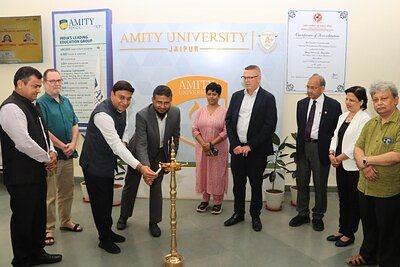
AI and Global Pacts: Amity Uni Leads India's Inclusive Education Push
JAIPUR, India – April 28, 2026 – A landmark international workshop hosted by Amity University Rajasthan has set a new course for inclusive education in India, aiming to dismantle learning barriers for students with disabilities through the strategic integration of Generative AI and global best practices.
The two-day event, titled "Adoption of the Inclusive Education Toolkit to Improve Accessibility in Indian Educational Institutes," brought together leading academics and administrators from across Jaipur. Organized by the Amity Cognitive Computing and Brain Informatics Center (ACCBI), the initiative represents a crucial collaboration with Nottingham Trent University (UK) and King Fahd University of Petroleum and Minerals (Saudi Arabia), signaling a concerted effort to translate accessibility theory into widespread practice.
Redefining the Classroom with AI and Inclusive Design
At the heart of the workshop was the introduction of an "Inclusive Education Toolkit," a comprehensive framework of strategies and digital resources designed to empower educators. Rather than a single software product, the toolkit represents a new methodology focused on embedding accessibility into the very fabric of educational content and delivery. Participants engaged in hands-on sessions covering inclusive design principles for creating accessible Open Educational Resources (OERs) and MOOCs, practical training on content creation tools that meet international standards, and a deep dive into the transformative potential of Generative AI.
Generative AI is emerging as a powerful ally in this mission. Experts detailed how AI can create highly personalized learning pathways, adapting content and pace to suit individual student needs. For students with disabilities, this could mean AI-powered tools that generate real-time audio descriptions for visual content, simplify complex texts, or provide intelligent tutoring systems that offer tailored feedback. The technology promises to enhance student autonomy and engagement by making educational materials more interactive and adaptable.
Prof. Kanad Ray, Director of ACCBI, emphasized the workshop's practical focus. "The goal of this workshop is to move from theory to implementation," he stated. "By adopting the Inclusive Education Toolkit, we are providing educators with tangible digital tools and AI-driven strategies to eliminate barriers in the learning process." While the potential is vast, the dialogue also acknowledged the critical need for ethical oversight, addressing potential AI biases and ensuring data privacy to build a truly equitable system.
A Global Partnership for Local Impact
The workshop's strength was significantly amplified by the expertise of its international partners, who brought decades of specialized research and practical experience to the table. Nottingham Trent University (NTU), a key collaborator, has long been a pioneer in the field. Its research, led by figures like Prof. David Brown, has produced impactful tools such as the award-winning educational coding app Pocket Code and AI-enabled adaptive learning platforms like MaTHiSiS, which supports students with learning disabilities and autism.
NTU's work extends to using virtual reality to teach independent living skills to neurodivergent individuals and developing AI tools to predict and mitigate anxiety-inducing events for students with autism. This deep well of proven, co-created solutions provided a rich foundation for the workshop's training modules.
King Fahd University of Petroleum and Minerals (KFUPM) contributed its extensive experience in creating a comprehensively supportive campus environment. The university's dedicated Special Needs Support Office and its focus on infrastructure—from modifying buildings with special tracks for the visually impaired to providing advanced assistive devices—demonstrates a holistic commitment to accessibility. Prof. Mufti Mahmud, a senior researcher affiliated with both KFUPM and NTU, brought his expertise in Cognitive Computing and Responsible AI, highlighting the synergy between the partner institutions.
This global knowledge transfer is vital for accelerating progress in India. As Prof. Amit Jain, Vice Chancellor of Amity University Rajasthan, noted, "Creating an inclusive campus goes beyond infrastructure; it requires a fundamental shift in how we design our curriculum and digital resources. This international collaboration ensures our faculty and administrators are equipped with global best practices to make education truly accessible to every student."
Aligning with India's National Vision for Equity
The initiative arrives at a critical juncture for Indian higher education. While India's National Education Policy (NEP) 2020 champions inclusive and equitable learning, significant challenges remain. Students with disabilities often face a profound digital divide and limited access to higher education, with many institutions lacking the necessary infrastructure, training, and resources to support them effectively. The gap between policy and on-the-ground implementation has been a persistent hurdle.
The Amity-led workshop directly addresses this gap by focusing on building capacity at the institutional level. By equipping educators and administrators with practical tools and strategies, the initiative aims to catalyze a grassroots movement that complements top-down policy directives. It underscores the sentiment that true inclusivity is not just about compliance but about a cultural and pedagogical transformation within universities, aligning perfectly with India's national vision for a more equitable academic landscape.
The formation of a collaborative network of Jaipur-based institutions at the conclusion of the workshop marks a pivotal step in this journey. This network will serve as a hub for sharing knowledge, developing joint action plans, and collectively upholding high accessibility standards. By fostering a regional ecosystem committed to inclusive education, Amity University Rajasthan is positioning itself at the forefront of a national effort to ensure that digital advancements in education benefit every learner, regardless of their abilities.