
- TDConnex operates at a scale with components in over a billion devices worldwide.
- The company is expanding with a new 1 million square foot manufacturing campus in Tamil Nadu.
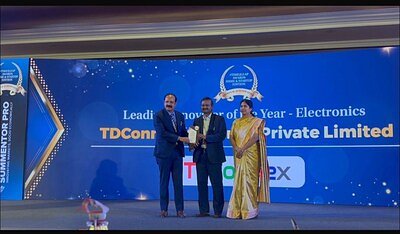
- TDConnex is one of only two recipients in the electronics category at India’s 2026 MSME Awards.
Experts would likely conclude that India's strategic policies and public-private partnerships are successfully positioning the country as a global leader in high-tech manufacturing, particularly in micro-precision components critical for advanced technologies.
A Tiny Component, A Giant Leap: India's Rise in High-Tech Manufacturing
CHENNAI, India – May 17, 2026
This week, a company you’ve likely never heard of won an award for making parts in products you use every day. TDConnex, a global manufacturer of micro-precision components, was named ‘Leading Innovator of the Year’ at India’s 2026 MSME Awards. On the surface, it’s a standard corporate press release. But look closer, and you’ll see the intricate workings of a much larger system in motion. This single award is not just a plaque on a wall in Chennai; it is a powerful symbol of a strategic, nation-wide realignment that is reshaping global technology supply chains and positioning India as a cornerstone of our collective technological future.
For decades, the world’s manufacturing map has been relatively fixed. But recent global disruptions have exposed the fragility of hyper-concentrated supply chains, prompting a worldwide search for resilience and diversification. This is where the story of TDConnex’s award becomes a story about all of us. It’s an indicator that the system is adapting, building new redundancies and capabilities. The recognition, bestowed by one of India’s most selective national bodies for enterprise innovation, highlights not just one company's success, but the viability of a new manufacturing paradigm.
The Architecture of Ambition
TDConnex’s success is no accident; it is the direct result of a carefully constructed ecosystem. India has been methodically laying the groundwork for this moment for years. Ambitious national policies like the 'Make in India' initiative and the Production Linked Incentive (PLI) schemes have created a fertile ground for high-tech manufacturing. These programs are more than just subsidies; they are a clear statement of intent, designed to attract global leaders in advanced sectors by offering a stable, supportive, and financially compelling environment.
The PLI scheme for large-scale electronics manufacturing, for instance, offers direct incentives on incremental sales, effectively sharing the risk of massive capital investment with companies willing to bet on India. This policy architecture is designed to achieve a dual purpose: boost domestic manufacturing to serve a burgeoning local market and, crucially, establish the country as a credible, scaled-up export hub for the rest of the world. The national recognition of TDConnex, one of only two recipients in the electronics category, serves as a powerful proof point that this strategy is bearing fruit, validating the nation's push to climb the global value chain from assembly to deep-tech innovation.
The Invisible Engines of Modern Life
What TDConnex actually makes is central to understanding this shift. The term 'micro-precision components' sounds esoteric, but these are the invisible engines of our modern world. They are the microscopic, meticulously engineered pieces inside our smartphones, medical diagnostic tools, electric vehicles, and data centers. With components already in over a billion devices worldwide, the manufacturer operates at a scale that is difficult to comprehend, where precision is measured in microns and failure is not an option.
This is not the low-skill assembly work of the past. It is advanced manufacturing that requires a mastery of materials science, robotics, and complex quality control. By building this capability on Indian soil, the company is helping to seed a new technological foundation. The success of this endeavor demonstrates that the country’s workforce and infrastructure are ready to meet the exacting standards of the world’s most demanding technology companies. As we move further into an era defined by 5G, the Internet of Things (IoT), and advanced medical technology, the demand for these high-precision components will only grow, making the capabilities being nurtured in India strategically vital.
A Symbiotic System: Investment Meets Infrastructure
The story of TDConnex’s growth in the state of Tamil Nadu is a case study in effective public-private partnership. The company’s planned expansion—a new 1 million square foot manufacturing campus—is set to be built within a SIPCOT industrial park. The State Industries Promotion Corporation of Tamil Nadu (SIPCOT) is a government agency that provides the foundational infrastructure—developed land, reliable power, water, and connectivity—that allows companies to focus on their core business.
This symbiotic relationship is a critical part of the system that enables communities to thrive alongside corporate growth. By providing a robust framework, the state de-risks major investments and ensures that development is planned and sustainable. In return, the company brings capital, technology, and jobs. TDConnex’s CEO, Thanga Venkatachalam, highlighted this collaborative spirit in his remarks, noting, "This award is a testament to the extraordinary engineers, technicians, and leaders on our India team who have turned that ambition into reality." He also credited the "truly global collaboration" that supported the Indian operation's growth, illustrating how modern success is built on interconnected networks of expertise and support.
The new facility is not just about more of the same. It represents a significant expansion of capabilities into new, high-value verticals, including medical devices and power electronics for industrial applications. This diversification is a sign of a maturing industrial ecosystem, one that is moving from fulfilling existing needs to anticipating the demands of tomorrow’s supply chain.
Cultivating a High-Tech Workforce for a Thriving Future
Ultimately, the most critical infrastructure is human capital. A factory, no matter how advanced, is only as effective as the people who run it. The success of TDConnex is built upon a fast-growing team of Indian engineers and technicians who have scaled the business in "every dimension," according to its CEO. This achievement points to the most profound and sustainable impact of this kind of investment: the development of a highly skilled local workforce.
This is where corporate responsibility and public policy intersect with community well-being. By investing in training and creating pathways for technical careers, companies like TDConnex become engines of social and economic mobility. The establishment of a world-class manufacturing hub does more than just create jobs; it fosters a local culture of innovation, inspires a new generation to pursue careers in science and technology, and creates a virtuous cycle of development. The new campus in Tamil Nadu will not just be a building of steel and concrete; it will be a hub of human ingenuity, contributing to a system that allows both people and industries to prosper together.