
- 140 million demat accounts in India today, up from 40 million in 2020
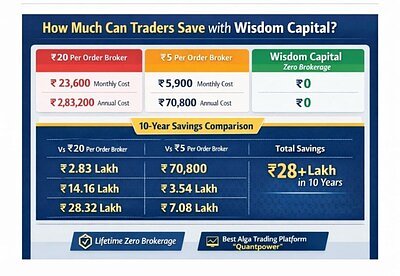
- ₹2,83,200 annual savings for active traders switching to zero-brokerage models
- 10% of the market now directly owned by individual investors
Experts agree that zero-brokerage models have democratized trading in India, forcing the industry to prioritize technology and affordability while reshaping investor demographics.
A Decade of Zero Fees: How Free Trades Redefined India's Brokerage Wars
NEW DELHI – March 10, 2026 – As India witnesses an unprecedented surge in retail investors, brokerage firm Wisdom Capital is marking a significant milestone: over a decade of its 'Lifetime Zero Brokerage' model. This anniversary arrives at a pivotal moment for the Indian financial markets, which have seen the number of demat accounts skyrocket from 40 million in 2020 to over 140 million today, fundamentally reshaping the investment landscape.
The firm's long-standing strategy of eliminating brokerage fees has positioned it as a key player in a fiercely competitive market, forcing a broader industry conversation about cost, technology, and the future of trading in a nation rapidly embracing equity culture.
The Disruption of 'Free'
When Wisdom Capital was incorporated in 2013, the concept of zero-brokerage trading was a radical departure from the norm. Traditional brokerages typically charged a percentage of the trade value, while the first wave of discount brokers introduced flat-fee pricing. By offering a plan with no brokerage charges on trades, often for a one-time account fee, the company directly challenged the revenue foundation of its competitors.
For active traders, the impact was immediate and substantial. Standard discount brokers charging a flat fee of ₹20 per order could cost a frequent trader upwards of ₹2,83,200 annually, based on an activity level of 1,000 trades per month. Wisdom Capital’s model promised to reduce that cost to zero, a compelling proposition that democratized access to the markets for traders who were previously priced out by transaction friction.
This aggressive pricing strategy did not occur in a vacuum. It was part of a larger wave of disruption that forced the entire industry to reconsider its value proposition. The subsequent years saw the rise of fintech giants like Zerodha and Groww, who also built their empires on low-cost models, solidifying a market-wide shift where minimal fees became the baseline expectation for a new generation of investors.
Beyond Cost: The Tech Arms Race
As the Indian market matures, the battle for dominance is no longer fought solely on price. With millions of new, digitally native investors entering the fray—nearly half of whom are under 30—the focus has shifted to technology. Today's traders demand sophisticated tools, seamless user experiences, and the power to execute complex strategies with ease. This is where Wisdom Capital aims to differentiate itself again, coupling its low-cost structure with high-tech capabilities.
Central to this strategy is its association with Quantpower, an advanced algorithmic trading platform. While zero brokerage lowers the barrier to entry, platforms like Quantpower are designed to empower traders once they are in the market. The platform offers a suite of institutional-grade tools, including:
- Algorithmic Strategy Building: Enabling users to create, test, and deploy automated trading rules without needing to write complex code.
- Advanced Backtesting: Allowing traders to test their strategies against historical market data to evaluate potential performance.
- Quantitative Analysis: Providing tools for in-depth options and futures analysis, helping traders identify opportunities and manage risk.
By integrating these capabilities, the firm is betting that the future belongs to brokers who can cater to both the cost-conscious novice and the sophisticated algo-trader. This synergy addresses a growing demand from an investor base that is rapidly moving up the learning curve, seeking an edge in an increasingly complex market.
Fueling India's Retail Revolution
The backdrop to this strategic positioning is nothing short of a retail revolution in India. The number of registered investors on the National Stock Exchange (NSE) has nearly tripled since early 2020, with individual investors now directly owning nearly 10% of the market. This surge, fueled by increased internet penetration, user-friendly mobile apps, and a growing awareness of wealth creation, has transformed the demographic profile of the Indian investor.
Digital platforms have been the primary enablers of this transformation, democratizing access to financial markets on an unprecedented scale. Brokerage firms are no longer just intermediaries but technology companies at their core, tasked with educating, empowering, and equipping millions of first-time market participants. The growth is particularly pronounced among younger Indians, who are diversifying their savings away from traditional assets like gold and real estate and into equities at a record pace.
In this context, a model combining zero transaction costs with powerful analytical tools represents a potent formula for attracting and retaining this new wave of market participants. It addresses the twin needs of affordability and empowerment, which are paramount for an audience that is both aspirational and discerning.
The Business of Zero
The persistent question for any zero-brokerage firm is a simple one: how do you make money? The business model is a delicate balance of volume and value-added services. While a core offering like equity delivery might be free, revenue is generated through a variety of other channels.
These firms typically charge low, flat fees for more speculative, high-volume segments like intraday trading and Futures & Options (F&O), which form a significant revenue stream. Furthermore, revenue is derived from premium services and platforms, such as the tiered subscription plans offered for advanced features on platforms like Quantpower. Other income sources include interest earned on client funds held in trading accounts (though regulated by quarterly settlement rules in India), fees for margin trading facilities, and cross-selling other financial products.
The entire model hinges on achieving massive scale. By leveraging technology to keep operational costs low, discount brokers can thrive on a 'low margin, high volume' strategy. This makes the Indian market, with its vast and growing investor base, a prime territory for such a model to succeed. The ongoing competition ensures that firms must continually innovate, not just on price, but on the entire ecosystem of services they provide to a vibrant and expanding client base.