
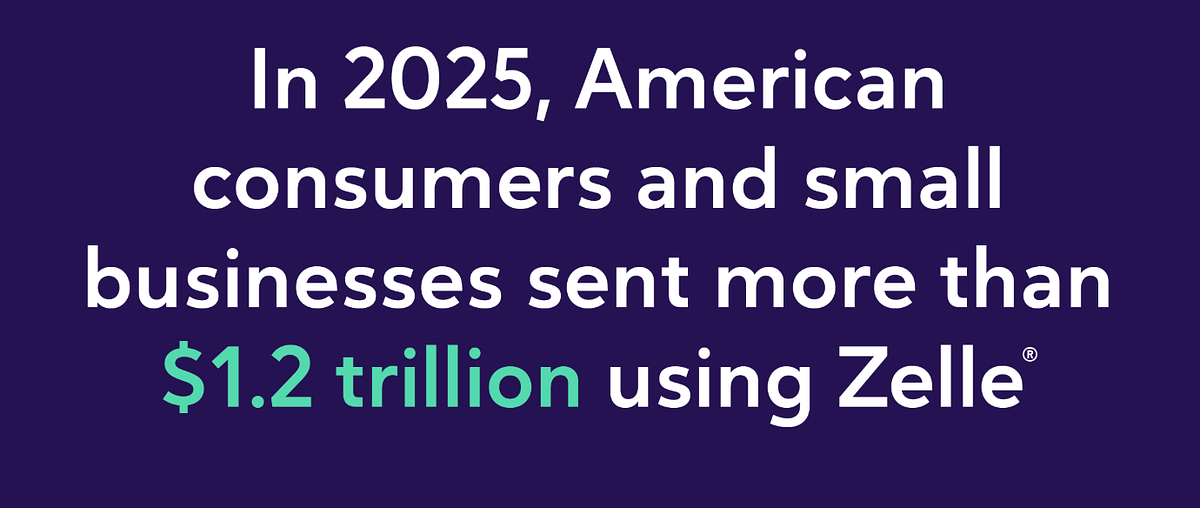
- $1.2 trillion: Zelle processed over $1.2 trillion in payments in 2025, marking its second consecutive trillion-dollar year.
- 20% growth: The platform saw a 20% year-over-year increase in total dollar volume.
- 100 million accounts: Zelle had a record 100 million bank and credit union accounts sending money in December 2025.
Experts would likely conclude that Zelle has solidified its role as a foundational financial utility in the U.S., driven by its seamless integration with traditional banking infrastructure and its ability to facilitate large-dollar, real-time transactions for both consumers and small businesses.
Zelle's $1.2T Year Cements Its Role in the U.S. Economic Engine
NEW YORK, NY – February 11, 2026 – By Matthew Richardson
In a year marked by economic uncertainty, the digital payment network Zelle has emerged as a powerful engine of American commerce, processing over $1.2 trillion in payments in 2025. The staggering figure, announced by the company, marks its second consecutive trillion-dollar year and represents a robust 20% year-over-year growth in total dollar volume.
This expansion is not just a story of a popular app; it signals a fundamental shift in the nation's financial behavior. Zelle's growth rate occurred at a nearly six-times-faster clip than U.S. consumer spending (3.5%) and business investment (3.2%) in the third quarter of 2025, underscoring its deepening integration into the very fabric of the economy. With an average of $3.4 billion moved daily and a record 100 million bank and credit union accounts sending money in December alone, the platform has solidified its position as a foundational financial utility.
"Leadership isn't about buzzwords or flashy launches – it's about reliability and results," said Denise Leonhard, general manager of Zelle, in a statement. "Zelle is powering America's consumers and small businesses, enabling reliable, large-dollar money movement for essential living expenses in an evolving American economy."
The Quiet Giant in the Payments Race
While fintech apps like Venmo and Cash App often capture headlines with their social features and branding, Zelle has quietly established a commanding lead in the U.S. digital payments race. Its $1.2 trillion in payment volume for 2025 dwarfs the performance of its main competitors. For comparison, PayPal's Venmo processed over $325 billion in total payment volume, while Block's Cash App reported slowing user growth in early 2025.
Zelle's dominance stems from its unique model. Owned by a consortium of major U.S. banks and operated by Early Warning Services, LLC, it is integrated directly into the mobile banking apps of more than 2,300 financial institutions. This strategy has made it a default, frictionless option for millions of Americans who can send and receive money without downloading a separate third-party app. While Venmo boasts high user engagement, Zelle’s bank-to-bank infrastructure facilitates larger average transaction sizes, contributing to its massive overall volume.
The scale of its operation is immense. In August 2025, the network shattered its own record by moving more than $9 billion in a single day. This quiet but powerful market leadership demonstrates how the traditional banking industry has successfully leveraged its existing infrastructure and customer trust to build a formidable competitor in the fintech space.
Powering the Small Business Economy
Nowhere is Zelle’s impact more transformative than in the small business sector. In 2025, nearly 30% of all dollars flowing through the network—a total of $357 billion—were tied to small businesses. This represents a 26% increase from the previous year, with the number of enrolled small businesses growing 15% to 7.7 million.
For contractors, childcare providers, landscapers, and countless other local service providers, the platform has become a critical tool for managing cash flow. The ability to receive payments instantly, rather than waiting days for checks to clear or credit card payments to settle, allows business owners to pay suppliers, meet payroll, and reinvest in their operations without delay. This trend aligns with a broader shift in the business-to-business payment landscape, where real-time payments are becoming increasingly central to strategy.
"End of the month there's a lot of bills due, so cash flow can get really tight for a lot of business owners," said Ernie C., the owner of a wedding ceremony business in Oregon, in a testimonial provided by the company. He noted that the certainty of having funds available helps him "pay the people that I need to pay in a timely manner, so that just really helps me manage my cash flow with the business."
The New Fabric of Social Finance
Beyond its commercial applications, Zelle has become deeply woven into the personal financial lives of Americans. While common uses like splitting rent and utility bills remain prevalent, self-reported data shows the platform is increasingly used to manage a wide array of shared experiences.
From pooling funds for Beyoncé concert tickets to reimbursing a friend who planned a group trip to a football game, Zelle facilitates the social transactions that define modern life. Users are splitting costs for trips to major music festivals like Coachella and Stagecoach, as well as for shared self-care appointments for hair and nail services. The frequent use of emojis like ❤️ and 🏈 in transaction memos signals a high degree of trust and familiarity between users, reinforcing the platform's core principle of sending money only to known and trusted individuals.
"I don't know what I would do without [Zelle] at times when I don't know how to make payments, or I am in need or another one of my friends or families in need," said Natasha C., a consumer from Texas, in a provided statement.
Navigating the Challenges of Trust and Security
With great volume comes great responsibility. The platform's foundation of trust is both its greatest strength and its most significant challenge. Zelle leverages the robust, multi-layered security of its partner banks, and its own press release highlights that nine out of ten surveyed users feel safe using the service. However, the irreversible nature of its real-time transactions has made it a target for social engineering scams, where fraudsters trick users into authorizing payments.
This issue has attracted regulatory attention. Although the Consumer Financial Protection Bureau (CFPB) surprised industry watchers by dropping a lawsuit against Zelle's operator and several major banks in March 2025, the scrutiny over consumer protection and fraud liability persists. In response, the industry is adapting. JPMorgan Chase, for example, implemented new protective measures in 2025 to block or delay Zelle transactions it flagged as potentially fraudulent, particularly those originating from contacts met on social media platforms.
These developments highlight a crucial tension: balancing the demand for instant, frictionless payments with the need for robust consumer protection. As Zelle's role expands from a simple peer-to-peer service to a critical piece of national financial infrastructure, its ability to innovate in fraud prevention will be as important as its growth in transaction volume. Its deep integration within the banking system provides a powerful framework for this, but the ever-evolving tactics of scammers remain a persistent threat for the entire digital payments ecosystem.
Topics & Related
Digital Transformation
Related Company Pulse