
- 92% of financial services decision-makers agree that improving data quality is critical to AI success, but only 12% have achieved full, enterprise-wide deployment of AI projects.
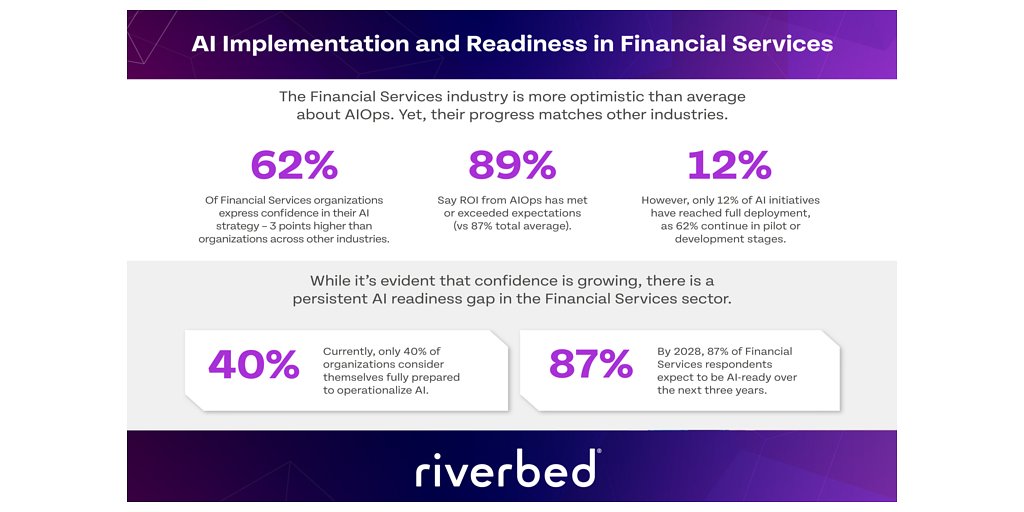
- 89% of financial organizations report that AI's ROI has met or exceeded expectations, yet only 40% feel fully ready to operationalize their AI strategy.
- 62% of AI initiatives remain stuck in pilot or development phases, highlighting a significant implementation gap.
Experts agree that while financial firms recognize the strong ROI of AI and the critical need for high-quality data, the industry faces substantial challenges in operationalizing AI due to data quality issues, IT complexity, and regulatory pressures.
Finance AI Hits Data Wall Despite Strong ROI, Study Finds
REDWOOD CITY, CA – February 04, 2026 – The financial services industry is facing a critical paradox in its adoption of artificial intelligence. While firms are reporting significant returns on their AI investments, a new study reveals that the vast majority are failing to move initiatives beyond pilot stages, stymied by poor data quality and overwhelming IT complexity.
A global survey from AIOps and observability firm Riverbed, titled ‘The Future of IT Operations in the AI Era,’ found that while a staggering 92% of financial services decision-makers agree that improving data quality is critical to AI success, only 12% have achieved full, enterprise-wide deployment of their AI projects. A substantial 62% of initiatives remain stuck in pilot or development phases, highlighting a growing implementation gap between AI ambition and operational reality.
This struggle persists even as the sector expresses strong confidence in AI's potential. The study shows 89% of financial organizations report that the return on investment from their AIOps (AI for IT Operations) has met or exceeded expectations. Yet this optimism is tempered by a stark lack of preparedness. Only 40% of financial organizations feel fully ready to operationalize their AI strategy today, pointing to deep-seated foundational challenges that threaten to derail the industry's technological transformation.
“Financial Services organizations are among the most sophisticated and disciplined adopters of AI, and our research shows they’re already seeing strong returns,” said Jim Gargan, Chief Marketing Officer at Riverbed. “However, the sector operates under unique pressures, including rigorous regulatory scrutiny, zero tolerance for downtime and a critical need for data accuracy. What’s clear is that success now depends on simplifying IT, consolidating observability tools and vendors, improving data quality, embracing open standards like OpenTelemetry, and ensuring network and application performance can support AI at scale.”
The Data Dilemma at the Core of AI Paralysis
The most significant roadblock identified in the study is data. Financial services firms showed the lowest level of confidence in their data across all industries surveyed, with only 43% of decision-makers feeling fully confident in the accuracy and completeness of their organization's data. This data deficit is the primary reason AI initiatives struggle to graduate from proof-of-concept to production.
In an industry where decisions involving billions of dollars and immense regulatory risk are made in milliseconds, untrustworthy data is a non-starter. AI models are only as reliable as the data they are trained on, and inaccuracies can lead to flawed insights, biased outcomes, and significant compliance breaches. This finding aligns with broader industry analyses, which consistently point to data quality and availability gaps as the biggest challenges for AI adoption. Other reports have noted that over 60% of AI projects in finance face significant implementation delays, with many failing to meet their projected ROI precisely because of these foundational data issues.
The Riverbed study underscores a deep awareness of this problem within the sector, with the 92% of leaders who cite data quality as critical representing the highest proportion of any industry. This indicates that the challenge is not a lack of understanding, but a struggle with execution in complex, legacy environments.
Crushed by Complexity: The Observability Tool Sprawl
Compounding the data problem is the sheer complexity of the IT environments within financial institutions. Decades of technological accumulation to support real-time transactions, digital banking, and now AI workloads have resulted in a fragmented and unwieldy toolset. The survey found that, on average, financial IT teams juggle 13 different observability tools from nine separate vendors.
This “tool sprawl” creates critical visibility gaps across applications, networks, and user experience, making it nearly impossible to get a unified view of performance. When issues arise, teams are forced to swivel between disparate dashboards, slowing down decision-making and increasing operational risk. This complexity directly hinders the ability to deploy and manage AI at scale.
In response, the industry is making a decisive move toward simplification. An overwhelming 96% of financial organizations are actively consolidating tools and vendors. In a clear signal of their intent to break from the status quo, 95% are considering new vendors as part of this consolidation—the highest level among all industries surveyed. This reflects a willingness to rethink long-standing technology relationships in favor of integrated platforms that can reduce risk and support a scalable AI strategy.
A New Blueprint: Unified Observability and Open Standards
As financial firms seek to tame complexity, a new strategic blueprint is emerging, centered on unified observability and open standards. According to the study, 95% of financial leaders agree that a unified observability platform would make it easier to identify and resolve operational issues, providing the cross-domain correlation needed for trustworthy AI.
Central to this strategy is the rapid adoption of OpenTelemetry, an open-source framework that standardizes the collection of telemetry data (metrics, logs, and traces) from cloud-native applications and infrastructure. The financial services sector is leading the charge, with 92% of organizations already leveraging the framework—more than any other industry.
Industry leaders see OpenTelemetry as a critical enabler for their future. Nearly all respondents (99%) agree that it reduces vendor lock-in and increases flexibility, while 97% view it as a foundational technology for future AI-driven automation. By creating a common language for data collection, the framework allows organizations to build a reliable data pipeline that can feed AI models with consistent, high-quality information, regardless of the underlying vendors or technologies.
The Next Frontier: Data Movement and Network Performance
As AI initiatives mature, the industry's focus is shifting from simply developing algorithms to managing the performance of the underlying infrastructure that fuels them. The movement of AI data across distributed environments—from public clouds to on-premise data centers and edge locations—is now a primary concern.
Financial services organizations place greater importance on AI data movement than any other sector, with 94% viewing it as important to their overall strategy. Furthermore, with AI workloads becoming more demanding, network performance and security have emerged as decisive success factors, cited as essential by 81% of respondents.
Looking ahead, the industry is already planning for the next phase of AI governance and architecture. The study found that 76% of financial organizations plan to establish a formal AI data repository strategy by 2028. This move underscores a strategic shift toward creating governed, high-performance systems that can balance the drive for innovation with the non-negotiable requirements of compliance, security, and control in one of the world's most demanding industries.
Topics & Related
Artificial Intelligence
Generative AI
Machine Learning
Cloud Migration
Regulation & Compliance
Revenue
Software & SaaS
AI & Machine Learning
Corporate Finance
Related Company Pulse