
- 92% of manufacturing leaders see digital transformation as strategic priority
- 98% plan to use machine vision by 2029
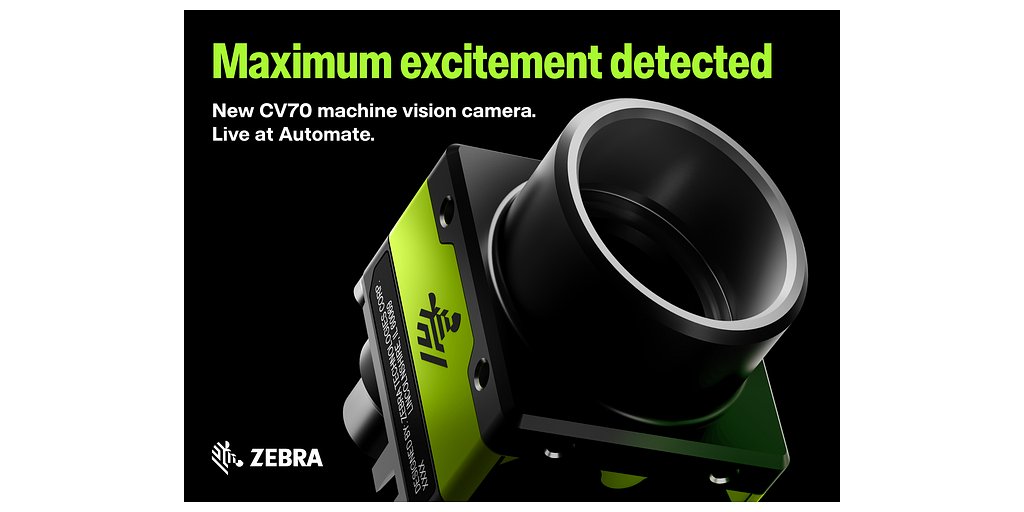
- CV70 camera delivers up to 290 frames per second with compact dual-link CXP form factor
Experts would likely conclude that Zebra's integrated ecosystem represents a strategic shift toward holistic, data-driven manufacturing solutions that enhance operational resilience and human workforce capabilities.
Zebra's Vision: Engineering Resilience on the Factory Floor
CHICAGO, IL – June 22, 2026 – In the relentless pursuit of operational permanence, the modern factory floor is the new frontier. Here, amidst the hum of machinery and the flow of goods, the difference between market leadership and obsolescence is measured in microns and milliseconds. It is on this competitive ground that Zebra Technologies (NASDAQ: ZBRA) made its latest strategic move at the Automate 2026 conference, unveiling not just a new product, but a comprehensive vision for the future of manufacturing.
The company showcased an integrated ecosystem designed to fuse the physical and digital worlds, a move that signals a deeper industry shift towards intelligent automation. While press releases often announce incremental updates, Zebra’s presentation in Chicago felt more foundational. It was a declaration that the era of siloed, single-purpose automation is giving way to a more holistic, data-driven approach where every component—from scanner to camera to robot—works in concert. This is the new architecture of resilience.
The New Engine of Precision
At the heart of Zebra’s announcement was the debut of its CV70 CXP machine vision camera. While the launch of a new camera may seem routine, its specifications and intended applications reveal a calculated response to the manufacturing sector's most pressing challenges. Designed for high-speed, high-resolution tasks, the CV70 is aimed squarely at industries where precision is non-negotiable, such as electric vehicle (EV) battery assembly and semiconductor inspection. In these domains, a microscopic flaw can lead to catastrophic failures and costly recalls.
The CV70 leverages the CoaXPress (CXP) 2.1 standard to deliver frame rates up to 290 frames per second across models ranging from 5 to 25 megapixels. Critically, it does so in what Zebra claims is the market's smallest dual-link CXP camera form factor. This ultra-compact design is a significant engineering feat, allowing manufacturers to deploy high-performance inspection in tightly constrained spaces on the production line without compromising on resolution or speed. But the hardware is only half the story. Zebra’s strategic advantage lies in its vertical integration. The camera is designed to work seamlessly with the company's Aurora software platform, frame grabbers, and vision controllers. This single-vendor ecosystem approach eliminates the integration headaches and performance bottlenecks that often plague systems cobbled together from multiple suppliers. For manufacturers, this translates to faster deployment, simplified maintenance, and a more reliable, fully validated system.
This stands in contrast to the strategies of more specialized competitors like Cognex, known for its deep learning software, or camera-centric powerhouses like Basler and Teledyne. While these firms offer best-in-class point solutions, Zebra is betting that customers will increasingly value the operational simplicity and cohesive performance of a unified platform. It’s a classic battle between the specialist and the generalist, and Zebra is positioning its broad, integrated portfolio as the more durable long-term solution.
Building the Resilient Factory
Zebra’s showcase at Automate 2026 extended far beyond a single camera. The interactive demonstrations painted a picture of a fully connected, end-to-end operation. One workflow highlighted an automated print-and-apply process where machine vision and RFID technology worked together to validate every package and label in real time. This marriage of technologies ensures not only that the right product is in the right box, but also that its journey through the supply chain is flawlessly tracked, providing the kind of actionable visibility that underpins modern logistics.
This vision aligns perfectly with the company’s own research. According to Zebra’s Manufacturing Vision Study, an overwhelming 92% of manufacturing leaders now see digital transformation as a strategic priority, and 98% plan to use machine vision by 2029. These are not aspirational figures; they are a response to market pressures. Independent industry analysis confirms that machine vision can slash inspection errors by over 90%, directly impacting defect rates, waste, and ultimately, the bottom line. The drive for this technology is rooted in a clear and compelling return on investment.
The recent acquisition of Photoneo, also on display, further strengthens this ecosystem. Photoneo’s vision-guided robotics, capable of complex tasks like bin picking and depalletizing, add a crucial layer of physical automation to Zebra's data-capture and inspection capabilities. A factory that can see, identify, track, and now physically manipulate objects with high precision is a factory that is fundamentally more resilient to disruption, whether from labor shortages or quality control crises.
The Augmented Operator
Perhaps the most forward-looking aspect of Zebra’s strategy is its philosophy on the human workforce. In an industry often anxious about automation leading to job replacement, the company is championing a narrative of augmentation. This was the central theme of a session led by Charlie Long, Zebra's Vice President and General Manager of Machine Vision, titled, “The Augmented Operator: Driving Productivity with Machine Vision and Mobile Intelligence.”
“We relentlessly deliver innovation to help our customers overcome their biggest operational challenges,” Long stated. The underlying message is that technology should empower, not supplant, human expertise.
This approach recasts machine vision and AI as tools that give frontline workers enhanced capabilities. An operator equipped with a system that uses AI for anomaly detection can spot subtle deviations from a 'golden image' standard that would be invisible to the naked eye. An AI-powered optical character recognition (OCR) tool that reads text from any surface or angle dramatically reduces manual data entry errors. These technologies provide a layer of data-driven insight that allows workers to make faster, more informed decisions, transforming them from simple laborers into skilled overseers of a complex, automated process.
This human-centric model of automation is a hallmark of a sustainable strategy. It recognizes that human adaptability and problem-solving skills remain invaluable assets. By augmenting these skills, companies can achieve gains in productivity and quality that exceed what either humans or machines could accomplish alone. It’s a powerful formula for consistent value creation, one that builds a more capable and engaged workforce—the ultimate source of any organization's long-term strength in a volatile global landscape.