
- 17,000Pa suction power: Placing it among the most powerful in the market
- 99.99% pickup rate: Claimed for challenging messes like cat litter and spilled cola
- 50% efficiency improvement: Potential gain from adaptive cleaning strategies
Experts would likely view the xLean TR1 as a significant innovation in robot vacuums, particularly for its dual-form design and self-evolving AI, though its success will depend on real-world performance matching its ambitious claims.
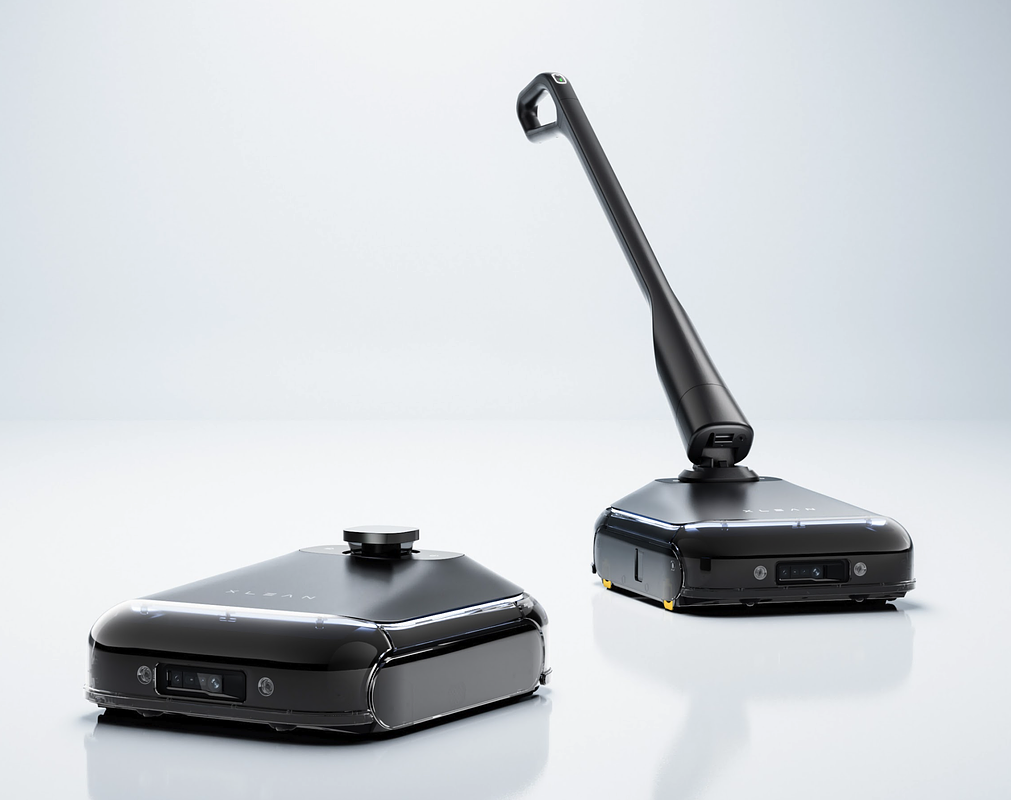
xLean TR1: The Robot Vacuum with a Split Personality and a Brain
LAS VEGAS, NV – December 29, 2025 – As the tech world converges on Las Vegas for CES 2026, the smart home floor is set to be dominated by an army of increasingly autonomous cleaning robots. Amidst this futuristic fanfare, a new contender, the xLean TR1 from XLEAN INC, is poised to capture the spotlight with a set of audacious claims that could redefine the category. Billed as the world's first dual-form transformable floor washing robot, the TR1 promises not only to merge two devices into one but also to learn and think with what it calls "human cleaning intent."
In a market saturated with iterative improvements, the TR1’s announcement signals a potential leap forward, combining a novel physical design with a sophisticated new approach to artificial intelligence. The device will make its official North American debut at the Venetian Expo, where attendees will be invited to witness if its performance matches its ambitious promises.
A New Form for Cleaning
The most immediately striking feature of the xLean TR1 is its transformative ability. The company states the device can switch from a fully autonomous robot vacuum to a handheld cleaning wand in a single second. This design philosophy directly targets a core frustration for many robot vacuum owners: the need for a separate device to handle sudden spills, stairs, upholstery, or messes in tight corners that the robot can't reach. While the concept of a multi-functional cleaning system isn't entirely new—competitors like Ecovacs with its DEEBOT X2 COMBO and Eufy with its E20 have introduced systems that pair a robot with a detachable handheld vacuum—the TR1’s proposition centers on a more seamless and integrated transformation.
Unlike systems that house a separate handheld unit in a large docking station, the TR1 is presented as a single, cohesive device that morphs between its two forms. This could offer a significant advantage in convenience and storage space. Powering its cleaning capabilities is a proprietary Dual-Motor DirectSuction™ system, which the company claims delivers an impressive 17,000Pa of suction. This figure places it firmly in the upper echelon of the market, though some rivals, such as recent models from Dreame and Ecovacs, have pushed suction power even higher. XLEAN INC asserts this power is sufficient to achieve a 99.99% pickup rate for challenging messes, including mixed liquid and solid waste, demonstrating its prowess with a test involving cat litter and spilled cola, which it reportedly cleans in just 15 seconds.
The Ghost in the Machine: Learning to Clean
Beyond its physical versatility, the TR1’s most groundbreaking claim lies in its software. XLEAN INC has dubbed it the "world's first cleaning robot built with a Self-evolving Intelligence system." This system moves beyond the pre-programmed obstacle avoidance and mapping AI common in today's high-end robots. Instead, it leverages a sophisticated machine learning technique known as Reinforcement Learning from Human Feedback (RLHF).
RLHF is an advanced AI training methodology, famously used to align large language models with human intent, that allows a system to learn and refine its behavior based on human preferences and interactions. For the xLean TR1, this means the robot is designed to continuously learn and evolve. According to the company, when a user operates the device in its handheld form to spot-clean a mess, the robot’s AI observes and learns from these human-guided actions. This feedback loop is intended to teach the robot more nuanced, human-like behaviors for when it operates autonomously. The promised results include superior obstacle avoidance, more intelligent recovery from being stuck, and genuinely advanced decision-making capabilities.
This learning system powers what the company calls "human-like autonomous cleaning strategies." Equipped with a self-developed dirt sensor, the TR1 can reportedly adapt its cleaning approach in real time. Upon detecting a heavy spill, it will initiate a deep, thorough cleaning protocol. For lighter dust, it will perform a faster, more efficient pass. This mimics how a person naturally cleans, prioritizing effort where it's most needed and potentially improving overall efficiency by up to 50%. This culminates in the robotic "Hunting Mode," where the TR1 is said to autonomously patrol floors, identify messes with human-like intent, and apply a targeted cleaning strategy, effectively hunting for dirt rather than just following a pre-set path.
Navigating a Crowded and Innovative Market
The xLean TR1 enters a fiercely competitive arena. The robot vacuum market is a hotbed of innovation, with established giants constantly raising the bar. At CES 2026, the TR1 will be vying for attention against other major advancements. Roborock, for instance, is showcasing models with a five-axis mechanical arm capable of moving small objects out of the way. Ecovacs continues to refine its all-in-one stations and is pushing suction power to 18,000Pa, while Dreame has models boasting extendable mopping pads to clean edges and corners more effectively.
In this context, the TR1’s success will hinge on its ability to prove that its unique combination of features offers more than just a marketing gimmick. While its suction power is competitive, its key differentiators are the seamless dual-form factor and, most critically, its self-evolving AI. While other brands mention AI and even reinforcement learning for specific tasks like obstacle recognition, XLEAN INC's focus on RLHF for holistic, behavioral evolution is a more profound claim. It suggests a shift from robots that are programmed to be smart to robots that can learn to be smarter over time.
As a relative newcomer to the North American market, with some prior presence at Europe's IFA 2025 show under the name Keli Evolution, XLEAN INC faces the challenge of building brand credibility against household names. The high-profile launch at CES will serve as a crucial test, where industry experts and the public can scrutinize whether its technology lives up to the hype.
The Dawn of the Truly Smart Appliance?
The technology promised in the xLean TR1 reflects a broader and more significant trend in consumer robotics: the transition from automation to true intelligence. For years, smart home devices have largely operated on fixed rules and pre-programmed logic. The TR1, along with parallel developments in academic research like Stanford's Tidybot, which learns cleaning preferences from user demonstrations, signals a move toward appliances that can adapt, personalize, and improve through interaction.
If the TR1's self-evolving intelligence performs as advertised, it could represent a watershed moment for home robotics. It would mean owning a device that not only performs a task but also becomes better at it the more you use it, tailoring its performance to the unique challenges of your home. The implications extend far beyond clean floors, pointing to a future of genuinely helpful robotic assistants that can anticipate needs and operate with a degree of common sense.
The promises are bold, and the bar is high. The live demonstrations and hands-on reviews from the CES show floor will be the ultimate litmus test for whether the xLean TR1 is simply another clever gadget or the first step into a new era of intelligent home cleaning.