
- 50% reduction in engineering time: ELECTRIX AI claims to cut manual engineering time by up to half.
- 2.2 million component files: The platform includes an extensive digital parts library from leading manufacturers.
- $700 million market: The U.S. electrical CAD market is valued at over $700 million.
Experts view AI-powered tools like ELECTRIX AI as a transformative solution for enhancing productivity and addressing the skilled talent gap in electrical engineering, augmenting rather than replacing human expertise.
WSCAD Launches AI-Powered Electrical CAD in U.S. to Halve Design Time
CHARLOTTE, N.C. – April 23, 2026 – German software developer WSCAD has officially launched its AI-powered electrical design platform, ELECTRIX AI, in the United States, challenging established market players with a solution that promises to cut manual engineering time by up to 50%. The move marks a significant strategic expansion for the company, bringing a mature European technology, now fully adapted for American regulatory standards, into the highly competitive North American electrical CAD market.
For over three decades, WSCAD has honed its software in Europe, and this U.S. version integrates electrical engineering, control cabinet design, fluid power, and building automation into a single platform. The company is positioning ELECTRIX AI not as another abstract application of artificial intelligence, but as a direct answer to industry pressures for greater speed and efficiency.
“Electrical engineers do not need more hype around AI, they need practical tools that help them get real work done faster,” said Dr. Axel Zein, CEO of WSCAD, in a statement. “ELECTRIX AI gives engineers an AI-powered assistant that supports their work inside the CAD environment, helping them save time, work smarter, reduce friction in the design process and create capacity for more innovation.”
An AI-Powered Engineering Assistant
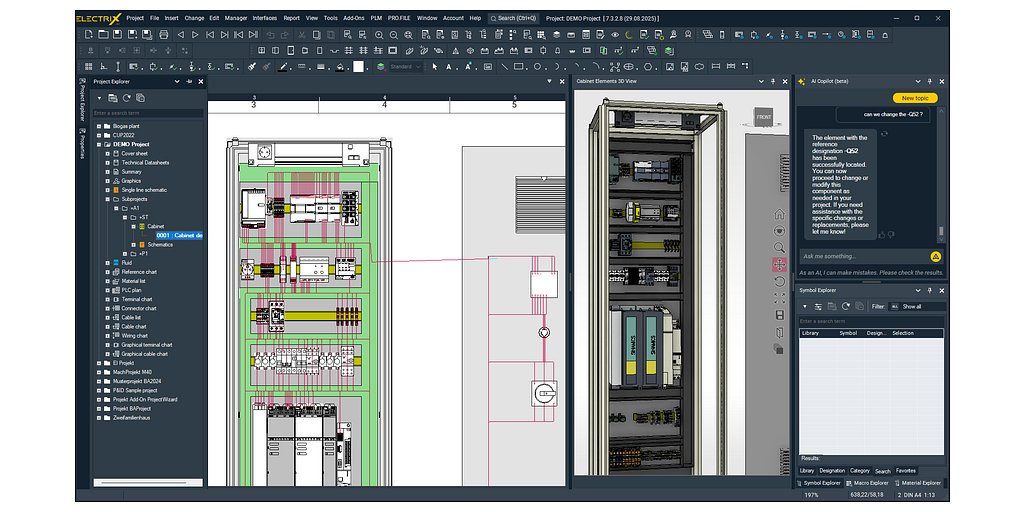
At the core of ELECTRIX AI's value proposition are features designed to automate the most time-consuming and repetitive aspects of electrical design. The platform’s AI capabilities are not bolt-on additions but are woven into the primary workflow. Key features include an AI-assisted project check, where the software can review schematics against uploaded project requirements to automatically identify issues and non-compliance.
Once schematics are finalized, the software can automatically generate a 3D layout for a control cabinet, intelligently placing components and supporting wire routing. This automation extends to documentation, with the ability to translate entire project files into more than 100 languages directly within the application—a critical feature for companies operating in a global market.
To facilitate this, ELECTRIX AI comes pre-loaded with an extensive digital parts library containing over 2.2 million component files from leading U.S. and international manufacturers, including Rockwell Automation, Eaton, Honeywell, and Phoenix Contact. In an era of increasing concern over data security, WSCAD also emphasizes its commitment to privacy, stating that no project data or personal user information is shared externally through the use of its AI functions.
Navigating a Competitive and Regulated Market
WSCAD enters a U.S. electrical CAD market valued at over $700 million and currently dominated by industry giants like Autodesk and Siemens, which are also integrating AI into their product suites. However, WSCAD’s strategic advantage lies in its specialized focus and its proactive approach to U.S. regulatory compliance—a major hurdle for any foreign technology company.
ELECTRIX AI is fully compliant with key American standards out-of-the-box, including NFPA 79 for industrial machinery, NFPA 70 (the National Electrical Code), and UL 508A for industrial control panels. It also includes a complete library of IEEE 315 / ANSI Y32.2 symbols. For U.S. engineers and manufacturers, this built-in compliance is a significant benefit, eliminating the laborious and error-prone process of manually cross-referencing designs against local codes. This ensures that designs are not only efficient to create but also ready for inspection and deployment without costly revisions.
While WSCAD bills its platform as the “world’s first AI-powered electrical design platform,” its distinction in a market where AI is becoming ubiquitous is its native integration specifically for the electrical domain. Rather than offering general-purpose generative design, ELECTRIX AI applies its intelligence to the specific, rule-based, and often tedious tasks that define electrical engineering workflows.
Quantifying Productivity and Addressing the Talent Gap
The company’s headline claim of a 50% reduction in engineering time is supported by a case study with customer WAGO, a provider of automation and connection technologies. According to WSCAD, WAGO was able to complete projects in half the time, allowing its team to service more customers without increasing headcount. This level of productivity gain is positioned as a direct solution to one of the engineering sector's most pressing problems: a persistent shortage of skilled talent.
By automating routine tasks, the software enables companies to better leverage the expertise of their senior engineers, freeing them to focus on high-level problem-solving and innovation. Simultaneously, it can help newer team members become productive more quickly by handling complex but repetitive work, such as generating bills of materials or wiring lists, in seconds.
This reflects a broader shift in the industry, where AI is seen not as a replacement for human engineers but as a crucial tool for augmentation. “AI will change the role of electrical engineers, but not replace the job,” Zein stated. “The engineer remains in charge. What changes is that AI can take over more routine tasks, allowing humans to become more productive, more strategic and ultimately more valuable.”
This evolution is already underway, with industry analysis suggesting a growing demand for engineers who possess skills in data analysis and programming alongside their traditional domain expertise. The consensus among workforce experts is that proficiency with AI-driven tools will soon become a baseline requirement for competitiveness in the field. This launch signals a pivotal moment where AI-driven assistants are no longer a future concept but a present-day reality for electrical design professionals.