
- $3.3 billion: Projected economic windfall for the NYNJ region from the World Cup.
- 21 counties: New Jersey's World Cup Community Initiative supports events across all counties.
- $20 million: New York's funding for free fan events and viewing grants.
Experts would likely conclude that while the Welcome World Rewards Program has the potential to distribute economic benefits more widely, its success hinges on seamless execution, broad participation, and overcoming significant logistical and privacy challenges.
World Cup Gamble: Can NYNJ’s New Rewards Program Score for Small Business?
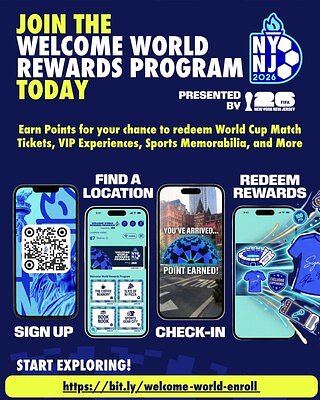
NEWARK, NJ – June 03, 2026 – With the world’s biggest sporting event kicking off in the New York-New Jersey region, the FIFA World Cup 2026™ NYNJ Host Committee is betting on a novel strategy to ensure the projected $3.3 billion economic windfall doesn’t just benefit stadium vendors and hotel chains. Today, the committee officially launched the Welcome World Rewards Program, a digital initiative designed to gamify local tourism and drive millions of fans into the shops, restaurants, and cultural institutions of the host region.
The program is a high-tech attempt to solve an age-old problem for mega-event hosts: how to spread the economic benefits beyond the confines of the main venue. By rewarding fans with points for visiting participating local businesses, the committee hopes to create a direct financial pipeline from the global spectacle to the local economy. The prizes are undeniably alluring, ranging from signed memorabilia to the most coveted prize of all: tickets to sold-out World Cup matches, including the Final on July 19.
"The Welcome World Rewards Program is about making sure the excitement of the World Cup extends outside of the stadium," said Alex Lasry, CEO of the NYNJ Host Committee, in a statement. "Every time someone visits a participating business, attends a community event, or explores a new part of the region, they're helping create economic opportunities while becoming part of the World Cup experience."
But as fans prepare to descend on the region, the program represents a major test. Can a digital loyalty platform truly redirect the flow of commerce and create a lasting economic legacy, or will it be overshadowed by the immense logistical and financial pressures of hosting the world?
The Strategy: Gamifying Local Commerce
At its core, the Welcome World Rewards Program is a sophisticated customer loyalty scheme scaled to the size of a global tournament. The mechanics are straightforward: participants sign up via a website—no app download required—and use their phones to digitally "check in" at participating locations. These check-ins, verified by geofencing technology, award points that can be redeemed for prizes. The more a fan explores, the more they earn.
For local businesses, which were able to sign up for free, the proposition is clear: attract a share of the millions of visitors and their spending money. The program is a key pillar of a broader strategy championed by state leaders to leverage the tournament for widespread economic gain.
"The World Cup is an opportunity for New Jersey to showcase everything that makes our state special — our small businesses, our downtowns, our diverse communities," stated Governor Mikie Sherrill. This sentiment is backed by New Jersey's $5 million World Cup Community Initiative, which supports locally led watch parties and cultural festivals across all 21 counties, many of which will be point-earning locations in the rewards program.
New York has launched similar efforts, with Governor Kathy Hochul dedicating $20 million in state funding to support free fan events across New York City’s five boroughs and a grant program to support viewing events statewide. These state-backed events and a separate lottery for 1,000 affordable tickets for NYC residents show a multi-pronged effort to make the event more inclusive and economically distributed. The rewards program acts as the connective tissue, linking these disparate events and businesses under a single incentive structure.
Beyond the Pitch: A New Playbook for Fan Engagement
The program's architects are betting that for many fans, the experience will be as much about the journey as the 90 minutes on the pitch. With ticket prices on the official market reaching thousands of dollars for premium matches, the chance to earn a ticket for free is a powerful motivator. To kickstart engagement, the committee is offering 20 extra chances to win tickets to the first two matches at New York New Jersey Stadium on June 13 and 16.
The prize pool extends far beyond match access. The committee has lined up exclusive experiences like lunches with New York sports legends, signed memorabilia from the Giants, Knicks, and Rangers, and tickets to concerts and other professional sporting events. This diverse reward catalog is designed to appeal to a broad audience, from die-hard football fanatics to families looking for unique local entertainment.
By integrating with cultural institutions and community fan hubs, such as the one planned for Sports Illustrated Stadium in Harrison, New Jersey, the program encourages a deeper engagement with the region. It reframes the fan journey, suggesting that the "authentic" World Cup experience isn't just in the stadium but in the local pizzeria in Newark, the museum in Jersey City, or the community watch party in the Bronx. It provides a structured itinerary for discovery, potentially turning a passive tourist into an active local explorer.
Hurdles on the Field: Scrutinizing the Bottom Line
Despite the optimistic vision, the program faces significant headwinds. The sheer scale of the NYNJ region presents a formidable challenge. While the Host Committee projects a massive $3.3 billion economic impact, some economists are skeptical about how deeply that impact will be felt.
"The benefits will certainly be concentrated around the Meadowlands and key transit hubs," noted one economics professor at a New Jersey university. "Whether a rewards program can meaningfully push that activity out to all 21 counties in New Jersey and across New York City remains to be seen. There's a real risk of a 'crowding out' effect where locals avoid these areas, negating some of the tourist spending."
Logistics are another major concern. MetLife Stadium will have no public parking for World Cup matches, forcing every single fan—up to 82,500 per match—onto an already strained public transit system. The high cost of travel, accommodation, and tickets in the NYNJ area may also limit the disposable income fans have left to spend at local businesses, regardless of point incentives.
Furthermore, the program's reliance on data collection raises inevitable questions about privacy. As users check in across the region, they generate a rich dataset of their movements and commercial habits. While the committee has focused on the program's benefits, the handling and security of this data will be a critical test of trust for participants.
The ultimate success of the Welcome World Rewards Program will depend on its execution and uptake. If the platform is seamless, the rewards attainable, and the participating business network robust, it could set a new standard for how host cities leverage mega-events. However, if it's plagued by technical glitches, perceived as inequitable, or simply fails to capture the imagination of fans facing a host of other logistical challenges, it risks being a footnote in the larger story of the 2026 World Cup.