
- 14 new electric buses deployed, serving up to 1,200 students daily across four school districts.
- $6.1 million project funded by federal, state, and local grants, with $2.8 million from the EPA's Clean School Bus Program.
- Expected $400,000 in long-term operational savings, with $200,000 saved annually on diesel fuel and reduced maintenance.
Experts agree that this initiative sets a replicable model for sustainable student transportation, demonstrating how public-private partnerships and innovative funding strategies can accelerate the transition to zero-emission school buses.
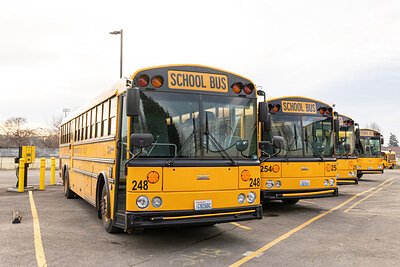
Washington's Quiet Revolution: Electric Buses Transform Student Transit
WOODLAND, Wash. – January 27, 2026 – A quiet hum is replacing the familiar rumble of diesel engines across Southwest Washington. The KWRL Transportation Cooperative today celebrated the deployment of 14 new, all-electric school buses, a move that promises a healthier, quieter, and more cost-effective ride for up to 1,200 students daily across four school districts.
A ribbon-cutting event at the Woodland bus depot marked the official launch of the Thomas Built Jouley electric buses, which will serve the Kalama, Woodland, Ridgefield, and La Center school districts. The new fleet, covering approximately 700 miles each day, represents a significant leap forward in sustainable student transportation, made possible through a complex web of public-private partnerships and strategic funding.
"This project is a testament to the power of partnership," said Shannon Barnett, Transportation Director for KWRL. "By working together to diversify transportation methods, we have unlocked new efficiencies that will benefit the Kalama, Woodland, Ridgefield, and La Center school districts for years to come."
A Blueprint for Green Funding
Putting these 14 buses on the road was not a simple purchase; it was an intricate financial puzzle solved through collaborative effort. The project's nearly $6.1 million price tag was covered almost entirely by a multi-layered funding strategy, demonstrating a replicable model for other public entities eyeing a green transition.
The financial backbone of the initiative includes a combination of federal, state, and local grants. The U.S. Environmental Protection Agency's (EPA) Clean School Bus Program, a $5 billion fund established under the Bipartisan Infrastructure Law, provided a crucial $2.8 million. This federal program is designed specifically to help school districts replace aging diesel buses with zero-emission alternatives, prioritizing rural and low-income areas.
At the state level, the Washington Department of Ecology contributed nearly $3.0 million for vehicles and infrastructure support. This funding stems from a combination of sources, including the state's landmark Climate Commitment Act, which leverages revenue from its cap-and-invest program to fund pollution reduction and public health initiatives. A key advantage for Washington districts is the ability to "stack" these state grants on top of federal awards, a strategy that allowed KWRL to cover nearly the full cost of the buses and their charging hardware.
Rounding out the public investment, Clark Public Utilities provided $300,000 in infrastructure funding for the Ridgefield depot, part of its own grant program to accelerate electric vehicle adoption in the region. This patchwork of funding highlights a new reality for large-scale public projects: success hinges on navigating and securing diverse streams of capital from all levels of government.
The Business of Electrification-as-a-Service
Beyond the funding, the operational side of the project is powered by an innovative business model known as Electrification-as-a-Service (EaaS). The KWRL cooperative partnered with Highland Electric Fleets, North America's leading EaaS provider, to manage the immense complexity of the transition.
Instead of purchasing the buses and infrastructure outright and taking on all the operational risk, the EaaS model bundles the entire solution into a single, predictable service. Highland coordinated the procurement of the Thomas Built buses, the installation of 16 Zerova 30 kW chargers at depots in Woodland and Ridgefield, and provides ongoing fleet support, maintenance, and management. This approach removes the steep learning curve and significant upfront capital barrier that often prevents public entities like school districts from electrifying.
For the KWRL cooperative and Woodland Public Schools, the financial benefits are substantial. They anticipate approximately $400,000 in long-term operational savings, with an estimated $200,000 saved annually on diesel fuel and reduced maintenance. Electric buses have fewer moving parts than their internal combustion counterparts, eliminating the need for oil changes, transmission fluid, and complex emissions control systems, drastically cutting down on repair costs and vehicle downtime.
This service model provides budget certainty, replacing the volatile price of diesel with a fixed cost structure, and allows the school districts to focus on their primary mission: education.
A Healthier Ride for Students and Communities
While the financial and operational arguments for electrification are compelling, the most profound impact may be on the health of the students and the communities the buses serve. Diesel exhaust is a known carcinogen and a significant source of air pollutants like nitrogen oxides and particulate matter, which are particularly harmful to children's developing lungs. In Washington, diesel exhaust is credited with causing 70% of the state's airborne cancer risk.
"Electric school buses remove diesel exhaust from daily routes and bus stops, benefiting students, drivers, and nearby communities," explained Duncan McIntyre, CEO of Highland Electric Fleets. He noted that replacing just five diesel buses can reduce the risk of pediatric asthma for 1,500 students. Asthma remains a leading cause of school absenteeism among children.
The benefits extend beyond air quality. The new electric buses provide a nearly silent and vibration-free ride. "That same shift also brings quieter, smoother rides that support a calmer start to the school day," McIntyre added. The reduction in noise pollution benefits not only the students on board but also the residential neighborhoods the buses pass through every morning and afternoon.
Leading Washington's Statewide Transition
The KWRL project is not an isolated event but rather a flagship example of a broader, statewide movement. Washington has positioned itself as a leader in transportation electrification, recently passing legislation that will require all newly purchased school buses to be zero-emission models starting in 2024. The state is actively creating the policy frameworks and funding mechanisms necessary to support districts in this transition.
The success of the KWRL cooperative serves as a powerful case study. It demonstrates that with the right combination of collaborative partnerships, strategic grant acquisition, and innovative service models, even small and rural districts can overcome the challenges of electrification. As other districts across the state and nation watch, the quiet hum of these 14 buses in Southwest Washington may well be the sound of the future of student transportation arriving.
Topics & Related
Acquisition
ESG
Clean Energy Transition
Automation
Decarbonization
Net Zero
Climate Risk
Carbon Markets
Revenue
EBITDA
Net Income
Automotive
Venture Capital
Related Company Pulse