
- Employment Rate: 83% of charter school alumni employed vs. 62% of district alumni
- Average Salary Difference: Charter grads earn $44,000 more annually ($120,109 vs. $76,178)
- Homeownership Rate: 47% of charter grads own homes vs. 18% of district grads
Experts acknowledge the promising trends but caution that the small sample size requires further research before drawing definitive conclusions about charter school effectiveness.
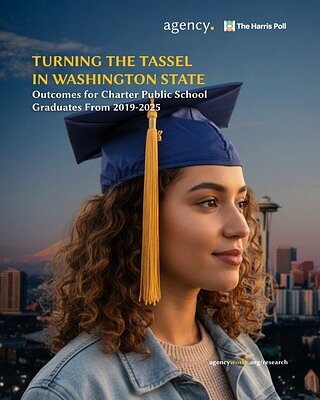
WA Charter Grads See Higher Pay, Homeownership in Early Report
SEATTLE, WA – March 18, 2026 – Graduates of Washington state’s charter public schools are seeing significantly higher employment rates, salaries, and rates of homeownership within seven years of graduation compared to their peers from traditional district schools, according to a new report. The study, commissioned by the education advocacy group Agency, Inc. and conducted by The Harris Poll, offers an early, provocative glimpse into the long-term life outcomes of students in the state's young and often embattled charter sector.
However, the striking findings—including an average salary difference of over $40,000—come with a significant caveat that has become a central point of discussion: the results for charter graduates are based on a small sample size and are described by the researchers as "directional only," prompting both excitement from school choice proponents and caution from data experts.
A New Metric for Success?
The report, "Turning the Tassel in Washington State," moves the conversation beyond traditional metrics like standardized test scores and college acceptance rates. Instead, it focuses on tangible life achievements. Among its key findings for Washington graduates:
- Employment: 83% of charter school alumni are employed part-time or full-time, compared to 62% of their peers from district schools.
- Income: Employed charter alumni report an average annual salary of $120,109, a stark contrast to the $76,178 average for district alumni.
- Homeownership: Nearly half (47%) of charter graduates own their homes, more than double the 18% of district graduates who do.
- Postsecondary Education: Charter alumni were also more likely to pursue higher education or training, with 97% doing so compared to 86% of district alumni.
Proponents of the charter school model argue these figures represent a paradigm shift in how school effectiveness should be measured. "While the Washington charter sector is still young, it is hard to argue with trends pointing in this direction. The numbers are astounding," said Debbie Veney, Founder and CEO of Agency and the report's author. "It's hard to imagine that any parent wouldn't want their child to attend a school that is likely to produce results like this."
The report also suggests that charter school graduates feel better prepared for their future. An overwhelming 96% said their teachers were invested in helping them plan for post-graduation success, and 97% felt their school encouraged them to "break barriers or defy expectations."
Chris Korsmo, Executive Director of the Washington State Charter Schools Association, framed the findings as a validation of family choice. "For Washington families, the ability to choose a school that works best for their child isn't political—it's about setting their child up for a successful future," Korsmo stated. "This report highlights encouraging outcomes for many charter public school grads."
The Data Dilemma
While the numbers are eye-catching, the report is transparent about its own limitations. The statistics for Washington's charter graduates were drawn from a small pool of respondents, between 50 and 99 individuals. This small sample size means the findings are not statistically representative of all charter graduates in the state and should be "interpreted as directional only."
This disclaimer is crucial. Statisticians caution that with such a small group, the results are more susceptible to random chance and the influence of outliers. A few unusually high earners, for example, could significantly skew the average salary for the entire group. Therefore, while the data suggests a promising trend, it cannot be considered definitive proof of charter school superiority. More extensive, longitudinal research with larger sample sizes would be required to confirm these early indicators.
Julie Kennedy, Executive Director of Excellent Schools Washington, acknowledged this nuance. "While the data is directional, the trends point toward something meaningful: that school quality matters, and that Washington families deserve more of what's working," she said. "This report offers an early and encouraging glimpse into what's possible."
A Flashpoint for Equity and Funding
The debate intensifies when examining outcomes for students of color. The report found that employed charter graduates who self-identified as Black, Latino, Hawaiian/Pacific Islander, or Native American earned an average of $132,611 annually. This is nearly double the $69,714 average for their peers from traditional district schools—a staggering difference of almost $63,000.
These findings land in a state where charter schools have a complex and contentious history. Authorized by a narrow voter initiative in 2012, Washington's charter schools have faced repeated legal and political challenges, primarily from the Washington Education Association (WEA), the state's largest teachers' union. The WEA has consistently argued that charter schools divert public funds to privately run organizations that lack accountability to local voters.
This conflict is most visible in school funding. While charter schools are public and tuition-free, they are not eligible for funding from local, voter-approved levies. This creates a significant funding gap, with charter school students receiving, on average, 25% less in ongoing public funding than their counterparts in traditional schools. This financial pressure has forced some charter schools to close, not for academic failure, but for financial instability.
Advocates argue this inequity starves a model that, according to the new report, may be a powerful engine for closing opportunity gaps. The report notes that the first charter schools in the state, whose alumni were surveyed for these outcomes, primarily served Latino students. Today, the state's 17 charter schools serve a disproportionately high number of low-income students and students of color compared to surrounding districts.
The report also surveyed over 1,000 Washington parents, revealing overwhelming support for school choice. According to the survey, 93% of parents agree they should have a choice in where their child goes to school, and 89% believe having more than one type of public school is a good thing. This strong parental demand stands in stark contrast to the political and financial headwinds facing the state's charter sector, placing these new, compelling-yet-preliminary findings at the center of a charged debate over the future of public education in Washington.