
- 5,000 autonomous shuttles: VW and Beep plan to deploy up to 5,000 self-driving Volkswagen ID. Buzz vehicles in U.S. cities over the next decade.
- Orlando launch: Initial testing and validation are underway in Orlando, Florida, with rides expected later in 2026.
- Level 4 autonomy: The fleet will use Mobileye Drive™, a sophisticated self-driving system with 13 cameras, nine LiDAR sensors, and five radar units.
Experts view this partnership as a significant step toward integrating autonomous mobility into public transit, with the potential to enhance urban connectivity and solve the 'first- and last-mile' problem, though success will depend on scalability and regulatory adaptability.
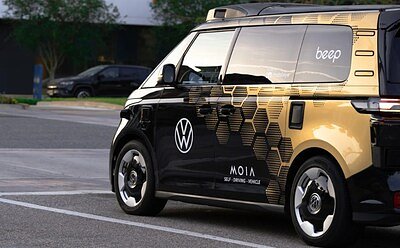
VW and Beep to Launch 5,000 Autonomous Shuttles in U.S. Cities
BELMONT, Calif. and LAKE NONA, Fla. – April 24, 2026 – A new era for American public transportation is set to begin in Florida, as Volkswagen Group’s MOIA America and autonomous mobility operator Beep, Inc. today announced a strategic partnership to deploy thousands of self-driving shuttles in U.S. cities. The ambitious plan involves scaling a fleet of up to 5,000 autonomous Volkswagen ID. Buzz vehicles over the next decade, focusing on integrating with and enhancing public transit networks.
The collaboration will kick off in Orlando, where validation testing is already underway. This partnership represents one of the most significant efforts to date to bring autonomous mobility into the public transit sector at a meaningful scale, combining a major automaker's production power with a seasoned operator's real-world deployment experience.
"Beep's strategic partnership with MOIA America unites the core capabilities needed to scale autonomous mobility — purpose-built production vehicles, proven software, and trusted operations," said Kevin Reid, CEO and Board Chair of Beep. He noted the collaboration aims to redefine microtransit, which he described as "one of the fastest growing transportation segments," by leveraging AI and autonomous technology to improve community access and connectivity.
Volkswagen's American Gambit
This announcement marks a pivotal step in Volkswagen Group's broader autonomous mobility strategy in the United States, showcasing a refined approach centered on powerful partnerships. After the high-profile shutdown of its previous venture, Argo AI, Volkswagen has aggressively pursued a multi-pronged strategy, collaborating with established technology leaders and specialized operators. The partnership with Beep follows other key U.S. initiatives, including a test program in Austin, Texas, and a planned collaboration with Uber to deploy autonomous ID. Buzz vehicles for ride-hailing.
By working with Beep, Volkswagen is targeting a different but equally crucial segment: public and community transit. MOIA America, VW's dedicated autonomous technology company, will provide a complete turnkey solution. This package includes the purpose-built, autonomous-ready ID. Buzz vehicles, the integrated self-driving system developed by Mobileye, and a comprehensive Mobility-as-a-Service (MaaS) software platform for managing the fleet.
"MOIA America's expansion into the Orlando region reflects the growing momentum of its autonomous mobility strategy in the U.S.," said Sascha Meyer, Chief Commercial Officer of Volkswagen Autonomous Mobility. "Through the MOIA brand, we are enabling autonomous mobility for a growing number of partners worldwide with a turnkey solution that combines the vehicle, MaaS technology, and operational expertise."
A Partnership of Production and Practice
The success of scaling autonomous services hinges on marrying advanced technology with operational excellence. This partnership is structured to do just that. While MOIA America brings the hardware and core software from one of the world's largest automakers, Beep provides the critical on-the-ground experience needed to run a complex, public-facing mobility network.
Beep is not a newcomer to this field. The company has established itself as a leading deployer of autonomous shuttles in the U.S., with years of experience managing fleets in planned communities, university campuses, and medical districts. Its proprietary AutonomOS™ platform is designed specifically for planning and managing these services. The company has already provided hundreds of thousands of passenger rides across its various deployments, including an extensive, long-running network in Orlando’s Lake Nona community, where the new ID. Buzz vehicles are currently being tested.
"Our technology enables Beep to deploy autonomous ride services at scale, designed to integrate into emerging microtransit transportation networks," said Paul DeLong, President of Commercialization of MOIA America. "This approach provides opportunities for communities to experience shared transportation technology as part of everyday mobility."
The Road From Lake Nona
The path to 5,000 vehicles begins on the familiar streets of Lake Nona, Florida. The choice of Florida as the initial market is highly strategic. The state has passed some of the nation's most progressive legislation for autonomous vehicles, creating a clear and supportive regulatory framework that allows for the operation of fully driverless vehicles on public roads. This permissive environment provides an ideal launchpad for testing and scaling the service before expanding to other U.S. markets with more complex regulatory landscapes.
Powering the fleet is the highly regarded self-driving system from Mobileye, an Intel company. The ID. Buzz vehicles are equipped with Mobileye Drive™, a Level 4 system that uses a sophisticated array of 13 cameras, nine LiDAR sensors, and five radar units to create a 360-degree view of the environment. A key feature of Mobileye's technology is its redundant approach to safety, using two independent perception systems—one camera-based and another based on radar and LiDAR—to ensure reliability. This is further enhanced by its crowd-sourced high-definition mapping system, which helps the vehicles navigate with precision.
Initial rides in the autonomous ID. Buzz vehicles are expected to be offered later this year, operating with onboard human safety operators during the initial validation phases to ensure a smooth and secure rollout.
Redefining Microtransit in a Crowded Field
While the autonomous vehicle landscape includes major robotaxi players like Waymo and a variety of shuttle providers such as May Mobility, the MOIA-Beep partnership is carving out a distinct niche. Their explicit focus is not on competing with private car ownership or traditional ride-hailing, but on augmenting public transportation infrastructure.
The goal is to provide a solution for the "first- and last-mile" problem—connecting people from their homes to transit hubs, or from a bus stop to their final destination. By offering efficient, on-demand shared rides, the service aims to increase overall public transportation ridership, reduce traffic congestion, and provide vital mobility options in underserved areas.
This transit-centric model could prove more scalable and economically viable for cities, municipalities, and large campuses looking to modernize their transportation networks without the massive capital investment required for new rail lines or bus routes. As the first autonomous ID. Buzz vehicles prepare to welcome passengers in Orlando, communities across the country will be watching to see if this partnership holds the key to unlocking a more connected and accessible future for urban mobility.